A GEO analysis shows you how visible your brand is in AI answers, what facts the models spread about you, and where you fall behind competitors. In this tutorial you’ll work through the analysis in five steps, using the AI Deep Dives directly in SISTRIX.
What is a GEO analysis?
GEO (Generative Engine Optimization) is optimization for generative AI systems such as ChatGPT, Google AI Overviews, or AI Mode. A GEO analysis is the stocktake behind it. It answers three questions: How do AI systems talk about your brand? Which sources do they draw their knowledge from? And where are competitors cited while you aren’t?
As a tool for this tutorial, you’ll use the AI Deep Dives: AI analyses built directly into SISTRIX that turn our data into insights using vetted SEO and GEO knowledge. You’ll find them as violet buttons in the filter bar of the respective feature. Every Deep Dive delivers a result in the same pattern: a short summary, the key findings with numbers, the sources behind them, and concrete recommendations. You can export every analysis directly as Markdown or PDF.
Once a Deep Dive has finished calculating, you can also ask it questions: using the input field at the bottom of the analysis, you can ask targeted follow-up questions, for example about specific measures against a particular piece of criticism, and get an answer that knows the full context of the analysis.
A note for orientation: the analysis works with two tools and two perspectives. The AI Check looks at your brand. In this tutorial we use Singapore Airlines. The Prompt Research looks at a topic from your market, here we work with “first class flight”. Across the five steps you deliberately switch between both. Every Deep Dive shows you at the top which area you’re currently in.
The five phases of a GEO analysis
The analysis follows five phases that build on one another. Each phase answers its own guiding question with the matching AI Deep Dives:
- Status quo analysis: How do AIs currently see my brand?
- Environment analysis: Who is asking what, before they know my brand?
- Content analysis: Which content works, and what’s missing?
- Competitive analysis: Where do I stand compared to others?
- Digital PR and off-site: Which external sources influence the AI answers?
You can also run individual phases in isolation, for example just the content analysis ahead of a relaunch. For a complete picture, though, we recommend the order used in this tutorial, because each phase builds on the findings of the previous one.
Step 1: Clarify the status quo
The starting point of every strategy is the understanding current state. Enter your domain or brand in the AI Check; in this tutorial we’ll use the brand Singapore Airlines as our example throughout. Open the Prompts area. You’ll see a list of all user questions where your brand is mentioned or cited in AI answers, each with an excerpt from the answer.
Brand perception: the sentiment picture
Start the Brand Sentiment Deep Dive using the violet button in the filter bar. The analysis evaluates all AI answers related to your brand and opens as a panel next to the prompt list.
At the top is the sentiment value, the ratio of praise to criticism, followed by the summary: how the models describe your brand, what role it plays, and in what tone it’s written about. Next come the key findings with concrete numbers, the named strengths and weaknesses, and the contested topics where praise and criticism collide, for example loyalty programs or cabin comfort.
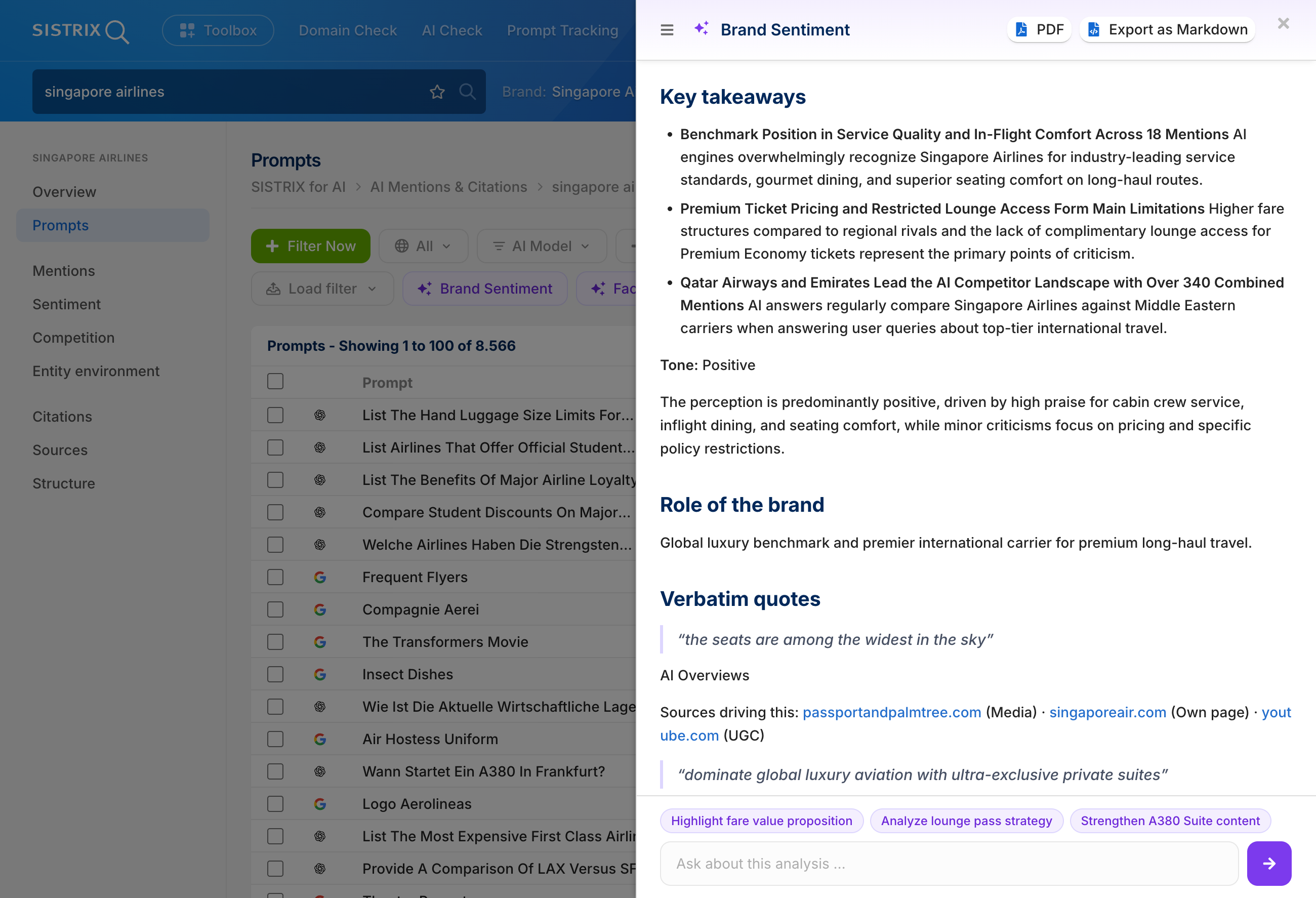
When reading, pay less attention to the balance itself than to the differences between platforms. If ChatGPT writes noticeably more critically about your brand than AI Overviews, it’s worth looking at the literal statements: the criticism often draws on just a few, recurring points that you can address in a targeted way.
Next, look at the strengths listed for your brand. Are the positive points described here actually your real USPs? Or are your true purchase arguments not being represented correctly by AI systems at all?
The criticism is worth a close look too. Does it reflect genuine weaknesses, or is it more the kind of expected criticism you’d see for a premium brand, such as complaints about higher fares? Which points can you identify that cast your brand in a misleading light?
From this you can derive measures to represent your own brand image correctly on every platform. To do that, ask directly in the analysis chat what can be done about a specific piece of criticism; you’ll get prioritized measures instead of just a stocktake.
Fact consistency: finding misinformation
Next, start the Fact Consistency Deep Dive in the same filter bar. It checks whether the information about your brand is consistent across platforms: which statements diverge from one another, where the models contradict each other, and which details are simply wrong, for example outdated prices, discontinued products, or incorrect route and seat details.
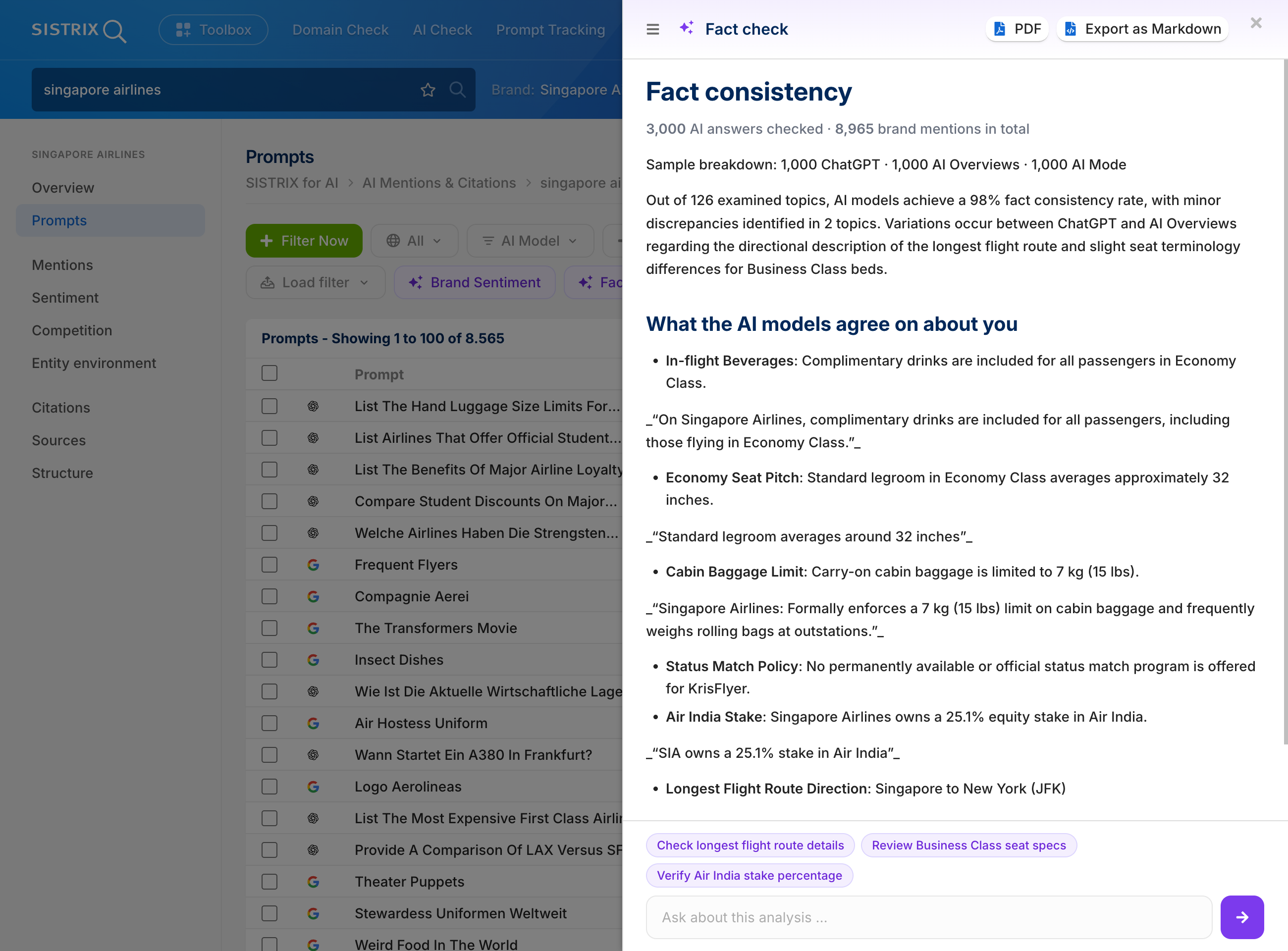
In the Singapore Airlines example, the AI models agree on 98 percent of the 126 topics examined; discrepancies show up in only two of them, for instance in the directional description of the longest route and in the seat terminology used for Business Class beds. Findings like this are valuable: you know exactly where to correct the record, and with priority, because a piece of misinformation that’s in AI answers today can become the standard picture of your brand tomorrow. The most effective lever is clear, machine-readable facts on your own pages: an up-to-date about page, well-maintained product data, unambiguous pricing, and a consistent way of communicating your USPs. Just as important are consistent company information and entity relationships on external pages such as trade publications and directories.
Topics & roles: the starting point for everything else
The third Deep Dive in this step is Topics & Roles. It shows which search queries beyond brand searches mention your brand, and in what role: as the central recommendation, as one of several options, or only as a side note.
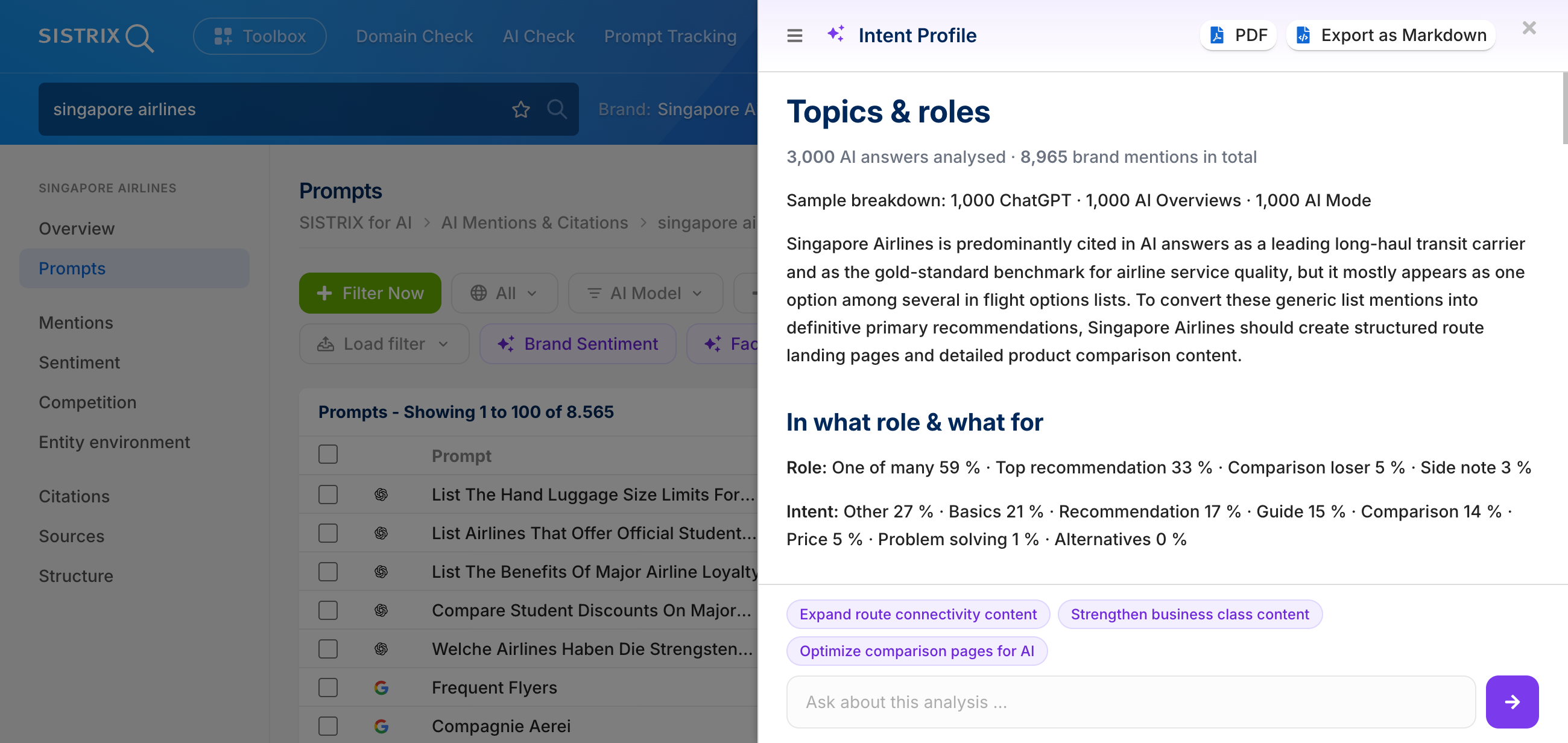
The result is your starting position for prioritization. If your brand appears in direct quality comparisons mainly as a reference point for others, a comparison loser, while it’s named as the top recommendation in cabin or product reviews, you know where the journey needs to go. Note down the topic areas with a weak role; they’ll matter again in step 3.
Step 2: Understand the environment
After looking at your own brand, the next step is looking at demand, deliberately independent of the brand. Switch to Prompt Research, essentially keyword research for AI search. Enter a topic from your market. Ideally, choose a field where your brand played only a weak role in Topics & Roles in step 1; that’s where the biggest lever is. For Singapore Airlines, we take first class flight, a segment where competition among premium carriers is especially fierce. You’ll see the topic landscape around the term: related topics, the distribution across the customer journey, and the intents behind the questions.
Buyer personas: who’s behind the questions
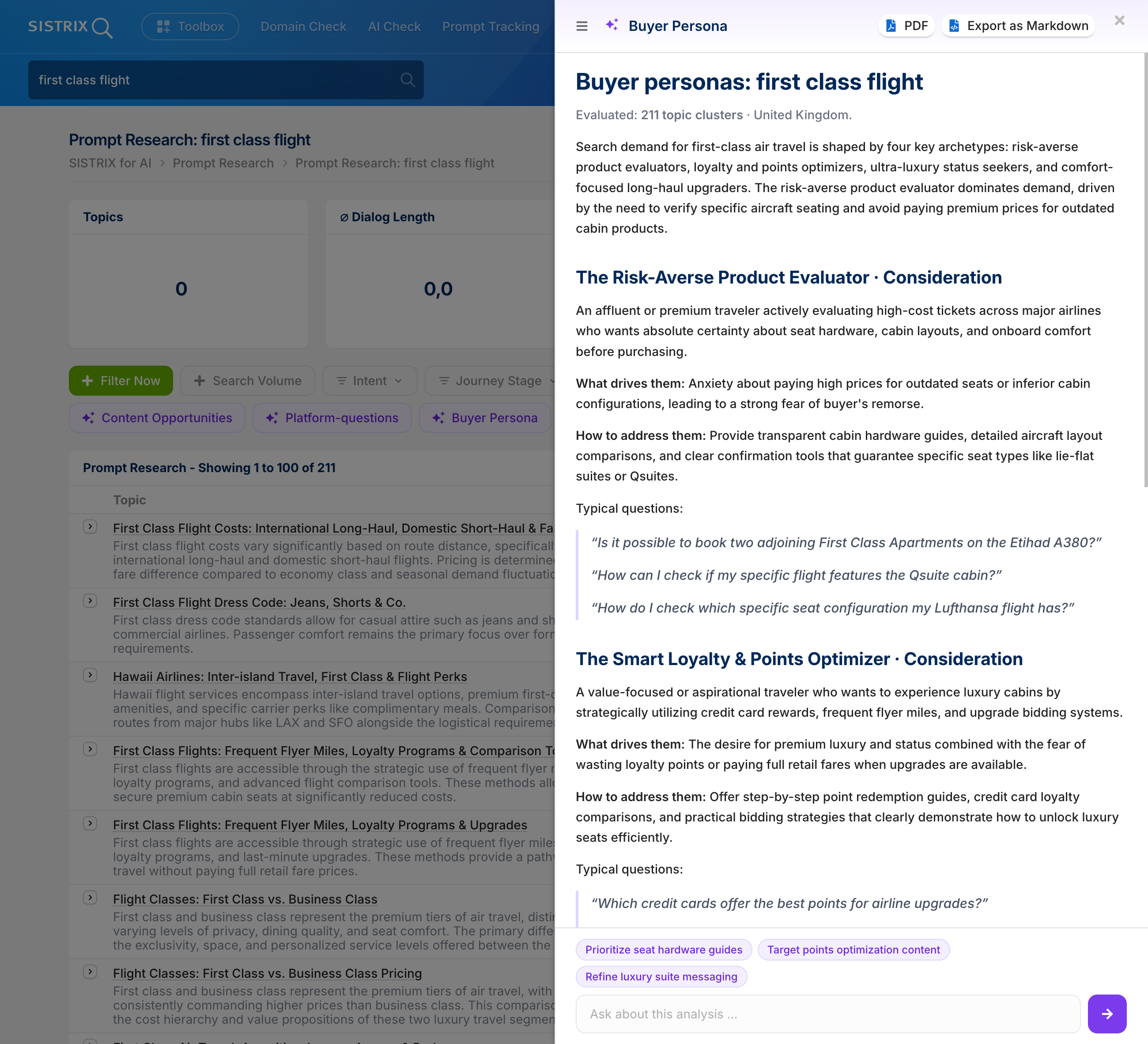
Start the Buyer Persona Deep Dive. It condenses the search queries into the user types behind them: who is asking, what drives them, which criteria matter to them, and how they can be addressed. For the topic of first class flight, these could be risk-averse product evaluators who want certainty about seat hardware and cabin layout before buying, loyalty and points optimizers who want to reach premium cabins through miles and credit card rewards, and ultra-luxury status seekers researching top-tier features like private suites and onboard showers.
These personas are the foundation for a tailored approach, regardless of how your brand currently stands. Every piece of content you plan in step 3 should map to one of these types.
Platform question profile: how and where people ask
Add the Platform-Questions Deep Dive. It shows how user questions differ by AI platform. On AI Overviews, questions tend to be short and keyword-focused, averaging around 6 words; on ChatGPT, they’re longer and more conversational, averaging around 10 words and frequently asking for structured formats like tables or guides. These differences shape the tone, length, and format of your content per channel.
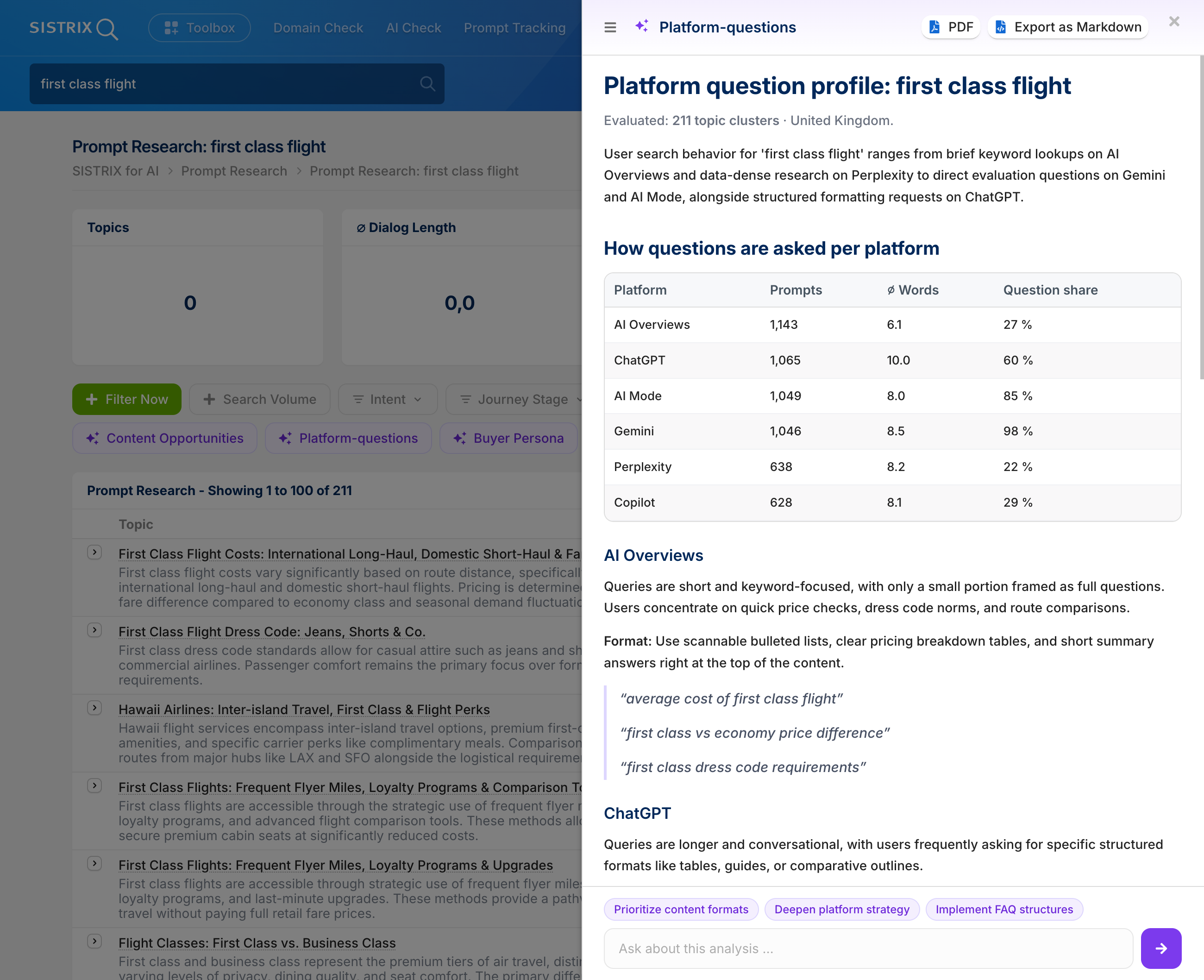
In concrete terms: for conversational ChatGPT questions, detailed guides with clear step-by-step structure work well; for AI Overviews, compact, precisely answered single questions work better. Hold on to these format notes; they flow directly into your editorial plan.
Step 3: Analyze content
Now it’s time to look at your content. This phase is the most extensive part of the analysis and combines three angles: what’s missing, what’s already working, and what competitors do better. You’ll stay in the Prompt Research for now, before switching back to the AI Check.
What’s missing: content opportunities
Stay in the Prompt Research on your topic from step 2 and start the Content Opportunities Deep Dive. It derives ready-made content ideas from real demand, each with the right format and the user question the piece should answer, prioritized by demand and journey stage. For first class flight, the top opportunity is a comprehensive luxury comparison guide weighing flagship suites, upgrade mechanics, and pricing against private charters.
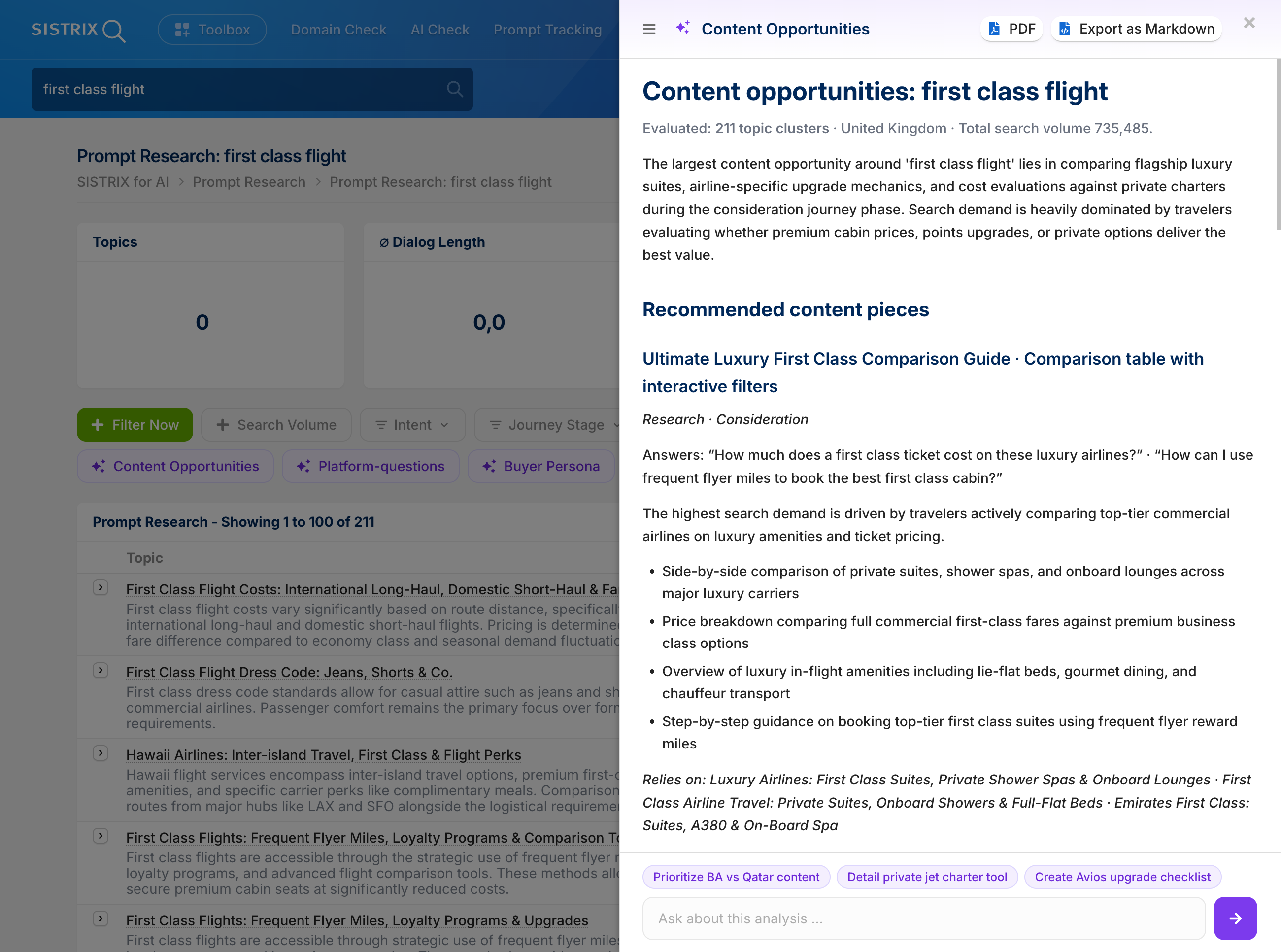
You can carry the result almost unchanged into your editorial plan. Cross-check it against the topic areas you noted in step 1 under Topics & Roles: content opportunities in fields where your brand is currently just a side note carry the highest priority.
What makes users hesitate: concerns and open questions
In the same area, start the Unanswered Questions & Concerns Deep Dive. It uncovers the unspoken doubts of your target audience: worries that show up in the prompts but are rarely stated directly, for example uncertainty about whether lounge access is really included, doubts about whether the seat configuration on a specific aircraft is truly lie-flat, or concerns about inconsistent service across different routes.
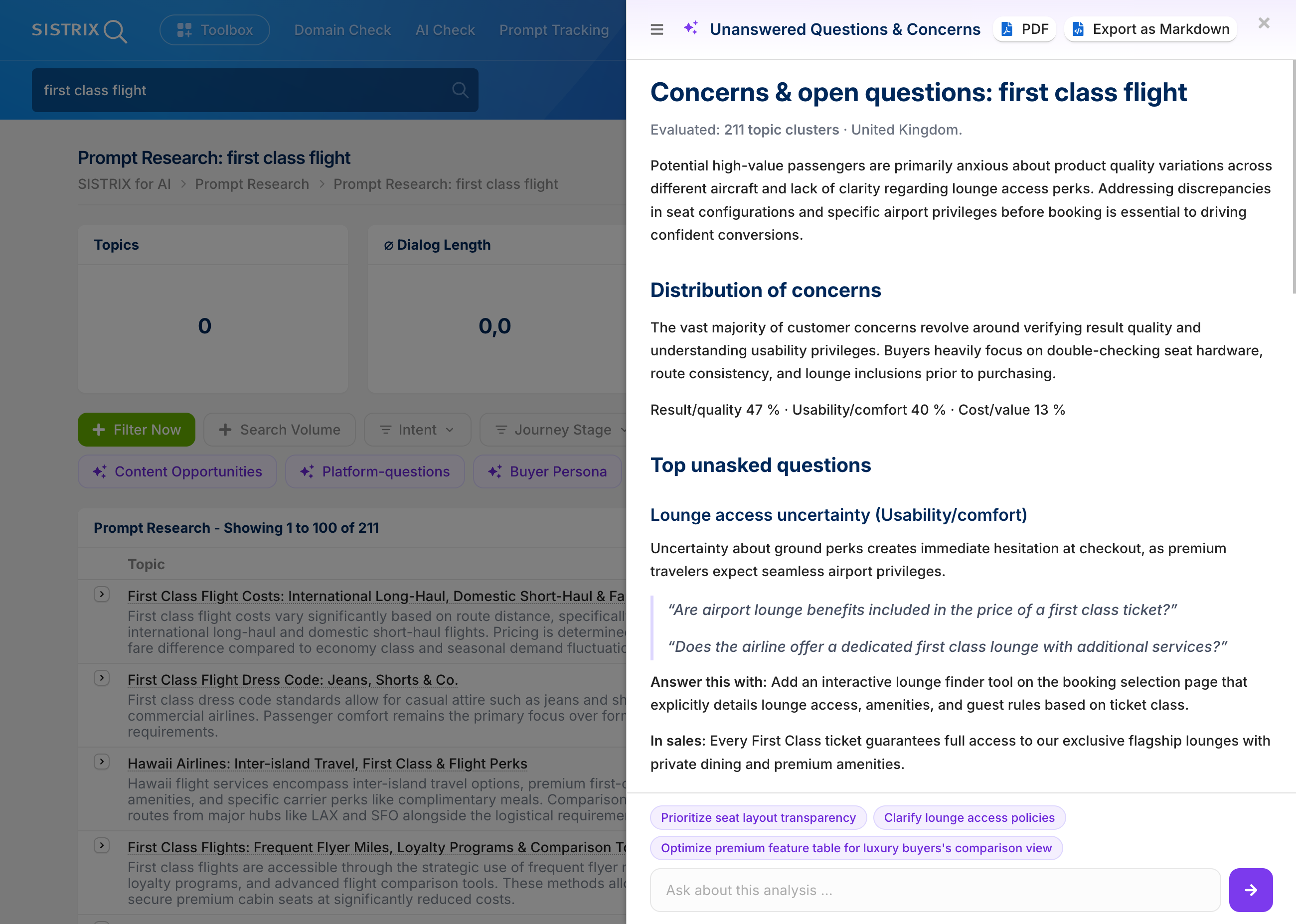
These trust barriers show up in neither keyword nor competitor data. That’s exactly why they’re valuable: content that takes these doubts seriously and resolves them builds trust before the purchase decision is made, and can build relevance directly within AI search.
What’s working: your own sources
Now switch to the AI Check, to the Sources area, and start the Own Citations Deep Dive. It shows which of your pages the AI systems use as a source, which section collects the most citations, and what the successful pages have in common, for example a particular format, a clear question-and-answer structure, or especially fact-dense content such as cabin and seating specification pages.
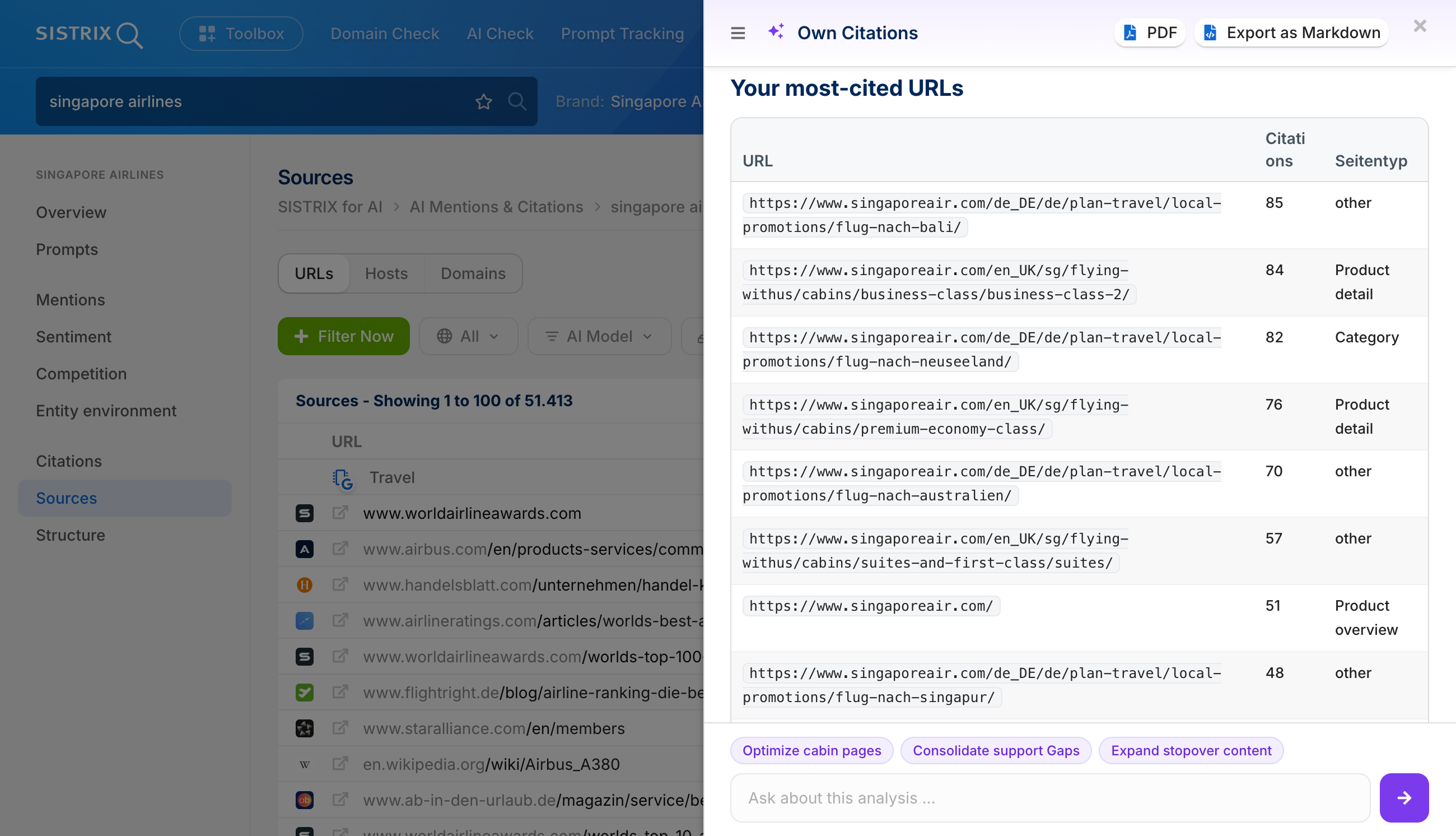
The recommendations at the end of the box are especially valuable here: they name the structural patterns of your successful pages. Transfer these patterns to the areas that aren’t cited yet, instead of starting from zero.
What competitors do better: source gaps
Switch to the Competitors area in the AI Check and start the Competitor Gap Analysis Deep Dive. It shows in which content areas the AI systems cite your competitors and not you, including the formats they use to achieve that, for example a structured content hub like British Airways’ /content/ area or Qantas’ /travelinsider/ hub.
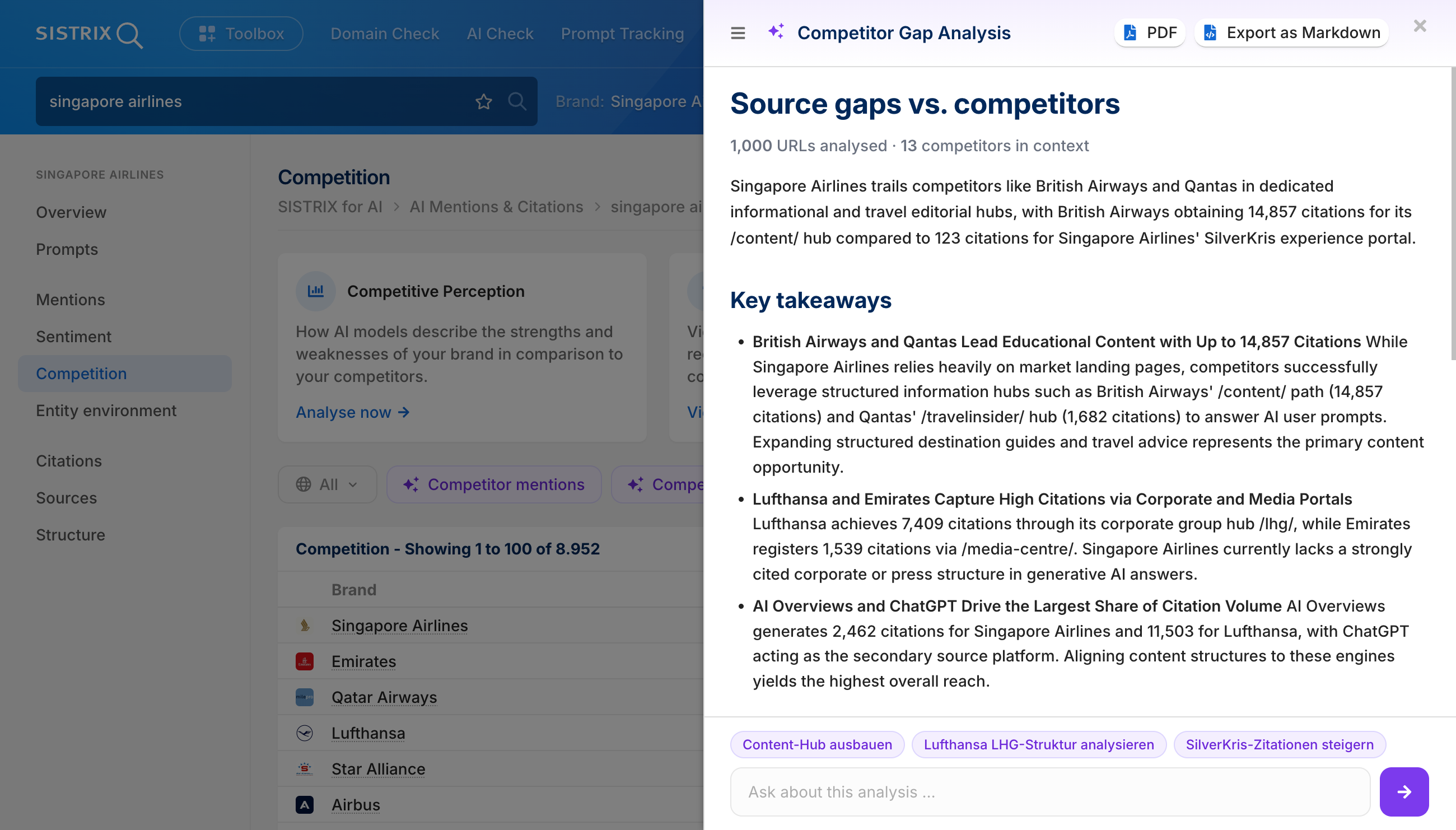
These are the concrete gaps you can close. Together with the structural patterns from Own Citations and the ideas from Content Opportunities, you’ll end this step with a complete, prioritized content plan that shows you not just the topics but also the right formats.
Step 4: Assess the competition
In step 3, competition was about concrete content gaps. Now you move up a level, to positioning. Stay in the Competitors area and start the Competitor Mentions Deep Dive. It answers the question of who you’re actually competing against in AI answers, and that isn’t always the same competition as in classic search results.
The analysis shows which companies are named in the same prompts, which brand is your biggest rival in the LLMs, and how the models position competitors relative to you: who’s seen as the premium provider, who as the more affordable alternative, and who as a specialist for a particular niche. For Singapore Airlines, Emirates and Qatar Airways turn out to be the most frequent comparison brands, both positioned as premium carriers, while Lufthansa and Cathay Pacific show up more as established network carriers.
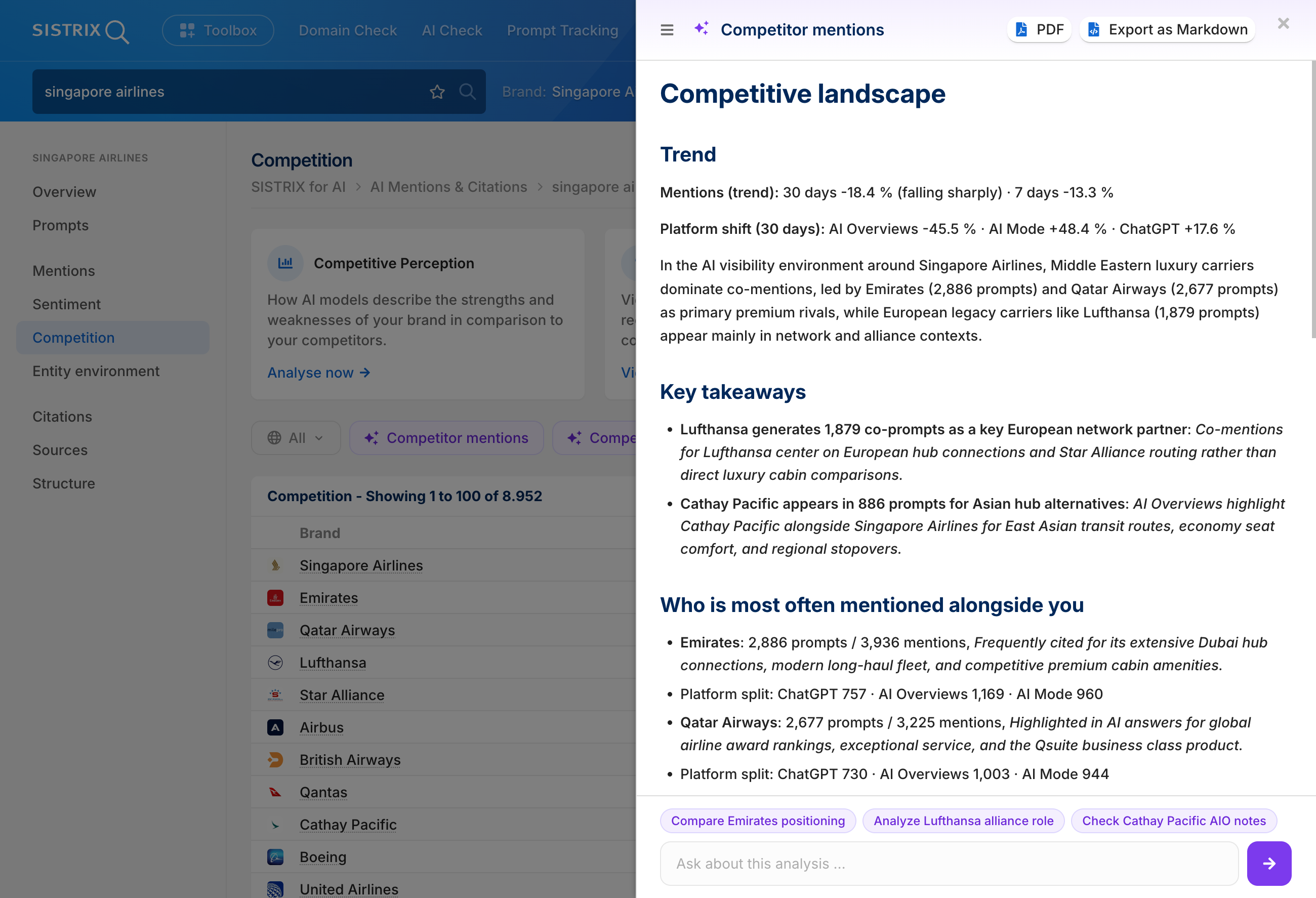
Use the result to sharpen your positioning. If the models mostly place you as one of several long-haul options in list mentions, while you see yourself as the definitive luxury benchmark, that’s a gap between self-image and AI-image that you need to close through content and external mentions. And if a competitor shows up that you hadn’t had on your radar, use the Deep Dives from step 3 to see what’s driving their visibility.
Step 5: Plan digital PR
To wrap up, turn your attention outward, because AI answers don’t just draw on your own pages. Switch to the Sources area in the AI Check and start the External Citations Deep Dive.
The analysis shows which external sites shape the AI answers in your industry: media outlets, trade portals, wikis, forums, or video platforms such as YouTube, Reddit, or Wikipedia, each with the number of citations and the prompts they appear in. Often, a handful of influential hosts dominate a large share of the answers.
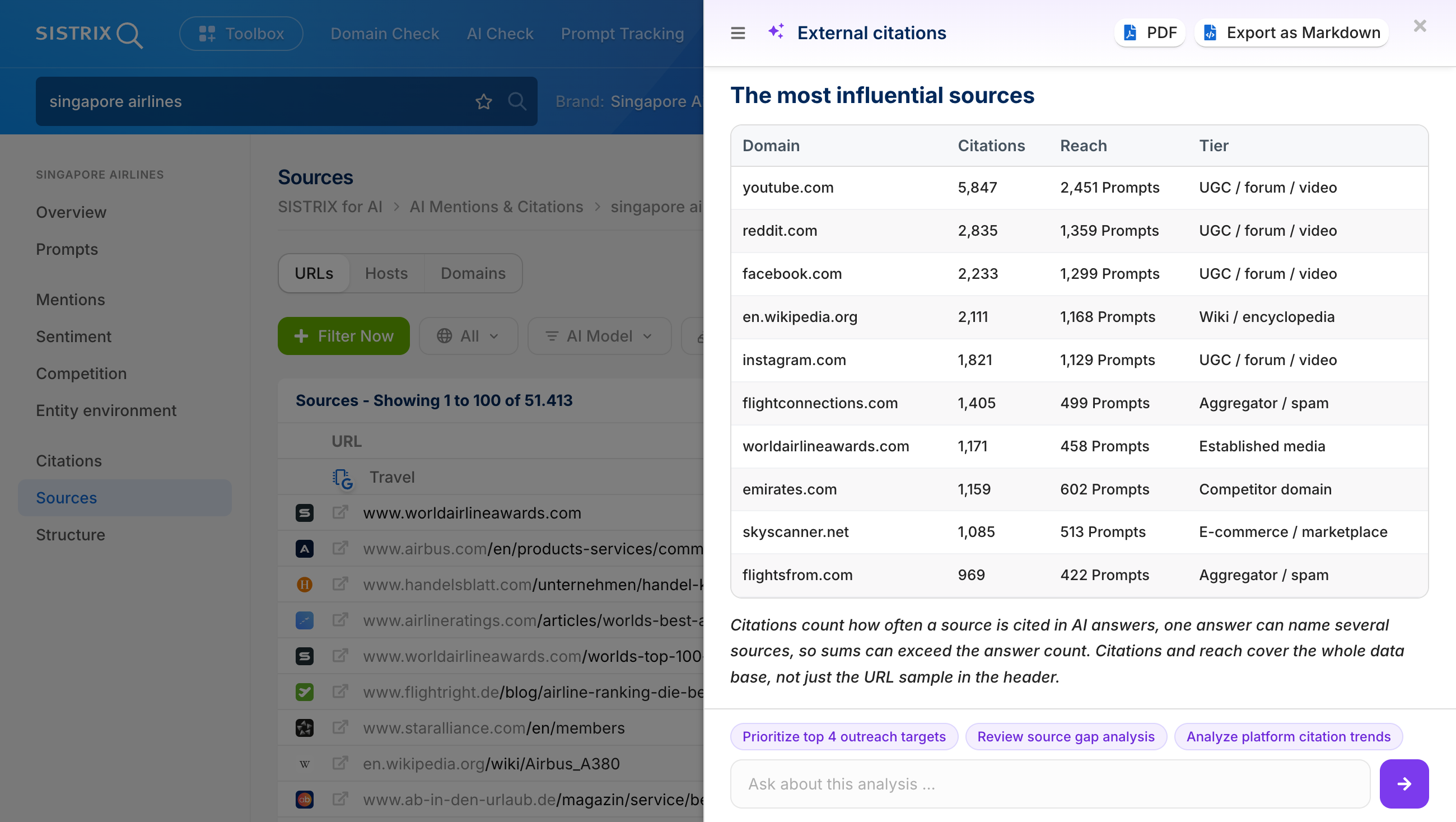
The result is a two-sided balance sheet. First, you see where your existing PR work is already landing in AI answers: mentions on influential third-party sites pay directly into your visibility. Second, you get an outreach target list: the sites that shape your topic area and don’t mention you yet are your top candidates for guest posts, product tests, interviews, and links.
Tip: export every Deep Dive directly as Markdown or PDF. That way you can collect the results of all five phases in one document and have the complete GEO analysis as a foundation for reporting and planning measures, including the recommendations from every single Deep Dive.
Test SISTRIX for Free
- Free 14-day test account
- Non-binding. No termination necessary
- Personalised on-boarding with experts