
Google announced a lot at this year’s I/O. Anyone expecting one big, singular moment that changes everything was disappointed. That moment doesn’t exist. What does exist instead is a dense bundle of announcements that, taken together, point in a clear direction: Google is transforming search into an agent.
- The Models: Gemini 3.5 Flash, Omni, Spark
- From AI Overview to AI Mode: Now Officially Mainstream
- A New Form of Contextual Search
- Ask YouTube, Maps, and Docs: Search Goes Deeper
- Shopping: Google Sets the Standard
- Android XR and the Glasses: A New Search Channel
- Google Builds Everything: Web, Image, Video, Music, Tools
- What This Means for SEO
How serious Google is about this is reflected in the numbers behind the scenes. Sundar Pichai cited a capex of 180 to 190 billion dollars for this year, compared to 31 billion in 2022. The eighth generation of in-house TPUs delivers three times the computing power for training and handles nearly 1,500 tokens per second during inference. Token volume as another indicator: from 480 trillion tokens per month a year ago to 3.2 quadrillion today. That’s not iterative improvement that’s a different order of magnitude.
The Models: Gemini 3.5 Flash, Omni, Spark
Gemini 3.5 Flash is the new default model in AI Mode and the Gemini app, rolled out globally. Faster than its predecessor, better on nearly all benchmarks, and in the Antigravity agent environment twelve times faster for agentic workloads. Gemini 3.5 Pro follows next month.
Gemini Omni combines Google’s language model intelligence with the best generative media models and can produce any output from any input: text, image, video, audio. It launches with video, but the ambition is universal.
Gemini Spark is the personal agent. It runs on dedicated VMs in Google Cloud, around the clock, even when the laptop is closed. It handles long-running tasks in the background and will connect to third-party tools via MCP in the coming weeks.
This announcement was mentioned very casually in passing, but it should not be underestimated. With easier MCP server connectivity in Gemini, the work of SEOs will change once again, and data analysis will be greatly simplified.
From AI Overview to AI Mode: Now Officially Mainstream
The transition from AI Overview to AI Mode had already been visible in the SERPs for some time: ask the Overview a follow-up question and you land in AI Mode. Now Google is making it official and rolling it out broadly. Gemini 3.5 Flash is now the default model in AI Mode, globally. Add to that a number that shows the pace: over one billion monthly AI Mode users, one year after launch. AI Overviews, according to Google, now reaches 2.5 billion monthly users.
A New Form of Contextual Search
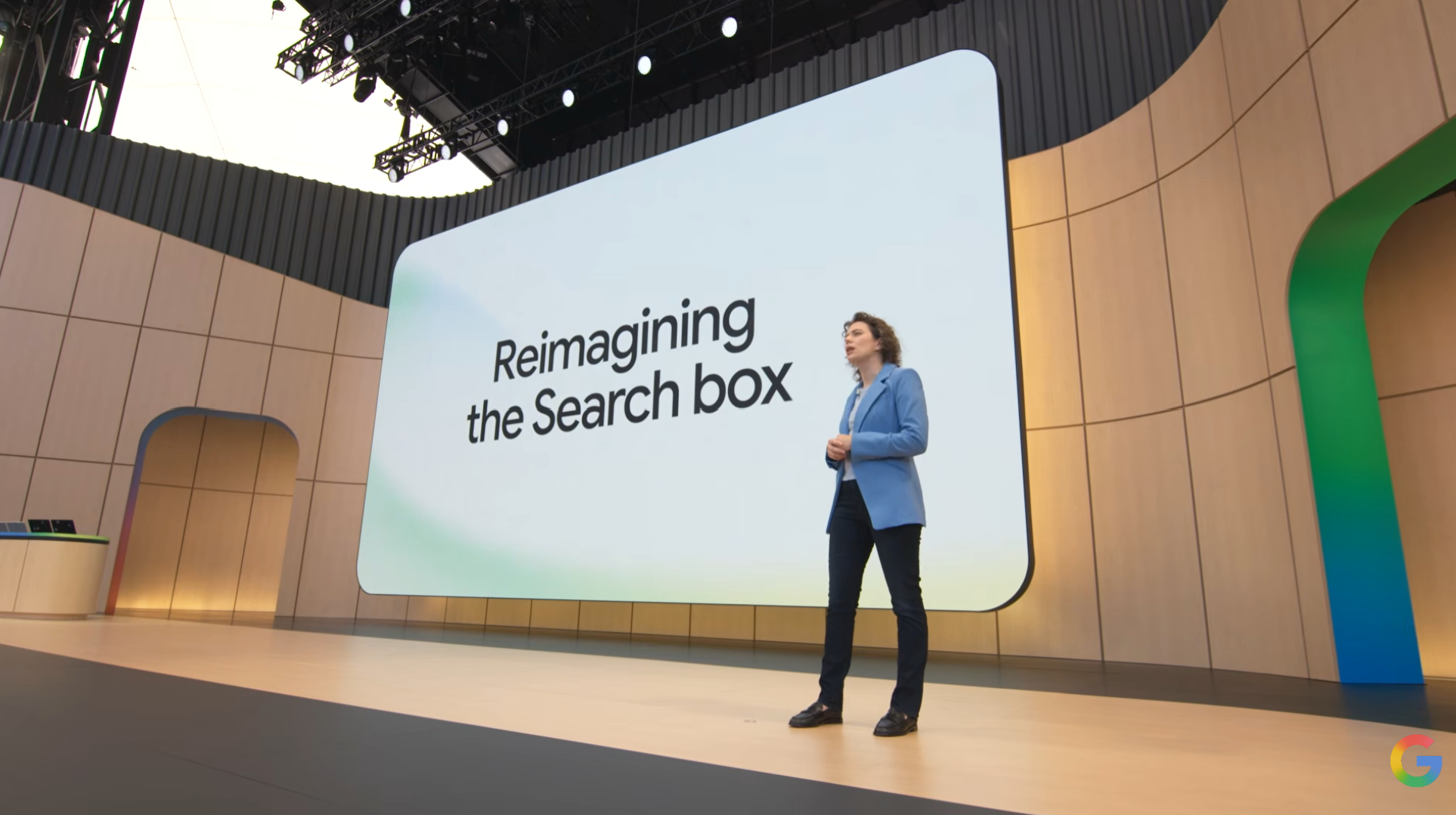
We’ve known for some time that search and the way we search will change fundamentally. Yet this year too, Google I/O left only limited space for Search. Nonetheless, the changes coming our way will have an enormous impact. The search box grows with the input, accepting text, images, files, and videos, and extends autocomplete with AI-based suggestions. Many queries today are no longer keywords but prompts and the new box responds to exactly that.
But it goes one step further. If last year we talked about hyperpersonalization, this is now already Hyperpersonalization 2.0. Conversational search is expanded with a large contextual layer. Gemini Spark knows the context from previous conversations. Information Agents monitor topics the user is interested in.
For certain queries, the AI builds its own interactive layouts directly in the SERPs in real time Generative UI (coming free for everyone this summer). Someone planning a move doesn’t get a list of links but a generated planner that incorporates calendar, Gmail, and weather data. My weekend plan takes into account my children, dogs, food preferences, and hobbies to create suggestions that really fit me. Google uses Gmail, Drive, Calendar, Photos, Maps, and real-time financial data not just to provide information, but to understand context.
The result: The idea that a ranking is the same for everyone is definitively over. Every search will take into account a completely individual context. Search doesn’t just learn what someone wants it learns who someone is. This means visibility is no longer a position in a universal index but a probability in an individual model. And if Google builds its own images, videos, and interactive tools directly in the SERPs for complex queries, the question is no longer “Which result will the user click?” but whether they even need an external site at all.
Ask YouTube, Maps, and Docs: Search Goes Deeper
“Ask YouTube reimagines the experience” that’s how Sundar Pichai put it in the keynote, and it fits well. Instead of typing in keywords, you ask YouTube a real question: How do I teach my three-year-old to ride a bike? YouTube understands the question, searches the entire catalog, and delivers a structured, interactive answer including follow-up questions to refine the result further. This opens up entirely new possibilities for video optimization that go far beyond title, description, and hashtags. Time for SEOs to also start venturing into the optimization of video content itself.
Similar logic applies to Maps: via Ask Maps, questions with local context are answered directly within Maps. For Local SEO, this presents new opportunities to leverage structured data and use cases relevant to your local target audience.
In our data on AI Mode in Germany, YouTube is already the most frequently linked source, ahead of Wikipedia. Ask YouTube reinforces this structurally: YouTube becomes a conversational knowledge platform with its own search logic. Those without a video inventory are absent from a channel that is becoming the preferred entry point for more and more topics. For Maps: local visibility is increasingly determined by structured data and Google’s own formats, no longer just organic rankings.
Shopping: Google Sets the Standard
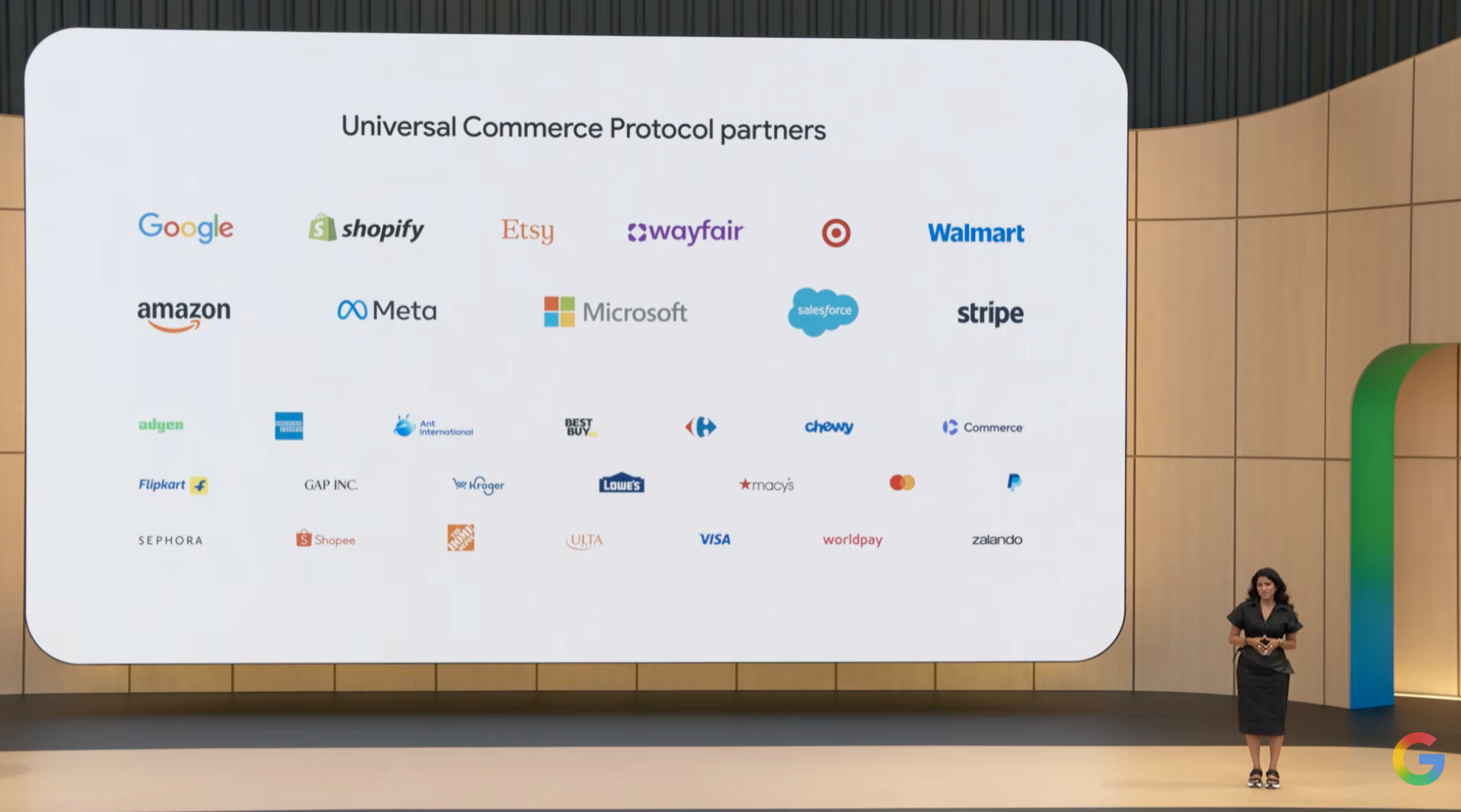
Google announced a cross-shop checkout directly in search, including a “Universal Cart” that detects compatibility issues and automatically applies discounts from linked cards. What’s interesting is less the feature itself than the infrastructure behind it: the Universal Commerce Protocol is intended to do for agent commerce what HTTP did for the web. An open standard that others can build on. OpenAI announced something similar. Google is delivering it sooner.
Anyone in e-commerce who relies on organic traffic from classic search is optimizing for a system that Google is currently replacing with agent commerce infrastructure. Visibility in the Universal Cart is a different playing field than rankings, with its own rules that are only just forming.
Android XR and the Glasses: A New Search Channel
Little noticed but relevant from a search perspective: Google announced audio glasses with Samsung, available from autumn, designed by Gentle Monster and Warby Parker. The demo showed someone navigating by voice to a location Gemini knows from a previous conversation, and placing an order in an app. This is not a gadget. It is another input channel for search no screen, no typing, fully voice-controlled and context-bound.
Google Builds Everything: Web, Image, Video, Music, Tools
Another message from I/O was clear, even if it wasn’t stated outright: with the right tools, almost anyone can now create what until recently required teams or agencies with enormous expertise.
Google Pics, the new image and design tool in Workspace, built on Nano Banana, treats every element of an image as an individual object: click, swap, regenerate.
Google Flow gets a new level of video production with Gemini Omni: scenes from any input, multiple versions in parallel, Veo running in the background as the video model.
Flow Music lets you produce music videos conversationally: style, mood, cuts all by instruction.
Generative UI creates interactive web interfaces, dashboards, and mini-tools directly in search no developer needed.
The list could go on. What’s truly relevant is not what’s possible individually, but the fact that the line between idea and finished product has nearly disappeared for almost every medium.
“You are in the era where the human has to be the most creative.” A sentence mentioned almost in passing, yet for me one of the most important statements from Google I/O. This is not consolation. It is a renegotiation. AI takes over the executable, the reproducible, the scalable. What remains is what machines cannot replicate: judgment, perspective, originality, and creativity!
What This Means for SEO
Sundar Pichai said it in the keynote, plainly and without exclamation marks: Google Search is AI Search. Not a future state, but a description of the present. Anyone still treating this as a transitional phase is optimizing for something that no longer exists in that form.
The era in which SEO could be practiced as it was two years ago is over: video optimization must be rethought, as must local and e-commerce SEO. The Universal Cart and the Universal Commerce Protocol are a different playing field than classic rankings. Audio glasses and voice-controlled channels without screens open up new opportunities for brands that are early adopters. And hyperpersonalization reaches another level once again.
This doesn’t only mean that visibility becomes more individual it also means that relevant content reaches relevant people better than ever before. Those who truly know their target audience their questions, their context, their behavior will be served more precisely in an individualized system.
This is exactly where the opportunity lies: creativity, genuine perspective, and a clear voice will not be lost in this system they will become more distinguishable. The mass of generated content makes human originality more valuable, not less. Those who start rethinking today will help shape the changes rather than simply be hit by them.