
Marks and Spencer, UK fashion and food chain, are beating their business partner Ocado at creating search visibility for the same food products. M&S aren’t selling those products but it feels like that could be the next step. Is this additive, or will it cannibalise? Is it an indicator that M&S can do it better themselves? Where does this leave Ocado and the traditionally fashion-focused M&S domain? One answer is that they could work well together.
The Marks and Spencer domain currently lives in the fashion sector. It’s an extremely strong player there and competes up in the top five across the fashion sector against Next, Asos NewLook and HM but the new /food section in the domain has rapidly gained visibility.
It’s all happening under what I suspect is a new project since the end of 2024 under www.marksandspencer.com/food and it covers everything from Cauliflower to Colin the Catterpillar. Personal opinion: it looks great from a user experience perspective.
M&S is being careful to call this a “catalogue” but one gets the feeling that this project is e-commerce ready. Products are linked to live in-store stock and pricing information. The next step could easily be click and collect.
Saying on that topic – what is next? Here are the possibilities
This is a test. What happens when you put food onto a fashion website? Are people finding it via search and Chatbots? Does it cannibalise the existing domain visibility or the Ocado visibility? Does the data show that people are seeking to buy from the website?
Click and Collect. There are parallels with Primark here, which is in itself very interesting because the two brands still exist on the British high street and both are experimenting with the same ‘live catalugue’ setup. Click and collect exists in the fashion department at M&S so they have experience here.
Full online delivery. This is a business decision that will have nothing to do with search visibility. “Ocado is the only way to get your favourite M&S Food delivered right to your kitchen table.” says the website, but who know’s what’s being discussed at board level. Strategic business direction is not the focus of this post, but i’ll be interested to hear the discussion.
Cross-link to Ocado. One other option would be to build the “buy” links to Ocado. It would vastly increase the strength of the Ocado website but, given that M&S owns half of it, that’s a good strategic option. It’s easy to implement, and easy to remove if it doesn’t work.
Finally, Marks and Spencer could just leave it as it is. They’ve already achieved great results in terms of search visibility.
Current visibility
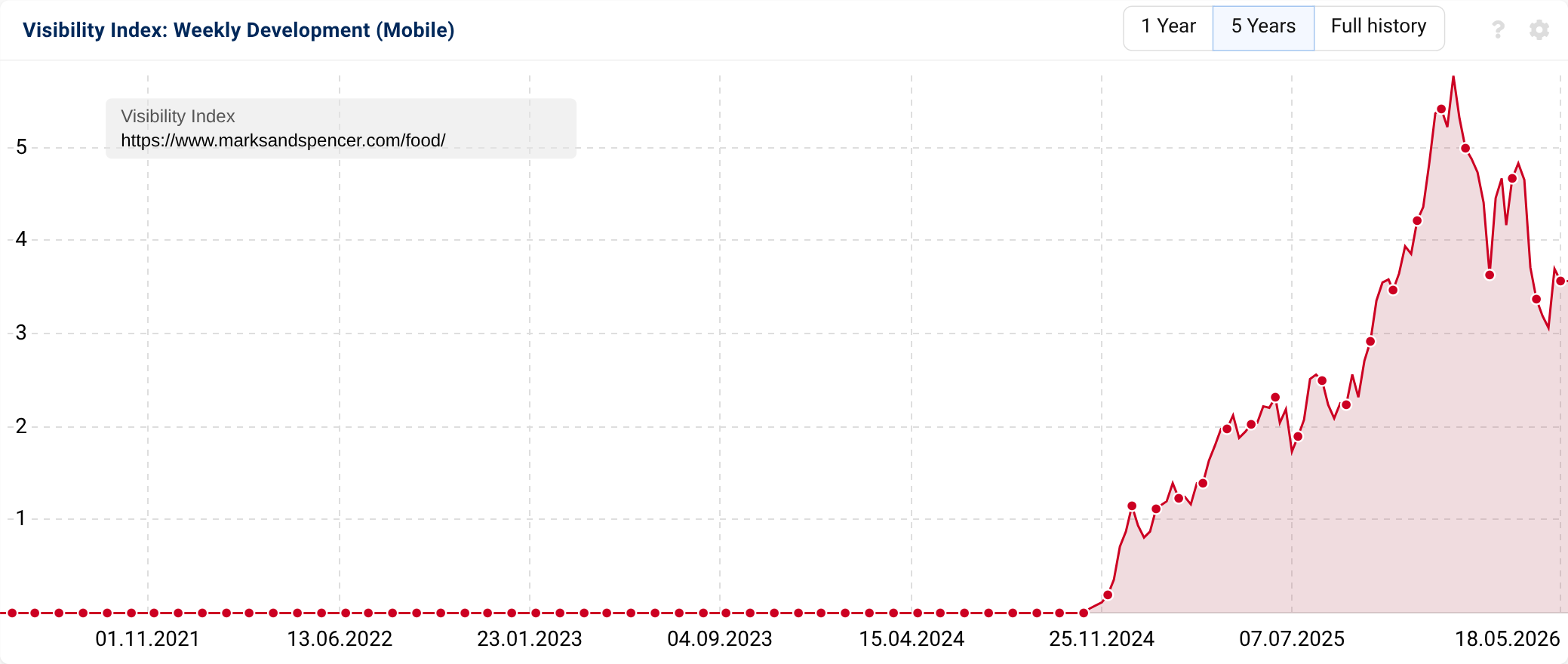
Below is the Visibility Index graphic, over 5 years, for the new /food directory on the marksandspencer.com website.
The Visibility Index graph for Ocado isn’t much better, and it includes competing products.
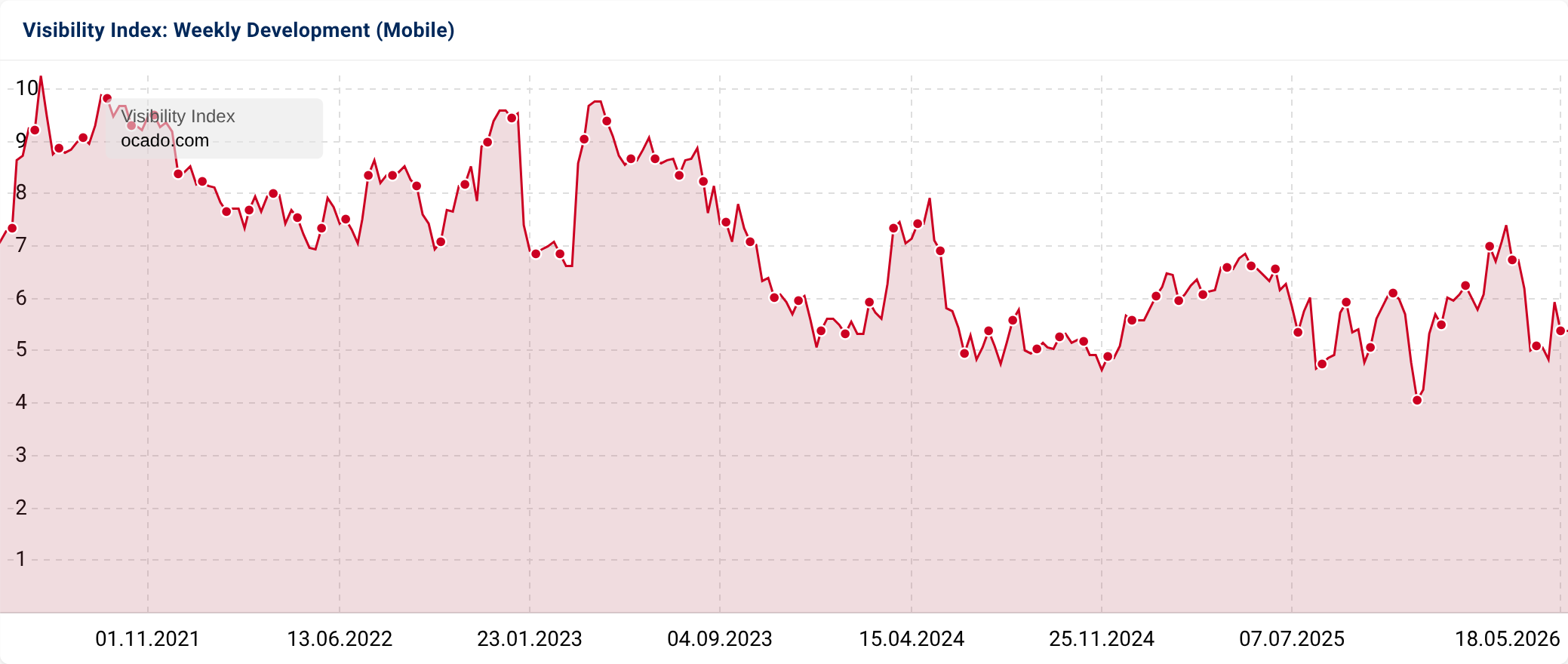
Due to the mixing of products in the URL structure at Ocado it is difficult to filter-out the exact VI that relates to M&S products but by filtering the URLs containing the “m-s” text we get an idea. Of the 8778 URLs ranking at Ocado ranking with one or more keywords in the top 10, 2918 contain the “m-s” identifier. That’s 33%. The M&S website is beating Ocado, even at this stage.
What’s doing well in the /food project?
Recent work by M&S shows good results, and it’s not all branded search wins. The Visibility Index for the directory sits at 3.58 as I write this and that’s a good level of visibility with an estimated 918826 clicks from those rankings per month.
Exposure to AIO, which will negatively affect that click figure, is 28% of ranking keywords, or, more accurately, 47% of the Visibility Index. (High ranking, high volume keywords have increased weighting in the VI.) For reference, pure e-com sites have below 10% exposure so the figures here indicate that Google is putting informational weighting across the searches. It makes sense considering you can’t actually buy anything yet.
A selection of the more important top 10 non-brand rankings:
| Keyword | Position | Search Volume | Clicks |
|---|---|---|---|
| gastropub | 6 | 58900 | 2785 |
| peonies | 9 | 99400 | 2557 |
| kefir yogurt | 1 | 8200 | 2436 |
| easter eggs | 6 | 35100 | 1662 |
| valentines meal deals | 2 | 9950 | 1482 |
| kier yogurt | 1 | 4450 | 1329 |
| margarine | 6 | 16900 | 800 |
| valentine day meal deals | 7 | 21000 | 787 |
| valentine's day meals deals | 7 | 13600 | 510 |
| grazing table | 4 | 6800 | 501 |
| picky bits | 2 | 3300 | 496 |
| m&s food offers this week | 1 | 1550 | 468 |
| dressing food | 3 | 4650 | 464 |
| easter ideas | 1 | 1500 | 454 |
| potluck | 5 | 5900 | 411 |
| picnic food | 6 | 8200 | 389 |
| charcuterie board | 9 | 13700 | 353 |
| pretzel bun | 2 | 2350 | 353 |
| creste di gallo pasta | 2 | 2200 | 331 |
| speck | 7 | 8450 | 317 |
| m&s valentine meal deal | 1 | 1050 | 314 |
| prosciutto | 4 | 4100 | 302 |
| m&s food christmas | 1 | 1000 | 298 |
| rollmops | 2 | 2000 | 297 |
| lambrusco | 4 | 3650 | 268 |
| m&s gingerbread house | 1 | 850 | 253 |
| crudite platter | 2 | 1700 | 252 |
| vitamin c foods | 8 | 8350 | 251 |
| m&s meal deal lunch | 1 | 700 | 222 |
| m&s valentines food | 1 | 700 | 222 |
| peony season | 1 | 700 | 209 |
| oily fish | 7 | 5500 | 208 |
| when is the next dine in for two | 1 | 650 | 206 |
| food for christmas | 5 | 2900 | 203 |
| m&s chocolates half price | 1 | 650 | 200 |
| high smoke point oil | 5 | 2700 | 189 |
| menu tapas | 2 | 1250 | 185 |
| asparagus season uk | 1 | 600 | 184 |
| all butter biscuits | 1 | 600 | 182 |
| marks and spencer food 10 deal | 1 | 600 | 182 |
| yumnut | 1 | 550 | 177 |
| asti spumante | 7 | 4700 | 176 |
| m&s christmas food 2024 | 10 | 8000 | 175 |
| marks and spencer valentines food | 1 | 550 | 172 |
| m&s valentine's dine in | 1 | 550 | 165 |
| peonies flowers | 6 | 3450 | 165 |
| sugarloaf pineapple | 1 | 500 | 161 |
| marks and spencers valentines meal deal | 1 | 500 | 161 |
| christmas breakfast ideas | 4 | 2150 | 159 |
Interesting to see here is the relationship between the previously available content on the website and the new rankings. Party and event food and drinks were always covered on the website, and related terms appear in some of the important top 10 non-brand rankings. They may have shifted rankings from other parts of the site.
There is some evidence of generic term dominance but not much. Kefir joghurt and margarine are two significant examples but rollmops, oily fish, wafer and fruity tea are also in the top 10 rankings.
Competitors
As you would expect, Tesco is an important competitor, but so is Facebook and BBC Good Food. More importantly, Ocado exists as a competitor, and it’s here I need to look a little closer to find out if cannibalisation is happening or whether the two sites are co-existing in the SERPs.
M&S vs Ocado – top 10 rankings
- There are 11098 keywords for which both domains rank in the top 100
- Both domains co-exist in the top 10 for 6148 of those keywords. Many, however, are branded keywords.
- Ocado rank in the Top 10 for 803 keywords for which M&S do not have a top 10 ranking. Examples are: Pasta sauce, yoghurt, groceries and food shop.
- M&S rank in the Top 10 for 1762 keywords for which Ocado do not have a top 10 ranking. Examples are kefir yoghurt, tamarind paste, tins of biscuits and christmas food.
Based on this, there seems to be 1) Positive co-existence for brand keywords. 2) Gaps in the M&S generic keyword coverage. 3) Strong specialist topic coverage in M&S. However, in terms of generic keywords there’s very little for which these domains both rank.
“cheese slices” is one of a few examples. The good news is that it has been stable, and rising, over time which is an indicator of what could be achieved.
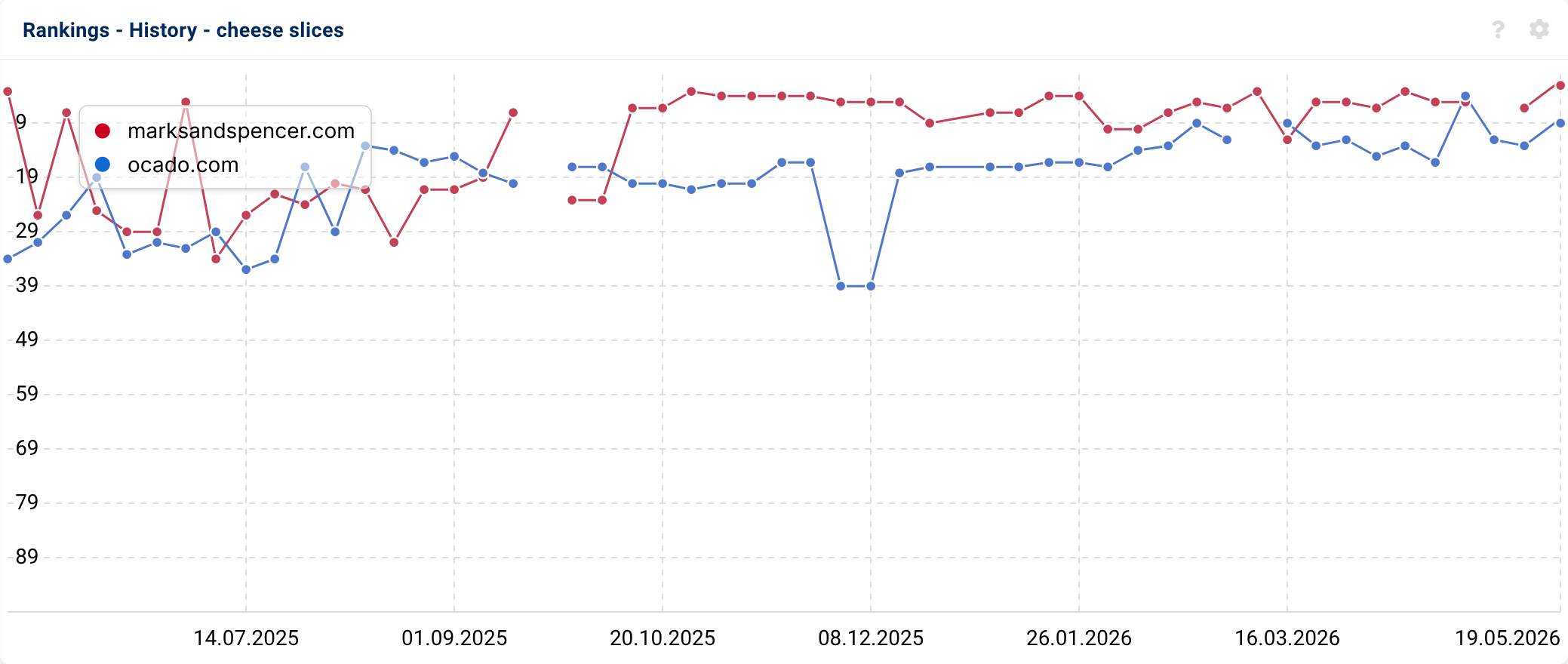
Keep in mind that you can order delivery in one domain and you can only browse in the other. Google will have already worked this out. If online delivery is enabled on the site, there will be a shift in the rankings that could lead to more co-existence in the rankings and less exposure to AI Overviews.
Can it do better?
The progression here is similar to what I saw at Primark when they introduced in-store availability and personal shopping lists. It seems that if you don’t provide ordering capability, you don’t get as much visibility as you could which indicates that more people want to buy than browse.
Key players in the sector are shown in the live tracker below. marks and Spencer is nowhere to be seen in this retail grocery index.
Google appears to have established a low commercial intent for M&S food searches. If customers are jumping back to search after seeing that you cannot order at M&S, Google will have all the data it needs to work that out.
Is this a successful project?
Visibility for M&S products via Ocado has never been truly successful. There’s in-domain cannibalisation and dual-brand confusion. The bar hasn’t been set very high.
Given the current visibility trajectory at Ocado, the percentage of that that will apply to M&S, the current success of the /food project and the potential that M&S would have if they turned on ordering, it seems to me there’s already a win here and, given the examples of brand and non-brand co-existence in the same SERP, a real opportunity for both websites to work together to push competitors out of the top 10.
More retail grocery analysis is available as part of our Visibility Leaders project.