AI search has already developed rapidly over the past three years. Nevertheless, I am convinced that we will see a further acceleration of AI developments this year. Based on current market trends and past experience, I am making the following five predictions for 2026:
1 – The unified Google Search box
ChatGPT currently has a decisive interface advantage over Google – it has a central input field, and depending on the input, the system automatically selects the best course of action. Whether a web search is to be initiated, an answer generated based on internal model knowledge, or an image created, the control process runs in the background.
While Google possesses all these capabilities and, in my opinion, is often significantly stronger than ChatGPT in the implementation of the individual disciplines, it suffers from a strong fragmentation of the user experience.
Currently, Google users have to decide for themselves which of Google’s AI tools is best suited to their particular query. The choices include AIO in classic search, AI Mode , Gemini , Google AI Studio, and other tools.
My prediction for the coming year is that Google will consolidate these offers into a single search box. In the future, Google will be able to independently assess the intent of the query and direct the user straight to the most suitable tool for their specific question.
2 – Google overtakes ChatGPT
ChatGPT is currently synonymous with AI chatbots worldwide. OpenAI has successfully built up the category and holds a correspondingly high market share – for now .
My prediction is that Google will overtake ChatGPT this year. After initially missing the boat in this segment, Google is now returning with momentum. Models like Gemini 3 are setting technological standards, while deep integration with browsers, search, partners and other infrastructure will ensure a market penetration that OpenAI cannot match.
The fact that Google currently lists Gemini and the AI mode of search separately is, in my view, a strategic move with regard to competition law [German]. It allows the company to continue playing the role of the hunter in regulatory proceedings, while the de facto integration behind the scenes is already paving the way for market leadership. The combination of technical excellence and its existing user base will make Google the dominant player in the field of AI chatbots next year.
3 – Perplexity approaches consolidation
Perplexity has contributed significantly to the concept of the “answer engine,” but faces a structural problem – the lack of its own defensible assets. While Google and OpenAI control deep technological stacks, Perplexity’s model functions more like an aggregation layer. The AI models it uses come from third parties: even its own “Sonar” model is based on Meta’s Llama architecture, and a large portion of its web results are sourced from Bing.
This means Perplexity lacks what will be crucial in the coming year – its own LLM, a significant web index, and, most importantly, its own distribution across operating systems and browsers. Without these levers, the platform is extremely dependent on the interfaces and pricing models of its competitors.
My prediction is therefore that in 2026 Perplexity will either be acquired cheaply as a strategic addition (for example by Microsoft to enhance Bing) or will have to cease independent operations due to massive margin pressure.
4 – Google massively pushes the spread of AI Mode
Following the channels of relevant Google employees in the search environment makes one thing clear: for the company, AI Mode is the logical next step in the evolution of internet search. Essentially, this mode functions like an enhanced AI Overview , but it omits the classic organic results at the bottom.
With this, Google solves one of the biggest structural problems of its own platform – users migrating to external websites. By consuming answers directly within the interface and deepening understanding through follow-up questions, user engagement remains entirely within the Google ecosystem.
It’s no wonder, then, that Google has already invested heavily in distribution in recent months. In the US, AI Mode is already prominently featured on the homepage [German], in the Chrome browser it’s integrated directly into the address bar (Omnibox), and at the end of traditional AI Overviews, there’s now a direct link to the chat mode.
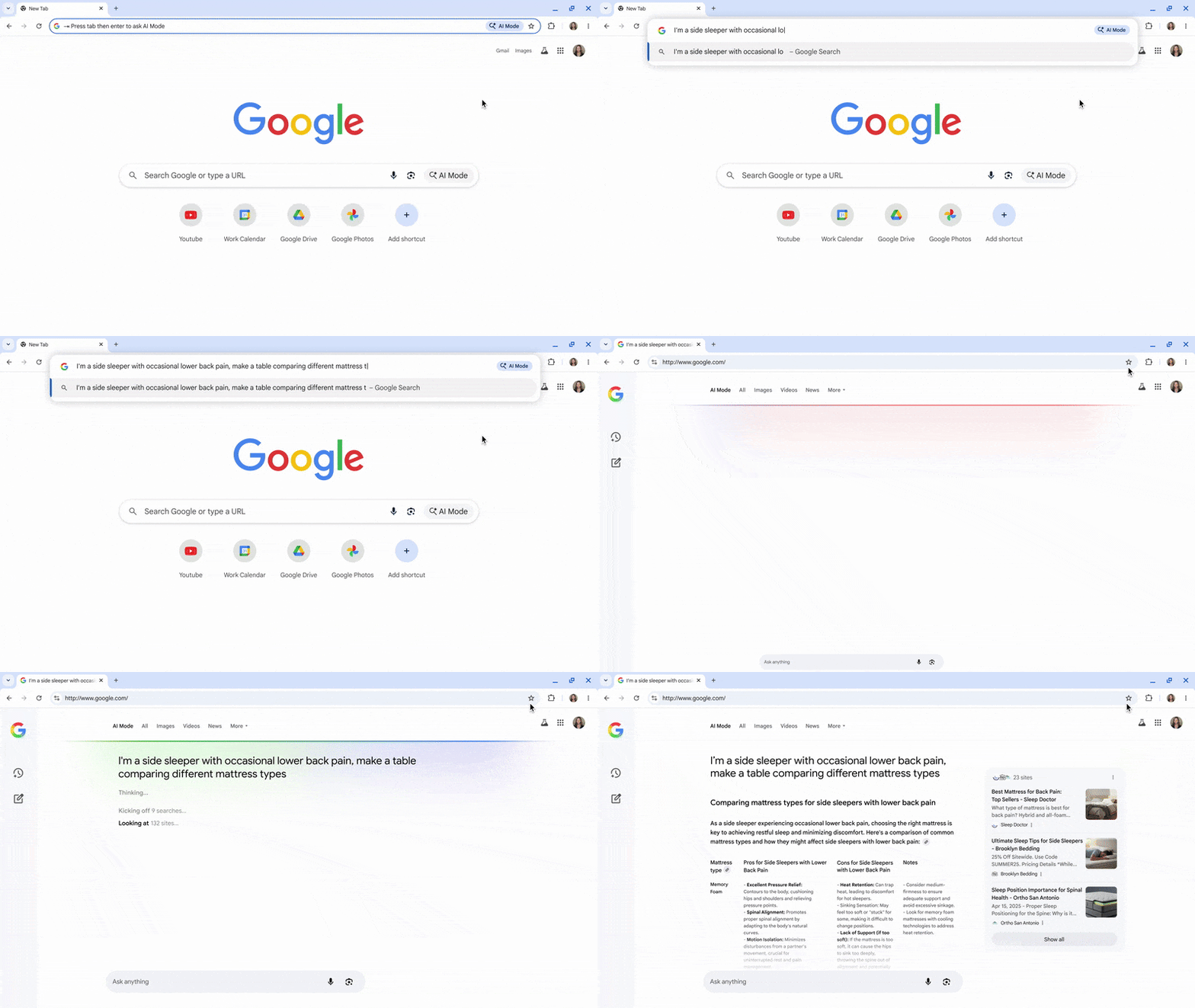
My prediction for the coming year is that Google will significantly intensify these efforts. We’ve only seen a fraction of the available distribution tools so far. In the future, AI Mode will be prominently featured at every touchpoint of the search journey.
5 – AI-Generated response formats and features
To date, both traditional web search and AI chatbot answers have been based on largely standardised response formats. While the combination of these elements results in an enormous variety of SERP layouts, the formats themselves are rigidly defined.
My prediction for the coming year is that we will see the transition to truly AI-generated response formats and applications. In the future, AI will no longer simply fill content into existing forms, but will create the perfect visual and functional presentation of the answer “on the fly” for each specific intent.
Furthermore, I expect we will increasingly see new features directly within the search results, generated by AI only at the moment of the query. The spectrum ranges from specialised computers for complex use cases to dynamic graphical visualisations and interactive examples.
For website operators, this means a further worsening of the situation: The necessary level of originality to motivate users to click on their own domain from the search results will continue to rise noticeably.
Looking into the AI crystal ball
Of course, neither I nor anyone else has a crystal ball and can say for sure what we can expect this year. Nevertheless, based on current market movements and the experiences of recent years, I consider my predictions to be very likely. I will provide regular updates here and on LinkedIn . Anyone interested can also take a look at the AI Insights Content Hubs , where we compile the latest SISTRIX information on AI topics.
Test SISTRIX for Free
- Free 14-day test account
- Non-binding. No termination necessary
- Personalised on-boarding with experts