
A lot changed in ChatGPT in October, most of it in a single night. Three of these changes matter for visibility in ChatGPT and for web analytics.
OpenAI has been rolling out GPT-6 in ChatGPT since 7 October, starting with paying users. We looked at our daily ChatGPT queries to see how much of this reaches logged-out users and what else changed along the way.
On 9 October, ChatGPT switched over overnight
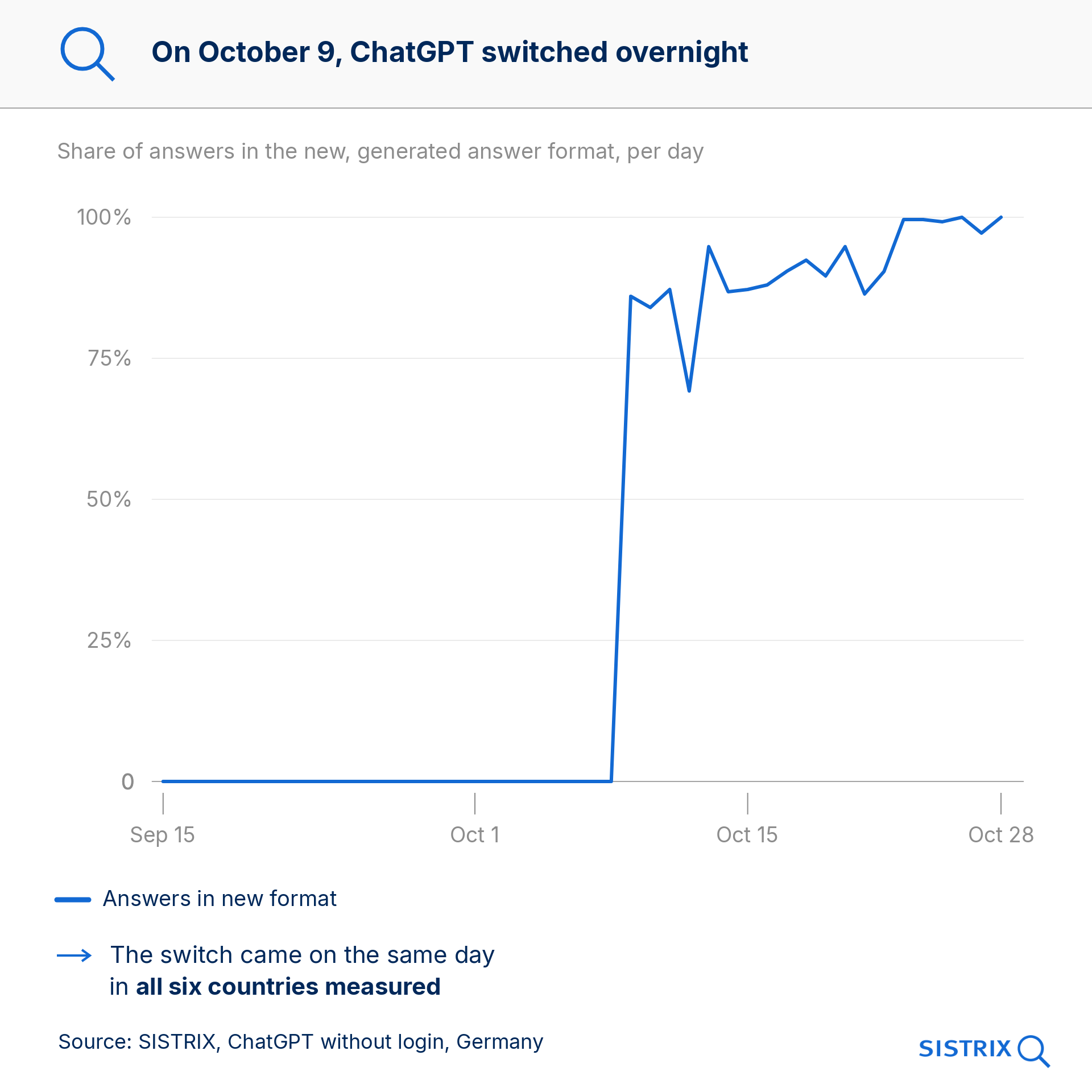
Up to 8 October, every answer in our data came in the familiar format: running text with citations and a source list at the end. During the night of 8 to 9 October, this changed within a few hours. Until 2pm on 8 October, not a single answer showed the new format. From 3am on 9 October, almost every answer did. In the following days, the share was between 69 and 95 per cent, and since 23 October it has been between 97 and 100 per cent.
In the new format, ChatGPT does not just write text, it assembles the answer from building blocks: sections, images, comparison rows and expandable source tiles. The change arrived on the same day in all six countries we analysed: Germany, Austria, Switzerland, the UK, the US and Spain.
Whether GPT-6 is behind this can only be shown indirectly. Until the end of September, every answer stated which model had written it: GPT-5.6 in 92.2 per cent of cases, GPT-5.6 mini in 7.8 per cent. Since the beginning of October, this information has been missing. However, the page still names a model when a session has reached its limit. Up to 30 September, this was GPT-5.6 every day. In the first week of October, no model name appears at all. Since 9 October, it has said gpt-6-auto every day, with a notice that reads roughly ‘You’re using our base model. Log in or sign up for more capability’. This suggests that logged-out users have also been getting GPT-6 since 9 October, two days after the launch for paying users.
How we measured this
For AI Check and Prompt Tracking, SISTRIX queries hundreds of thousands of prompts in ChatGPT every day, without logging in, so the answers are exactly what someone without an account sees. For this analysis, we evaluated a random sample of these queries for the period from 15 September to 28 October 2026.
The UTM parameter was missing for a week
ChatGPT appends the parameter utm_source=chatgpt.com to every link a user clicks in an answer. This is how analytics tools such as Google Analytics recognise that a visit came from ChatGPT. Up to 8 October, every source link in our data carried this parameter. From 9 to 15 October, only 1 to 24 per cent did, depending on the day, and on 16 October it was 42 per cent. Since 17 October, the parameter has been back on 99 to 100 per cent of links. This matches industry reports that had dated the gap to 8 to 15 October. In our data, it starts and ends one day later in each case.
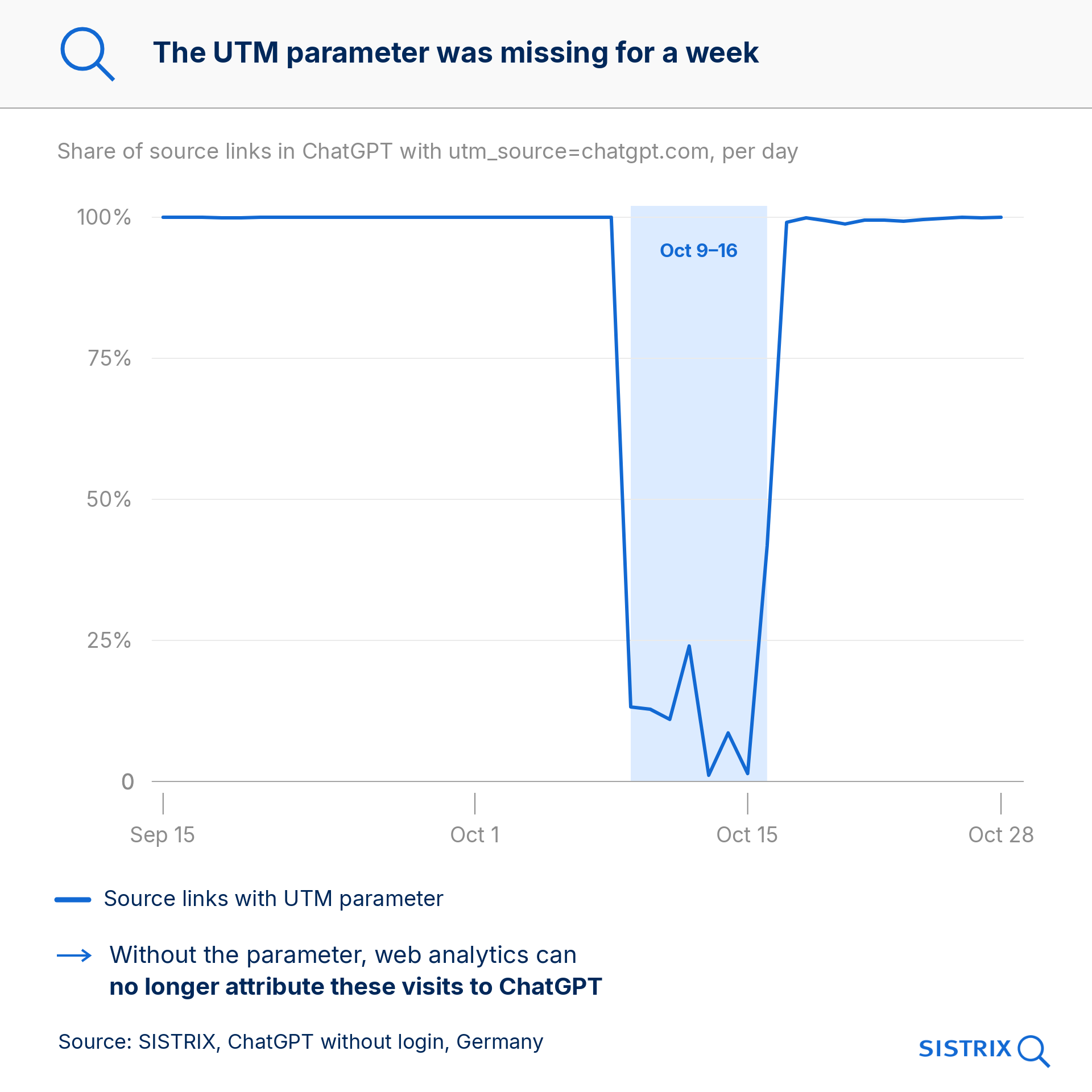
Only answers in the new format were affected. Their links also carry rel=”noopener noreferrer”, so the browser does not pass on a referrer when a link is clicked. Without the UTM parameter, web analytics has nothing left to identify a visit from ChatGPT. Such visits show up as direct traffic.
So if you see fewer visits from ChatGPT and more direct traffic at the same time between 9 and 16 October, you most likely have not lost any visibility. It is worth flagging these days in your reports before anyone reads a trend into them.
The source list disappeared for two weeks
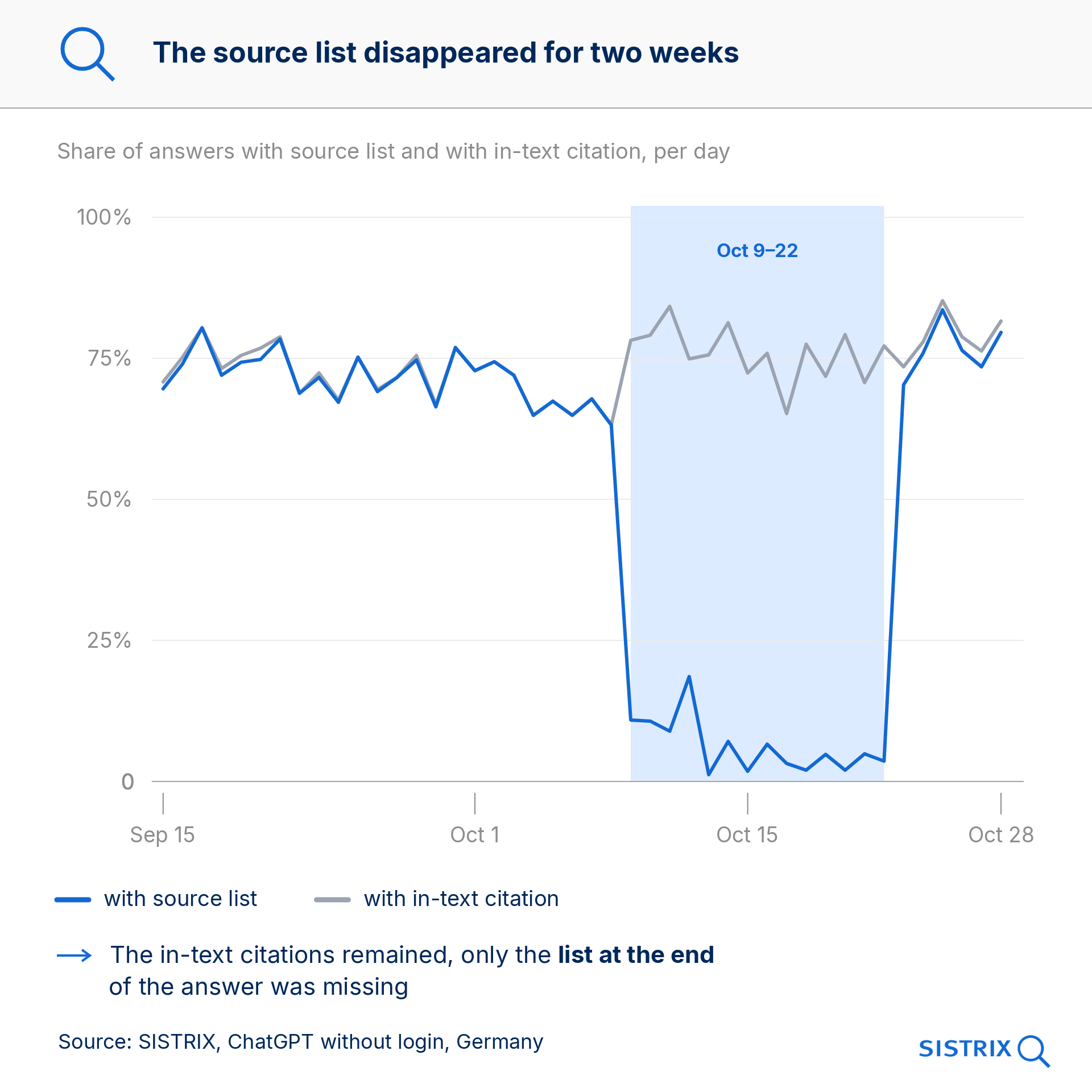
The new format also changed how ChatGPT displays its sources. The citations in the text remained: before the switch, 72.4 per cent of answers contained at least one source, afterwards 76.2 per cent. The source list at the end of the answer, on the other hand, almost completely disappeared. From 9 to 22 October, only 1 to 19 per cent of answers had such a list, compared with around 72 per cent before. Since 23 October, it has been back and appears below 70 to 84 per cent of answers. So whoever was cited remained visible, just in a different place: in tiles directly next to the relevant paragraph.
Several observers have also reported that ChatGPT has been linking more often since the model change. In our data, the number of linked pages per answer rises from 3.3 to 4.1, and the number of different websites from 2.3 to 2.9. Prompts that were queried throughout the entire period show the same movement, so it is not down to a change in the selection of questions. Even so, we cannot say for certain that the model is the reason: the increase came in two steps, on 9 October and again around 22 October, and both times it coincides with days on which ChatGPT rebuilt its display. The types of websites cited shifted only slightly. Manufacturers and institutions are cited a little more often, publishers a little less often, with differences of two to four percentage points.
SISTRIX AI Check shows whether your brand is mentioned and cited in ChatGPT, and with which pages. For your own prompts, Prompt Tracking does the same on a daily basis. You can try both with a free trial account.