

Which pages get cited by ChatGPT, Google’s AI Mode and AI Overviews, and what do they have in common? We analysed 96,418 URLs and checked which GEO recommendations hold up against a large dataset.
- What works: structure for the machine, trust for the human
- Structure: table of contents, Article and FAQ schema
- Trust: author box, last-updated date, sources
- Freshness: the year in the title
- Overall: cited 2.1 times as often
- All factors at a glance
- What delivers less than expected?
- llms.txt: no measurable advantage
- Not all schema is equal
- Readability: important for people, neutral for AI
- Word count: symptom, not cause
- Platforms and domain types: same principles, different weighting
- Conclusion: what you can put into practice from tomorrow
- How we measured
- FAQ: Frequently asked questions about the Citation Worthiness study
There’s no shortage of GEO advice these days, but solid data to back it up is much harder to find. Many recommendations are based on lab experiments, case studies with a few hundred URLs or top 100 lists that mainly measure brand strength. We’ve seen for ourselves how quickly small datasets can be misleading: in our test runs, the effect of FAQ schema reversed completely as the sample grew.
For the Citation Worthiness study, we therefore looked at a large volume of data: 48,527 pages from the SISTRIX AI Index for the DACH region that were cited by ChatGPT, AI Mode or AI Overviews, each compared directly with a non-cited page from the same domain. The key findings at a glance:
TL;DR
- Once in the template: Add a table of contents, Article schema, an author box with photo and, especially for editorial content, a visible last-updated date.
- Per page: Add an FAQ block with schema, a TL;DR, a question as an H2 heading, a table and source references wherever the content calls for it.
- Strategically: Know your domain type, keep content up to date and, for online shops, build an advice section.
- What you can skip: Prioritising llms.txt, treating schema as a miracle cure, padding texts to a set word count and trusting studies with fewer than 5,000 URLs.
- The effect: Pages that combine many of these features are cited 2.1 times as often as barely optimised ones.
How we measured and where the study’s limits lie is explained further down.
Please note: This study is based on data from the German-speaking market (DACH region: Germany, Austria and Switzerland). Results may differ for other countries and languages.
What works: structure for the machine, trust for the human
Almost all positive signals can be traced back to two principles:
- Make it easy for AI systems to extract content, for example with a table of contents, Article and FAQ schema, questions as subheadings, tables and lists.
- Show that a real person is behind the content and maintains it, for example with an author box, a last-updated date and source references.
Before we look at the individual features, a quick note on how to read the figures: all results are given as a factor. A factor of 1.7 for the table of contents means that, of two pages on the same domain, the one with a table of contents is cited 1.7 times as often as the one without. A factor of 1.0 means no difference, and values below that are associated with fewer citations.
Structure: table of contents, Article and FAQ schema
No structural signal is associated with more citations than the table of contents: pages with a visible table of contents and jump links are cited 1.7 times as often. Yet only 14 per cent of pages have one. Pages with Article schema are cited 1.6 times as often, and in most CMSs the markup can be enabled with a single setting. Pages with FAQPage schema are cited 1.5 times as often, across all three platforms and all domain types except encyclopaedias, even though Google has dropped FAQ rich results. The prerequisite is genuine questions rather than token FAQs.
There are also some smaller structural signals: at least five H2 headings (1.6), tables with a header row (1.5), ten or more bullet lists per page (1.5), at least one question as an H2 heading (1.4) and a TL;DR summary at the beginning (1.3). The figure for the number of H2 headings should be read with caution, though, as longer texts almost automatically have more subheadings. Questions as headings are a different matter, as their effect does not depend on text length.
Trust: author box, last-updated date, sources
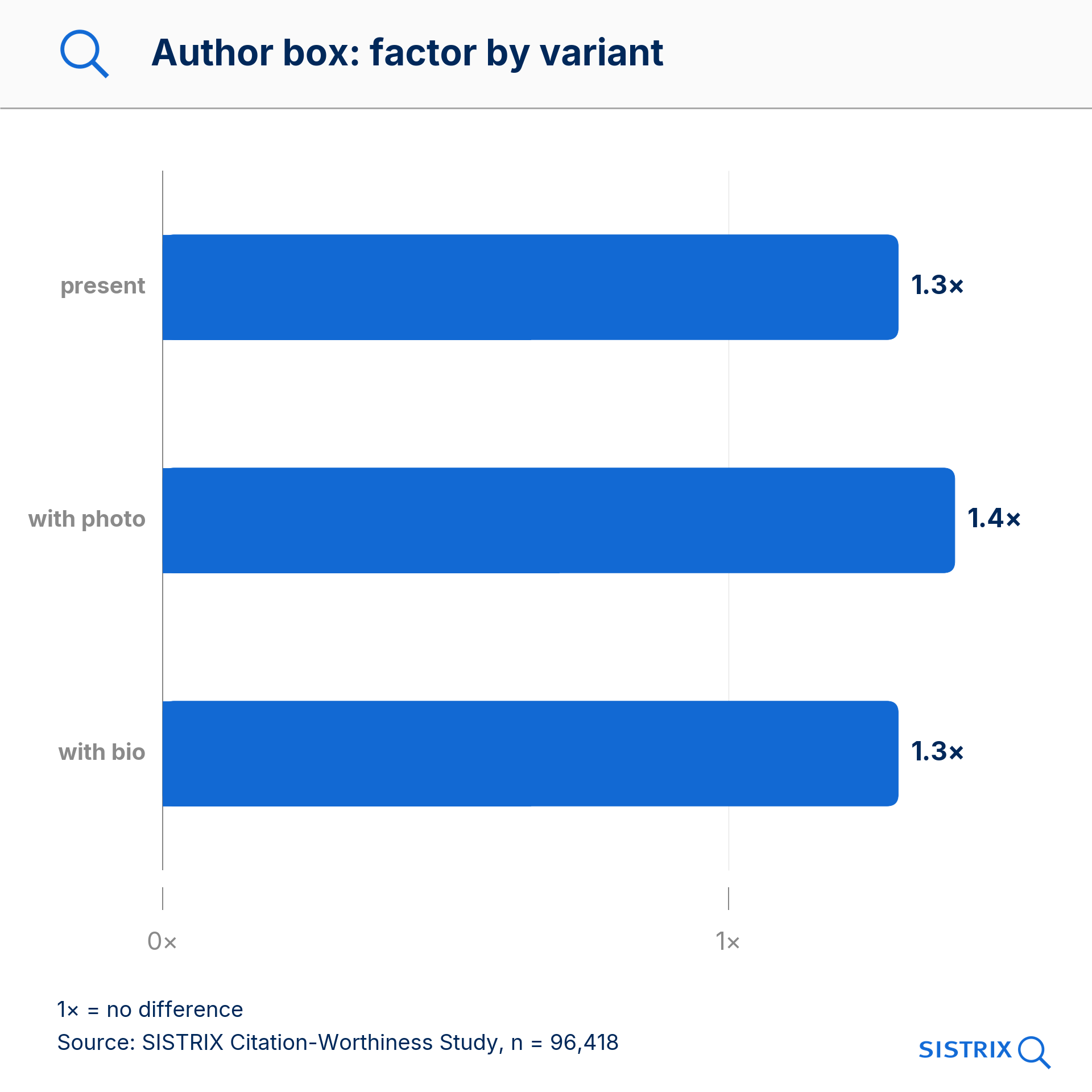
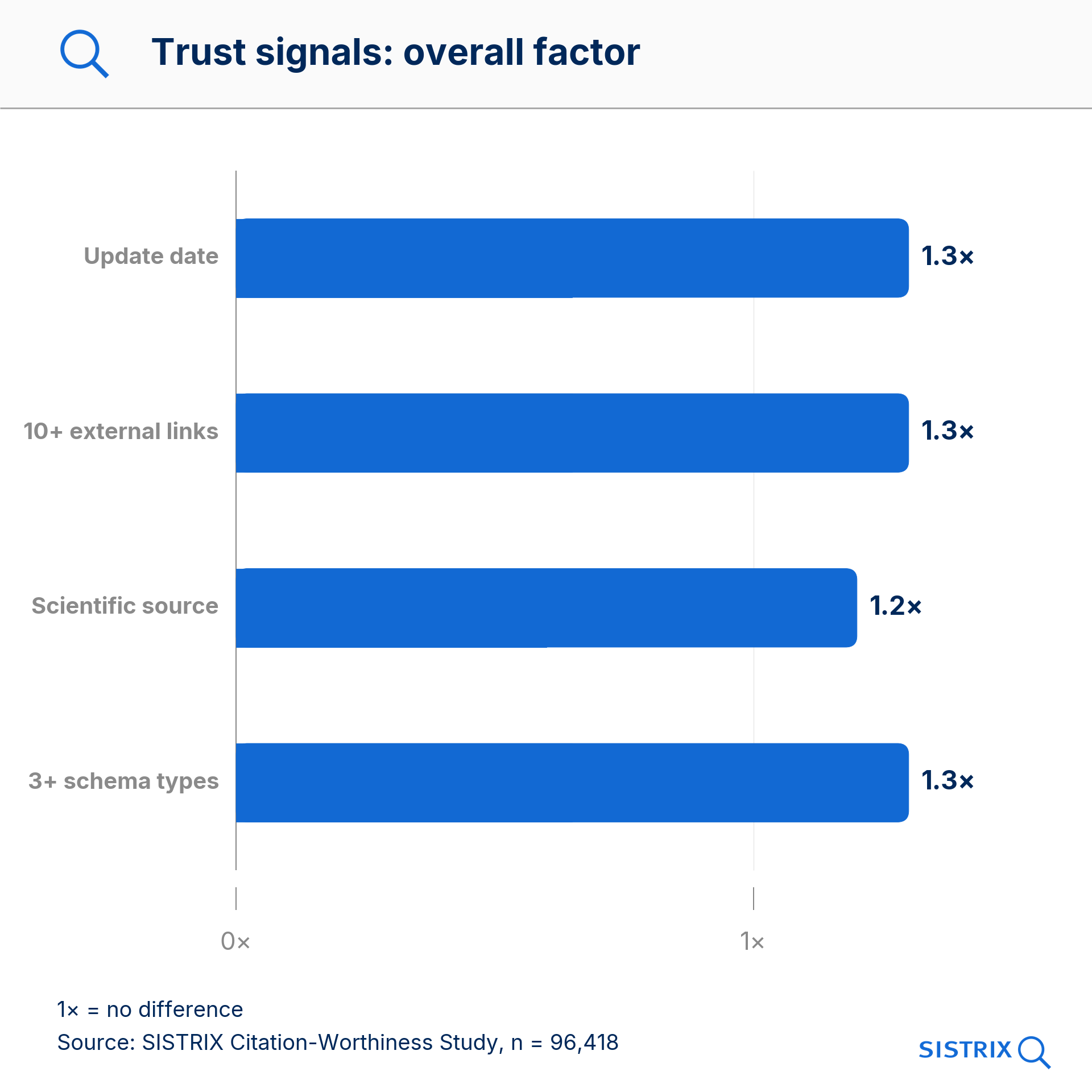
Pages with an author box and photo are cited 1.4 times as often. It doesn’t take much: a name, a photo, two sentences on the author’s expertise and Person schema. Pages with a visible last-updated date, at least ten external links or at least three different types of structured data are each cited 1.3 times as often. However, only 5 per cent of pages show a last-updated date, and how strongly it works depends on the domain type. More on that below.
Freshness: the year in the title
The highest value in the study goes to the current year in the title: pages with 2025 or 2026 in the title are cited 2.7 times as often, while pages with only an older year are cited just 0.7 times as often. That said, this is not a title trick. The year stands in for content that has been freshly created or maintained. Whether simply updating the year is enough cannot be determined from the data. In addition, this feature was not part of the originally planned analysis and was only added later. The value is therefore more of an initial indication than a confirmed result.
Overall: cited 2.1 times as often
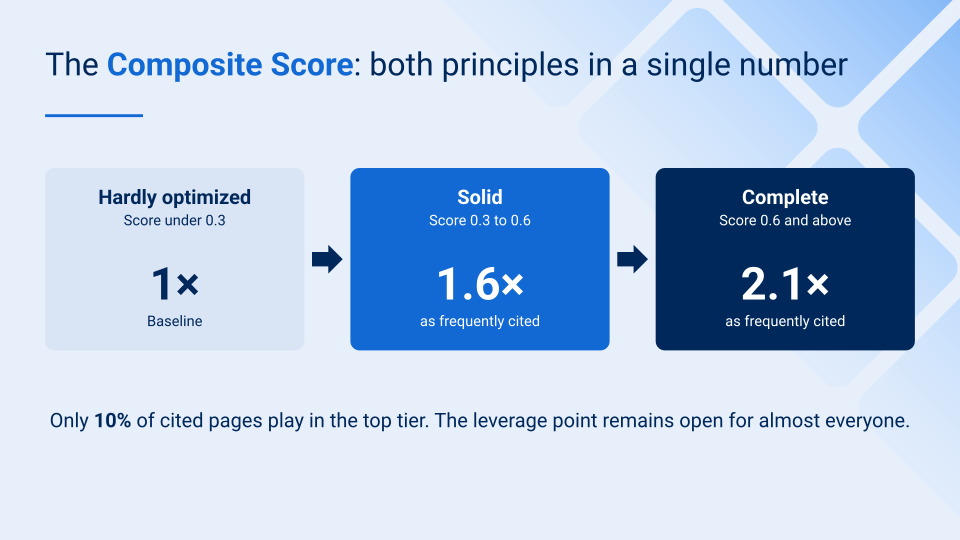
Individually, most signals have a moderate effect, but together they make a clear difference. To show this, we combined eleven of the features into an overall score. Pages that meet many of them are cited 2.1 times as often as barely optimised pages, and mid-range pages 1.6 times as often. Only 10 per cent of cited pages already meet many of the features, so almost all of them still have room for improvement.
All factors at a glance
| Feature | Citation factor |
|---|---|
| Current year in the title* | 2.7 |
| Table of contents | 1.7 |
| Article schema | 1.6 |
| At least five H2 headings | 1.6 |
| FAQPage schema | 1.5 |
| Table with a header row | 1.5 |
| Bullet lists (ten or more per page) | 1.5 |
| At least 1,000 words | 1.5 |
| Author box with photo | 1.4 |
| At least one question as an H2 | 1.4 |
| H1 with at least five words* | 1.4 |
| Visible last-updated date | 1.3 |
| At least three schema types | 1.3 |
| At least ten external links | 1.3 |
| TL;DR at the beginning | 1.3 |
| Title phrased as a question* | 1.3 |
| Title with at least 45 characters* | 1.3 |
| Meta description | 1.2 |
| Scientific source | 1.2 |
| Numbered lists | 1.2 |
| Expandable details blocks | 1.2 |
| At least 100 internal links | 1.2 |
| Title with a colon* | 1.2 |
| Images in the main content | 1.1 |
| Good readability (Flesch index) | 1.03 (not significant) |
| Breadcrumb, HowTo and QAPage schema | 1.0 |
| Title consisting only of the H1 plus a brand suffix* | 0.9 |
| Product schema | 0.8 |
| Only an older year in the title* | 0.7 |
| Recipe schema | 0.1 |
A factor of 1.0 means no difference. * Title and H1 features were analysed retrospectively and should be seen as initial indications.
What delivers less than expected?
llms.txt: no measurable advantage
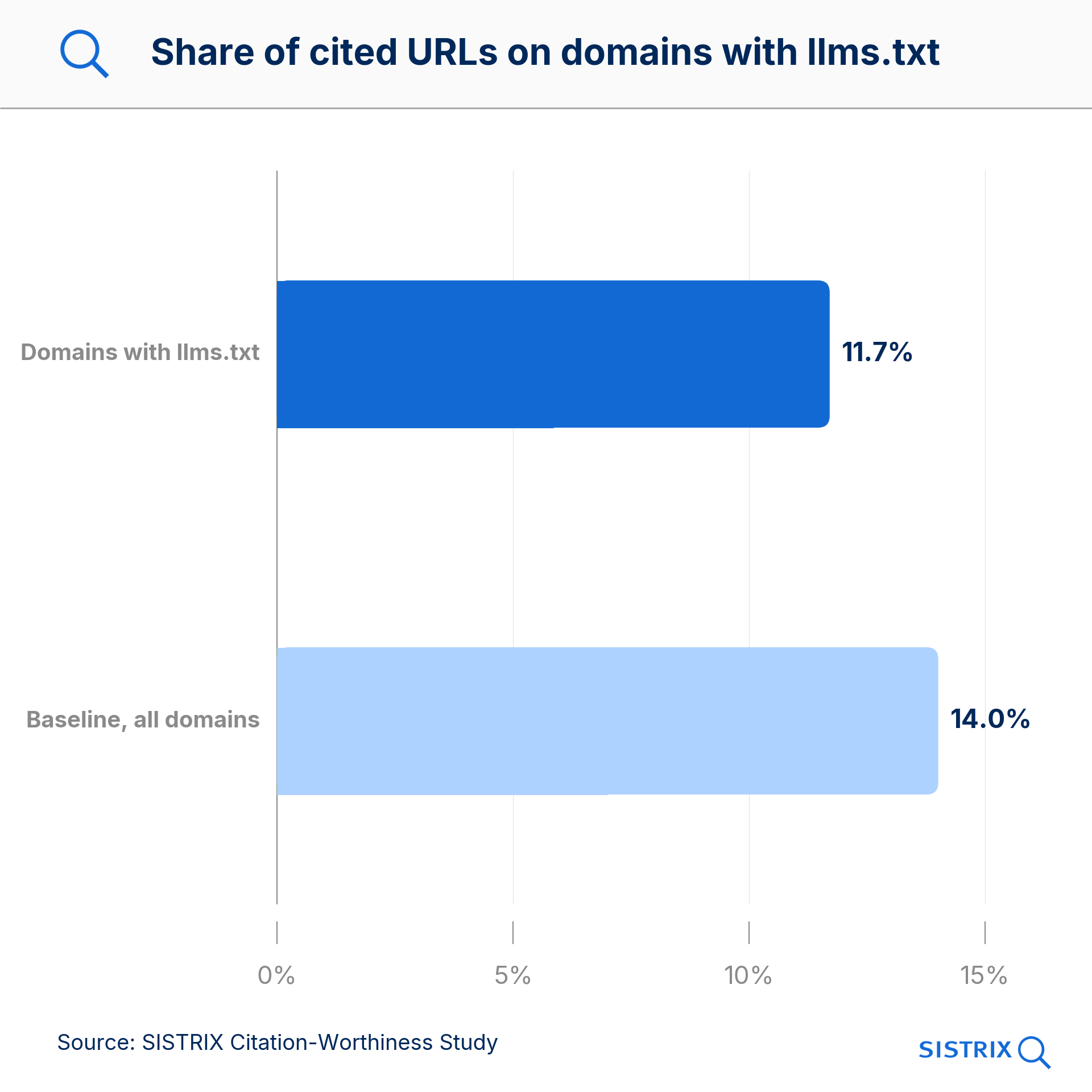
Few GEO topics have been debated as persistently this year as llms.txt. As things stand, there is no measurable effect on AI citations. Because the file applies to the entire domain, we made an exception here and compared domains with each other: of all cited URLs, 11.7 per cent come from domains with an llms.txt, while across all domains their share is 14.0 per cent. If anything, domains with llms.txt are less represented among the cited pages. Even so, this does not show whether the file does any harm, because the domains being compared also differ in many other respects. It shouldn’t be a priority, though.
Not all schema is equal
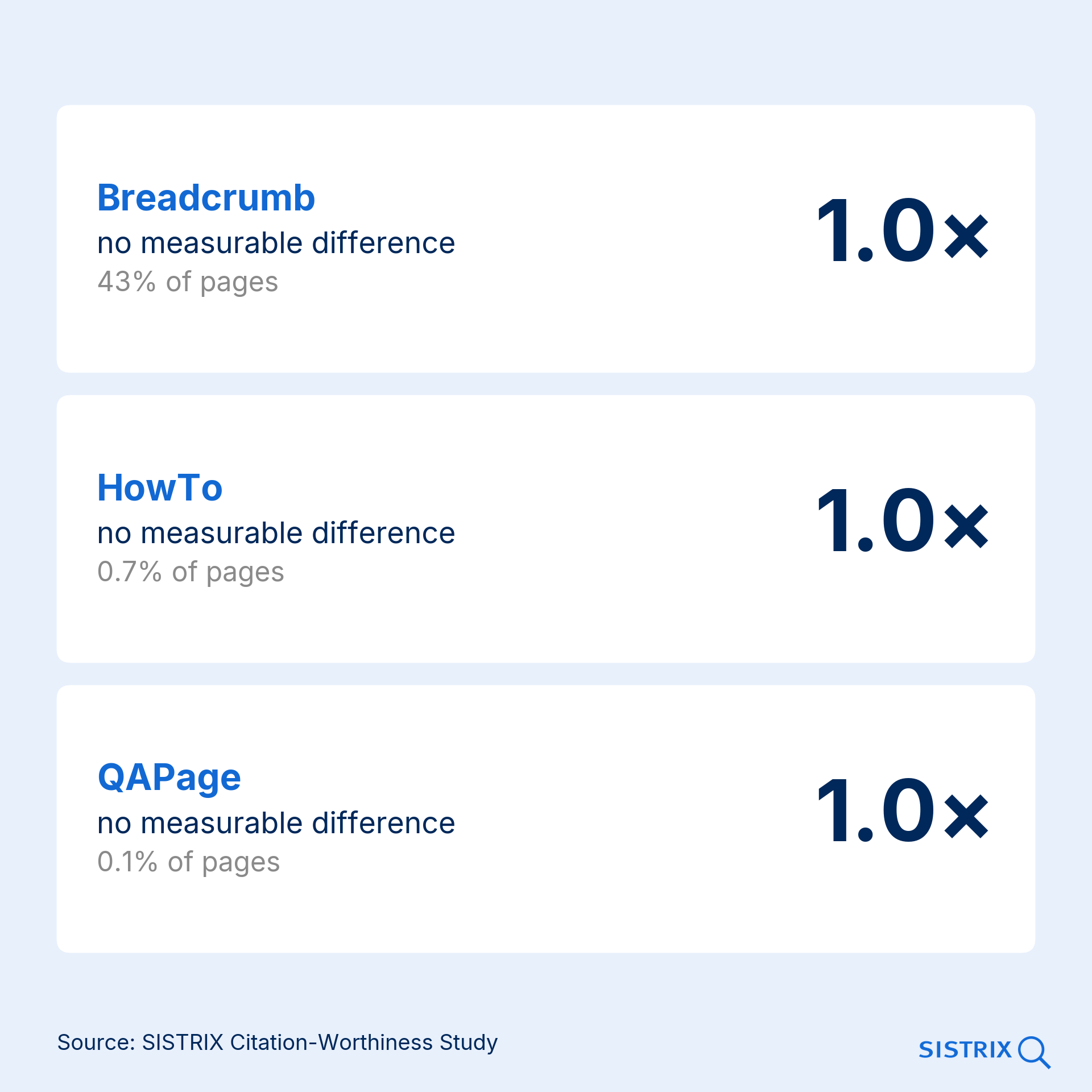
Structured data is often seen as a GEO wonder weapon. Breadcrumb, HowTo and QAPage markup, however, show no measurable difference (factor 1.0), even though breadcrumbs appear on 43 per cent of pages. They still make sense for classic search.
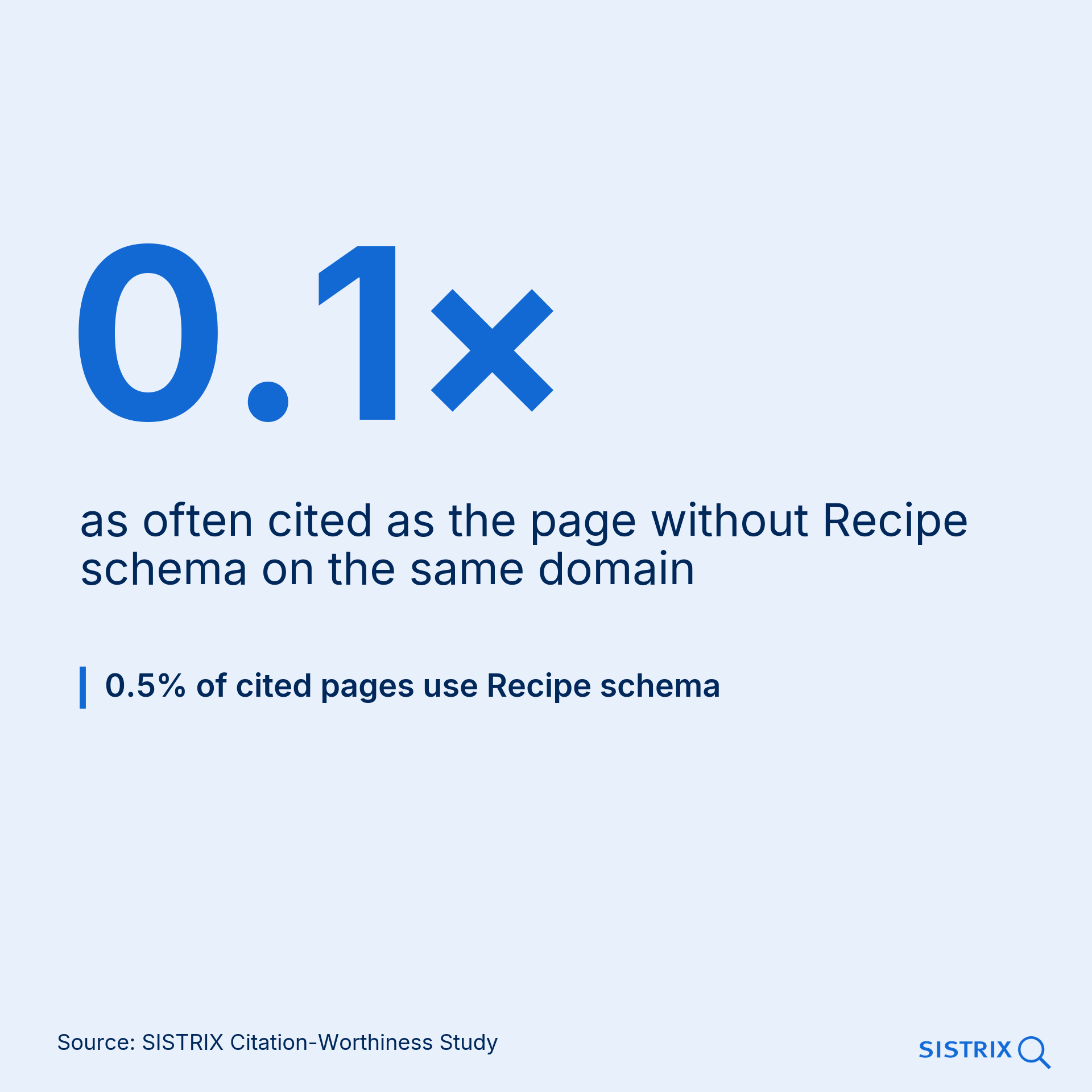
Recipe schema even stands out negatively: pages with this markup are cited only 0.1 times as often, and this applies to every industry for which there is enough data. Our hypothesis, which has not yet been validated: AI systems prefer to refer to a topic page rather than an individual recipe. For food publishers, it therefore makes sense to build topic and overview pages with Article schema as citation targets.
Product schema (0.8, or 0.5 for AI Overviews) and hreflang are associated with slightly fewer citations. Not a lever, but no cause for concern either: both have a purpose beyond GEO and should stay in place.
Readability: important for people, neutral for AI
Easy-to-understand texts remain important for readers. However, a good score on the Flesch index, which measures how readable a text is, does not make a page more citable. The factor of 1.03 is not significant.
Word count: symptom, not cause
Pages with at least 1,000 words are cited 1.5 times as often. However, longer texts usually also have more headings, tables and lists, so the value for length mainly reflects better structure. Covering topics comprehensively, yes. Writing to a word count, no.
Platforms and domain types: same principles, different weighting
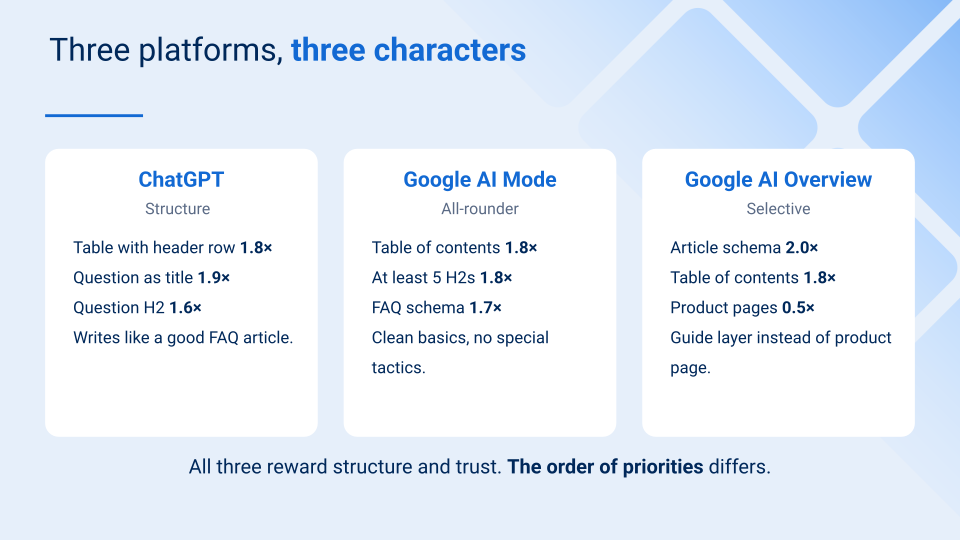
All three platforms reward structure and trust, but weight them differently. Beforehand, we had expected AI Overviews to respond most strongly to well-optimised pages. In fact, all three platforms are close together, with ChatGPT narrowly ahead and AI Overviews just behind. One hypothesis down.
- ChatGPT likes structure built around questions: pages with a title phrased as a question are cited 1.9 times as often there, pages with tables with a header row 1.8 times and pages with questions as H2 headings 1.6 times. Put simply, ChatGPT likes to cite content that is structured like a good FAQ article.
- AI Mode is the all-rounder. No single feature stands out, and clean basics pay off most reliably: pages with a table of contents or at least five H2 headings are each cited 1.8 times as often. There’s no need for special tactics here.
- AI Overviews are selective: pages with Article schema are cited twice as often here (2.0), whereas product pages are cited only half as often (0.5). What gets cited is mainly informational content rather than pages geared towards sales.
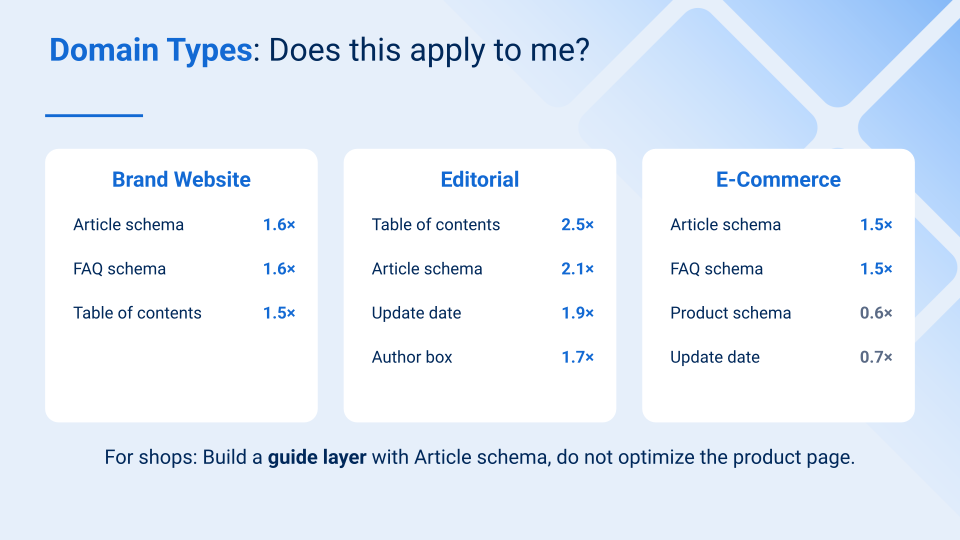
Which features are most strongly associated with citations also depends on the type of website. For brand websites, it is mainly Article and FAQ schema (1.6 each). On editorial sites, pages with a table of contents are cited 2.5 times as often and pages with a last-updated date 1.9 times as often. For online shops, it’s the other way round: a visible last-updated date is associated with fewer citations there (0.7), as is Product schema (0.6). For shops, an advice section with Article schema is therefore more promising than optimising product pages. Product schema shows particularly clearly how much the type of website matters: for SaaS providers, pages with it are cited 1.7 times as often, but for government websites only 0.1 times as often. Finally, for encyclopaedias, the optimisations show no effect at all when combined.
Conclusion: what you can put into practice from tomorrow
Small studies are quickly misleading, and comparisons of entire domains mainly measure brand strength. Within the same domain, however, the picture is clear: which page gets cited is measurably linked to on-page features. And what works follows two principles: structure for the machine, trust for the human. In practice, this can be summed up in an eleven-point self-audit:
- Belongs on every page: table of contents (1.7), Article schema (1.6), clear H2 structure (1.6), author box with photo (1.4).
- Where it fits the content: FAQ block with schema (1.5), table with a header row (1.5), TL;DR at the beginning (1.3), linked sources (1.3), last-updated date (1.3, especially for editorial content). None of these should be added artificially.
- Small but measurable: meta description (1.2), multiple types of structured data (1.3).
You can check which pages on your own domain are already being cited by ChatGPT, AI Mode and AI Overviews in SISTRIX.
And if you only do one thing: structure.
How we measured
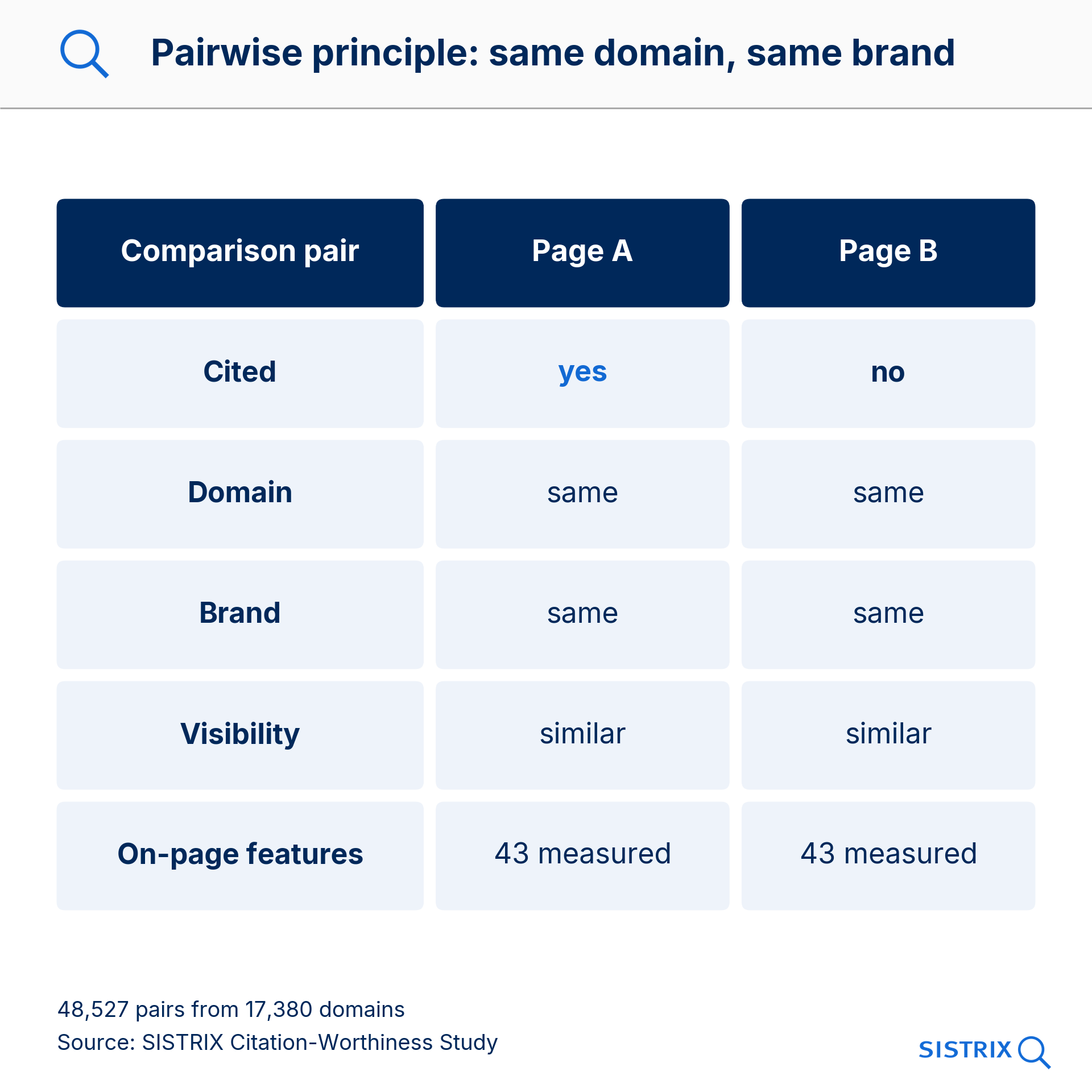
The analysis is based on 48,527 cited URLs from the SISTRIX AI Index for the DACH region in the second quarter of 2026, with around 16,000 each from ChatGPT, AI Mode and AI Overviews. Each cited page is compared with a non-cited page from the same domain. This means the strength of the domain and brand plays no role, leaving only what comes down to the page itself. In total, 96,418 URLs from 17,380 domains, each with 43 features, were included in the analysis. Incidentally, almost half of the cited pages are advice and how-to content (48.7 per cent), and most come from brand websites (38.7 per cent). Gemini 3.5 Flash handled the classification into domain and content types. A cross-check with Gemini 3.1 Pro showed 84 per cent agreement, and a sample of 100 pages was also checked manually.
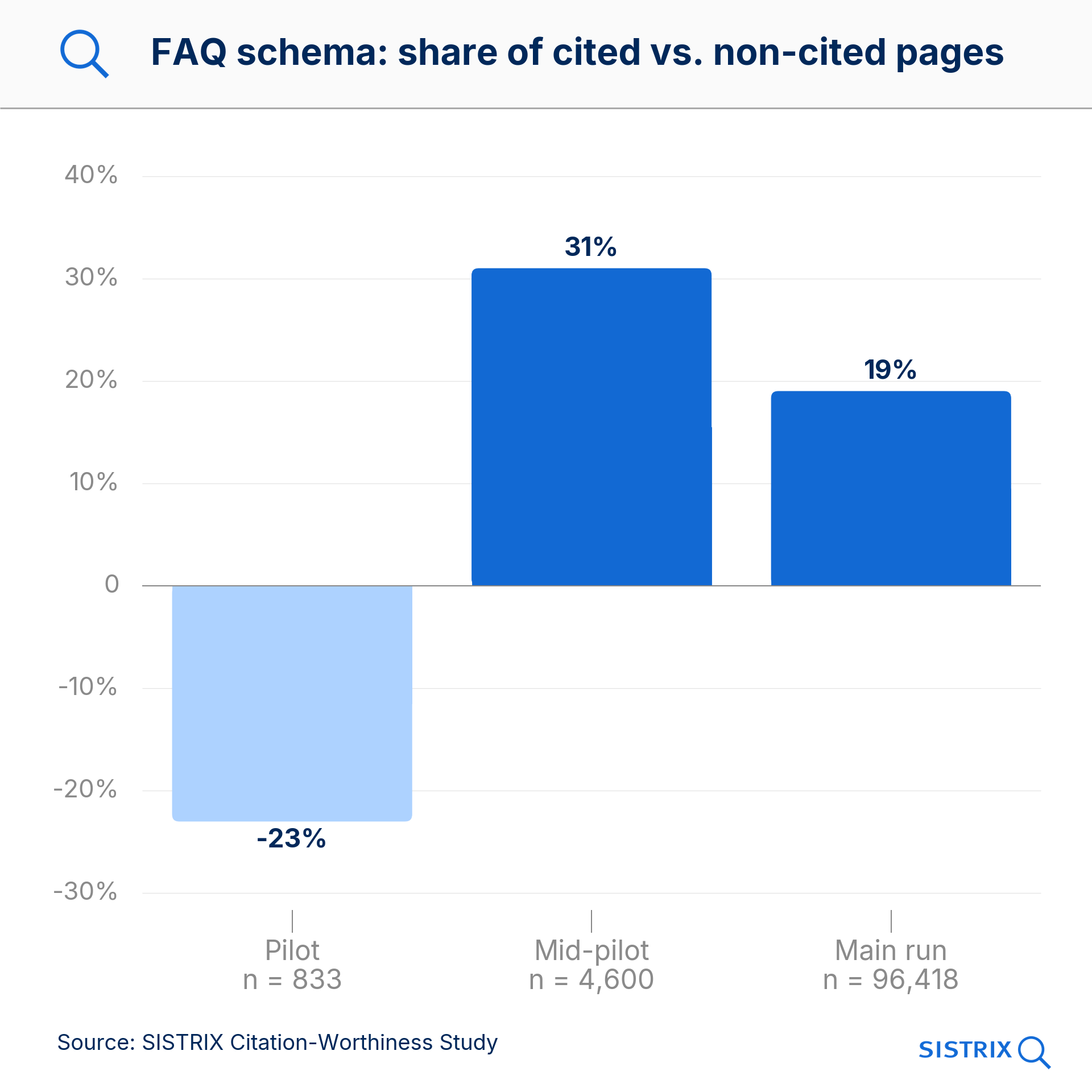
Our test runs showed how much the size of the dataset matters: at 833 URLs, FAQ schema was 23 per cent less common on cited pages, at 4,600 URLs it was 31 per cent more common, and at 96,418 URLs 19 per cent more common. Only from around 5,000 URLs onwards did the result reliably point in the same direction. This gives a simple rule of thumb for study size: Don’t trust a GEO study with fewer than 5,000 URLs. That applies to this study too: values for individual subgroups, such as government websites or encyclopaedias, are based on considerably fewer URLs and should be read with corresponding caution.
Like any study, this one has its limits: it shows correlations, not proven causes, and is a snapshot of the DACH region. Perplexity, Claude and Gemini chat were not included in the analysis. A follow-up study is planned.
FAQ: Frequently asked questions about the Citation Worthiness study
Citation Worthiness describes how likely it is that AI systems such as ChatGPT, AI Mode or Google’s AI Overviews will cite a page as a source.
Above all, a table of contents (cited 1.7 times as often), Article schema (1.6), FAQPage schema (1.5) and an author box with photo (1.4). Pages that combine many of these features are cited 2.1 times as often as barely optimised ones.
Not as things stand. There is no measurable effect on AI citations.
It depends on the schema type. Article and FAQPage schema are associated with significantly more citations, while Breadcrumb, HowTo and QAPage markup show no effect. Recipe schema is even associated with only a tenth of the chance of being cited.
Of two pages on the same domain, the page with a particular feature is cited X times as often as the one without. Technically, these are odds ratios, which, at a citation rate of around 1.4 per cent, are practically equivalent to the frequency ratio.
Using conditional logistic regression, which compares each cited page with a non-cited page from the same domain. Multiple testing across the 43 features is accounted for using the Benjamini-Hochberg correction. Title and H1 features were added retrospectively and should be seen as initial indications.
Test SISTRIX for Free
- Free 14-day test account
- Non-binding. No termination necessary
- Personalised on-boarding with experts