
Over the past couple of years, the search landscape for eCommerce has continued to evolve. Naturally, this has impacted women’s fashion. In our previous analysis, we highlighted how category pages and commercially focused content formats were still driving significant visibility despite early signals that Google was shifting towards a more product-led search experience.
- The Winners - Google organic search
- The Shirt Company - winning through specialisation and search alignment
- Simply Swim - scaling specialist expertise
- The Winners - AI search
- Who What Wear - becoming the source behind the recommendation
- InStyle - building authority through trusted fashion advice
- Summary & additional interesting observations
- AI recommendations are heavily influenced by a small number of publishers
- Brand visibility is shaped by the sources AI systems rely on
- What these findings mean for retailers & brands
Discover how SISTRIX can be used to improve your search marketing. Use a no-commitment trial with all data and tools: Test SISTRIX for free
While category coverage remains a key driver of visibility, and subsequently revenue generation, the latest data set suggests a shift away from scale-led retail dominance in Google organic search.
Large retailers still hold a significant share of the overall visibility in women’s fashion search results. However, when we apply the same methodology as before, a broader mix of brands now emerge as high performers. In particular, more niche brands and specialist retailers are appearing within the dataset, often outperforming larger competitors.
Rather than competing across entire product ranges, these brands are winning by focusing on specific niches and aligning with how users search. With smaller players often out performing large multi-category retailers for key head terms.
At the same time, the way users discover fashion online is becoming more fragmented. Google organic search remains critical for capturing commercial intent. But it now sits alongside a growing number of touchpoints, largely AI-driven search experiences. AI search currently sits predominantly in the discovery and evaluation phases of user journeys. Yet in the future, with the rise of agentic search, these platforms (and Google’s own AI mode) are looking to provide shopping experiences in-platform. I see this as the biggest shift yet to happen within eCommerce.
In this analysis, we’ve taken the same keyword set used in our previous study and applied our High Performance Content Format (HPCF) methodology to identify the directories performing most efficiently in organic search.
To complement this, we also generated a separate AI search dataset using prompts derived from People Also Ask questions associated with our keyword set. This allowed us to analyse which brands, publishers and websites are most frequently surfaced as recommendations and sources across modern AI search experiences.
Together, these two datasets provide a broader view of visibility in 2026. One shows who is capturing commercial demand within Google, while the other highlights who is influencing purchase decisions during the research phase.
The Winners – Google organic search
As with previous Visibility Leaders analyses, we used our High Performance Content Format (HPCF) methodology to identify directories that consistently outperform their competitors.
Rather than looking at total visibility alone, HPCF focuses on efficiency. Specifically, the proportion of ranking keywords that appear on page one of Google. This allows us to identify content formats and site structures that are performing exceptionally well within a given area of search, regardless of the overall size of the domain.
One of the more interesting findings from this year’s analysis was the number of specialist retailers appearing amongst the highest performing directories. While large retailers continue to dominate overall visibility, the strongest performers at a directory level were often brands with a narrower focus and deeper category expertise.
The Shirt Company – winning through specialisation and search alignment
The Shirt Company’s /collections/ directory is the small winner for Google organic search within this year’s women’s fashion dataset. As the name suggests, The Shirt Company specialises in shirts, operating within a much narrower product range than many of the larger retailers it competes against.
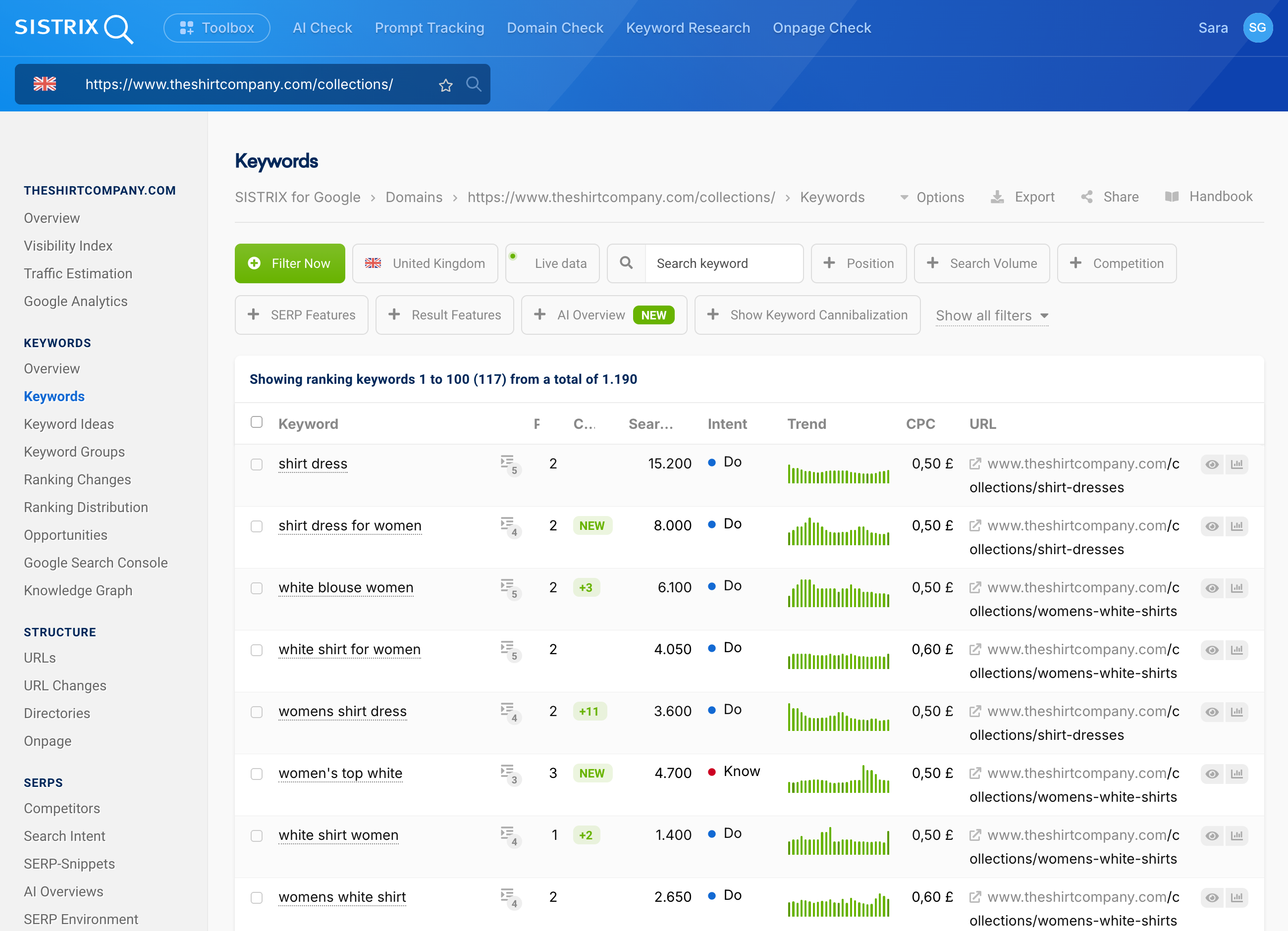
Despite this, the directory performs exceptionally well. Currently, over 80% of its ranking keywords appear on page one of Google, generating an estimated 12,000 monthly clicks from organic search. More notably, many of these rankings sit ahead of significantly larger fashion retailers including ASOS, Next, New Look, Zara and Marks & Spencer for relevant shirt-related searches.
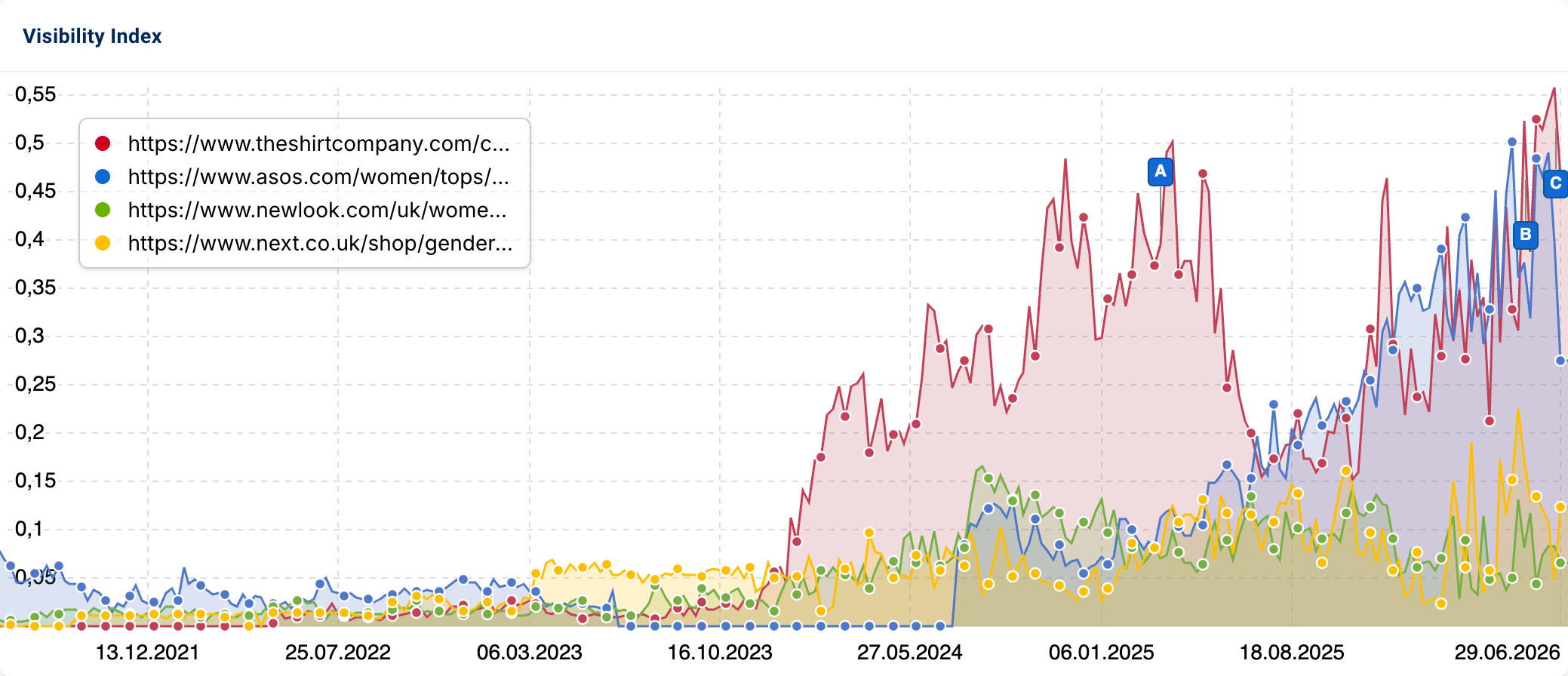
Unlike many larger retailers, The Shirt Company does not need to spread authority and optimisation efforts across hundreds of product categories. Instead, the site is able to focus almost entirely on a specific area of women’s fashion, creating strong alignment between its category structure, product offering and the way users search.
What The Shirt Company are doing well:
- Clear category alignment with search demand, focusing on shirt-related product categories and variations that closely reflect how users search.
- Strong topical relevance throughout the directory, with products, supporting content and navigation all reinforcing the site’s expertise within its niche.
- A clean and easily crawlable category structure that allows authority to flow efficiently throughout the collection pages.
- Consistency across the directory, ensuring that even deeper category pages receive the same level of optimisation and attention.
In summary, The Shirt Company demonstrates how specialist retailers can compete effectively against much larger brands. By focusing on a clearly defined niche and aligning its category structure closely with user demand, the site achieves exceptional visibility efficiency within organic search.
Simply Swim – scaling specialist expertise
Simply Swim’s /collections/ directory is the large winner for Google organic search within this year’s women’s fashion dataset. Unlike many of the larger retailers appearing throughout the analysis, Simply Swim remains highly specialised, focusing almost entirely on swimwear and swimming related products.
The directory currently ranks on page one for almost 75% of its ranking keywords, generating an estimated 126,000 monthly clicks from organic search. Across the directory, there are over 4,600 page one rankings, making it one of the most efficient large content formats within the entire dataset.
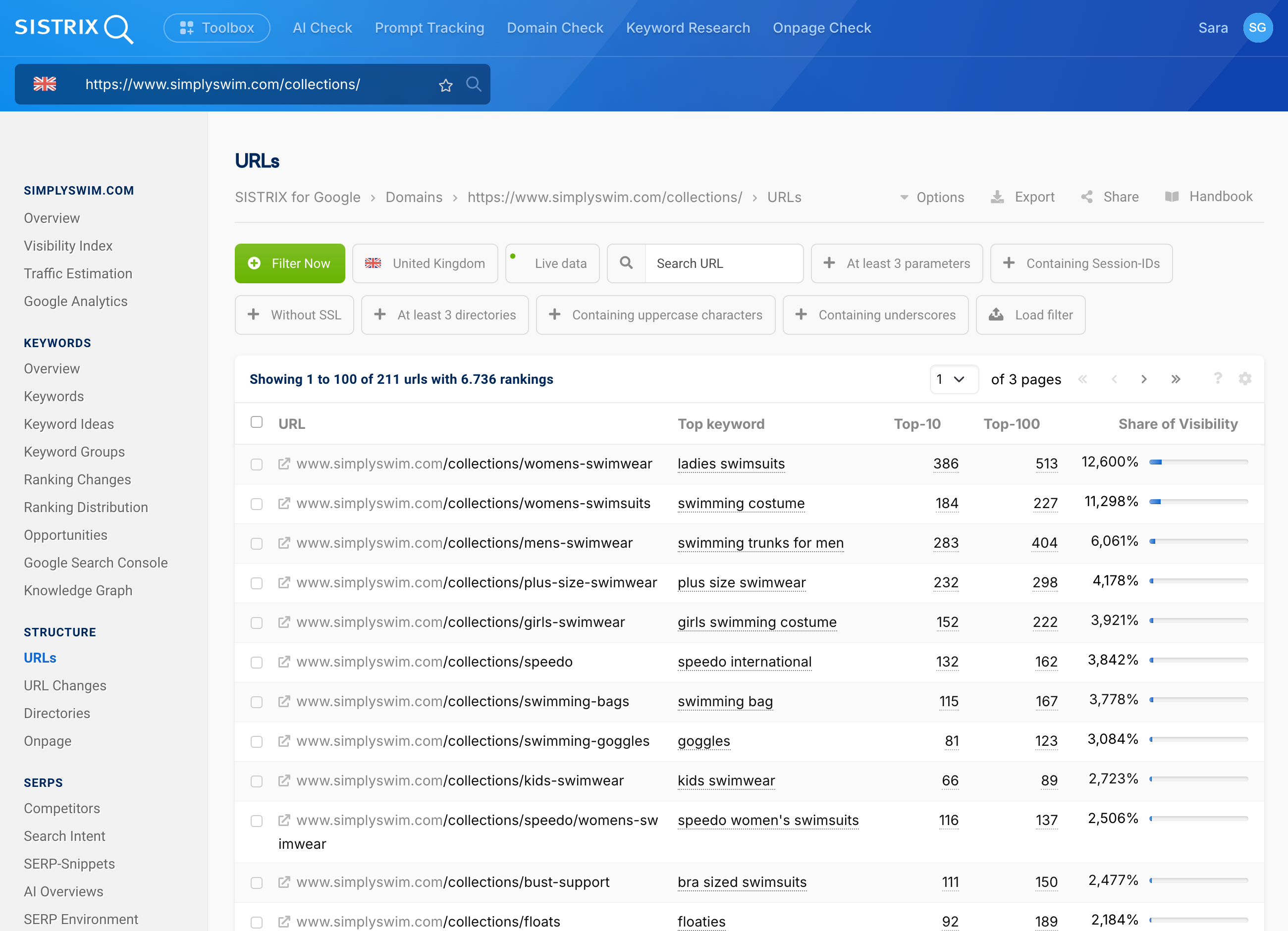
What makes this particularly interesting is the level of competition within the category. For many of their highest performing searches, Simply Swim is competing directly against much larger retailers including Next, Marks & Spencer, Sports Direct and Debenhams. Despite the disparity in overall site size, Simply Swim consistently achieves stronger visibility across swimwear related searches.
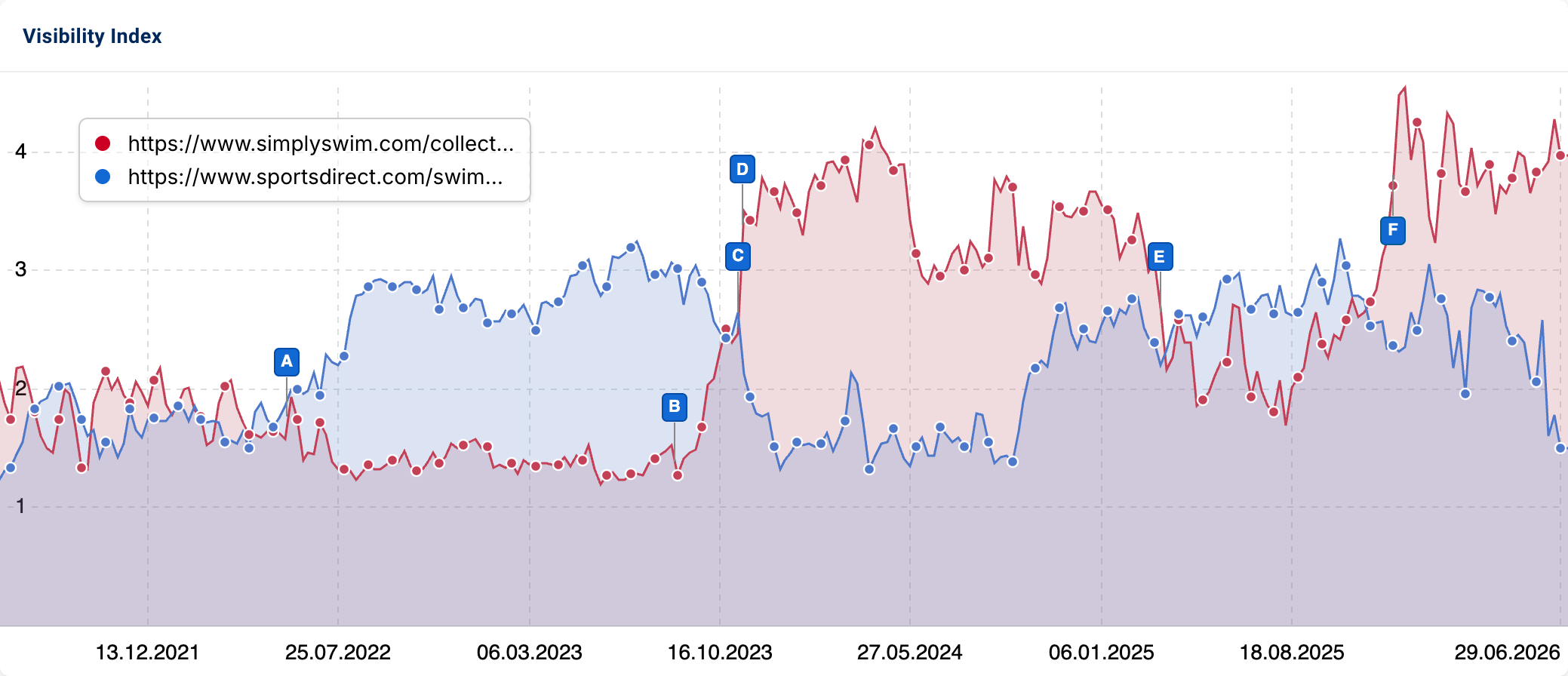
Looking through the directory, the same themes begin to emerge that we saw with The Shirt Company. Rather than attempting to cover every area of fashion, Simply Swim has built significant depth within a specific niche. This allows them to create a category structure that closely mirrors search demand, while maintaining a level of detail and optimisation that would be difficult for larger retailers to replicate across their entire product catalogue.
What Simply Swim are doing well:
- Extensive category coverage across swimwear and swimming related products, ensuring they have dedicated landing pages for a wide range of relevant searches.
- A well-structured category hierarchy supported by clear internal linking throughout the site.
- Strong alignment between product categories and search demand, allowing them to capture both broad and highly specific searches.
- Visible trust signals throughout the purchasing journey, including customer reviews, delivery information and customer service messaging.
- Consistent optimisation across the directory, ensuring deeper category pages receive the same level of attention as higher volume categories.
In summary, Simply Swim demonstrates how specialist retailers can successfully scale within organic search. By combining deep category expertise with broad coverage of a single niche, they have built a directory capable of competing with much larger retailers while maintaining exceptionally strong visibility efficiency.
The Winners – AI search
While Google organic search remains the primary mechanism for capturing commercial demand, it no longer represents the full search journey.
For many fashion-related purchases, users now spend time researching products, comparing options and seeking recommendations through AI-powered search experiences. Whether that is ChatGPT, Perplexity or Google’s own AI Mode, these platforms are increasingly influencing purchasing decisions before a user ever visits a retailer’s website.
To understand which websites are benefitting from this shift, we created a supplementary AI search dataset using prompts derived from People Also Ask questions associated with our original keyword set.
Rather than measuring rankings, this analysis focuses on retrievals and citations. In simple terms, we wanted to understand which websites AI systems repeatedly use as sources when generating answers and recommendations.
One of the clearest patterns within the data was that visibility is concentrated around a relatively small number of publishers, review sites and content creators. While retailers and brands do appear, they are rarely the primary source used to construct responses.
Looking at the most frequently cited domains, websites such as Who What Wear, InStyle, Vogue and Woman & Home appeared consistently across a wide range of prompts. This suggests that AI systems rely heavily on recommendation content, buying guides, product roundups and editorial style advice when generating responses.
Who What Wear – becoming the source behind the recommendation
Who What Wear is the large winner for AI search visibility within this year’s women’s fashion dataset. Across the prompts analysed, the website was cited 228 times, with 64 individual URLs appearing as sources within AI generated responses.
They are influencing purchasing decisions through editorial content that helps users evaluate products, compare brands and discover new trends.
A significant proportion of the URLs retrieved from Who What Wear follow a familiar format. Product roundups, style guides, trend analysis and recommendation content all appear heavily throughout the dataset. These content formats are particularly effective within AI search because they already perform a similar role to the AI system itself: aggregating information, comparing options and helping users make decisions.
What Who What Wear are doing well:
- Extensive coverage of fashion trends, products and styling advice across a wide range of topics.
- Strong use of comparison and recommendation content formats that naturally align with AI generated answers.
- Content written from a position of expertise, often including personal experience, editorial commentary and product testing.
- Clear content structure that makes information easy to extract and reference.
- Consistent publication of new content, allowing the site to capture emerging trends quickly.
In summary, Who What Wear succeeds because it creates the type of content AI systems need to answer fashion-related questions. Rather than acting as a destination for transactions, the site has become a trusted source of recommendations and product discovery.
InStyle – building authority through trusted fashion advice
InStyle was the second strongest publisher within our AI search dataset, receiving 190 citations across the prompts analysed and appearing consistently across a broad range of fashion related topics.
Much like Who What Wear, InStyle’s visibility is not driven by product pages or traditional eCommerce content. Instead, the site performs particularly well because it publishes the type of content users turn to when researching purchases, evaluating products or looking for expert recommendations.
Across the retrieved URLs, a clear pattern emerges. Buying guides, product recommendations, trend roundups and expert-led advice features account for a significant proportion of the content being surfaced. These formats are particularly well suited to AI search because they provide structured information, comparisons and clear recommendations that can be easily incorporated into generated answers.
What InStyle are doing well:
- Publishing recommendation and buying guide content across a broad range of fashion and beauty categories.
- Combining editorial expertise with practical product advice and reviews.
- Creating content that directly addresses common research and consideration stage questions.
- Using clear structures, lists and summaries that make information easy for both users and AI systems to interpret.
- Maintaining strong topical authority across key fashion and lifestyle themes.
InStyle’s success highlights the growing importance of trusted editorial content within AI search. While retailers continue to compete for visibility at the point of purchase, publishers such as InStyle are increasingly influencing decisions earlier in the journey by providing the information AI systems rely on to generate recommendations.
Summary & additional interesting observations
AI recommendations are heavily influenced by a small number of publishers
One of the clearest patterns within the dataset was the influence a relatively small number of publishers have over AI-generated recommendations.
Across hundreds of fashion-related prompts, websites such as Who What Wear, InStyle, Vogue and Woman & Home appeared repeatedly as cited sources. Whilst retailers and brands were regularly mentioned within responses, the information supporting those recommendations often originated from these publisher websites.
This is an important distinction. For brands looking to improve AI visibility, understanding who is being recommended is only part of the equation. Understanding where AI systems are sourcing those recommendations from may be even more valuable.
Many of the most frequently retrieved pages were product roundups, buying guides, trend features and comparison articles. In other words, the content helps users evaluate options before making a purchase.
For retailers, this creates a new visibility challenge. Success is no longer limited to ranking your own website. Increasingly, it may also depend on being featured within the publications and sources that AI systems rely upon when generating recommendations.
Brand visibility is shaped by the sources AI systems rely on
Whilst publisher citations were the clearest pattern, brand mentions showed another interesting trend.
Many of the brands appearing frequently within AI-generated responses were strongly associated with specific categories, use cases or audiences. Examples included brands such as Lululemon, Gymshark, Hoka, Patagonia, Arc’teryx and Canada Goose.
However, this does not necessarily mean AI systems are independently favouring specialist brands. A more likely explanation is that brand visibility is being shaped by the sources used to generate the answers.
If AI systems are relying heavily on publisher content, then the brands mentioned within that content naturally have a greater chance of appearing in AI-generated recommendations. This could favour brands with stronger products, clearer category positioning, greater editorial coverage or more effective PR.
For retailers, this reinforces the importance of understanding the citation layer behind AI search. Visibility is not only influenced by your own website, but also by how often your brand appears within the trusted third-party sources AI systems use to form recommendations.
What these findings mean for retailers & brands
Whilst Google organic search and AI search operate differently, both reward businesses that provide detailed, trustworthy information within their areas of expertise.
The Google winners in this study succeeded by creating highly relevant category experiences that aligned closely with user demand. They demonstrated deep coverage of their specialist areas, clear site structures and content that helped users find the right products.
Within AI search, a similar pattern emerged. The sources most frequently cited were those providing detailed product recommendations, comparisons, reviews and expert guidance. Rather than simply listing products, these websites helped users evaluate options and make purchasing decisions.
For retailers, the opportunity is to think beyond their own website.
Creating comprehensive category content, detailed product information and expert buying guidance remains important for organic search visibility. However, brands should also consider how that expertise is represented across the wider web. Editorial coverage, product reviews, buying guides, comparison content and third-party recommendations all contribute to the information ecosystem that AI systems increasingly rely upon.
The retailers most likely to succeed will be those that not only demonstrate expertise on their own platforms, but also ensure that expertise is reflected within the publications, reviewers and industry sources influencing AI-generated recommendations.
Test SISTRIX for Free
- Free 14-day test account
- Non-binding. No termination necessary
- Personalised on-boarding with experts