


Visibility Leaders brings you the winning domains, brands and URLs from the food and drink sector. This is the deep analysis of the leading domain and brand entities found in the food and drink sector research.
- The Winners in Organic Search
- FineFoodSpecialist.co.uk
- EpicerieCorner.co.uk
- The Winners in AI search citations
- Tesco.com
- Ocado.com
- Summary & additional interesting observations
- Grocery search isn't product research, it's fulfilment research
- There's a lot of demand sat outside generic product search
- Organic and AI visibility are held by different companies
- There isn't much of a specialist middle ground in UK grocery
- There are some HPCF’s from large supermarkets but they’re largely brand driven
- The people selling the products are the ones getting cited
Discover how SISTRIX can be used to improve your search marketing. Use a no-commitment trial with all data and tools: Test SISTRIX for free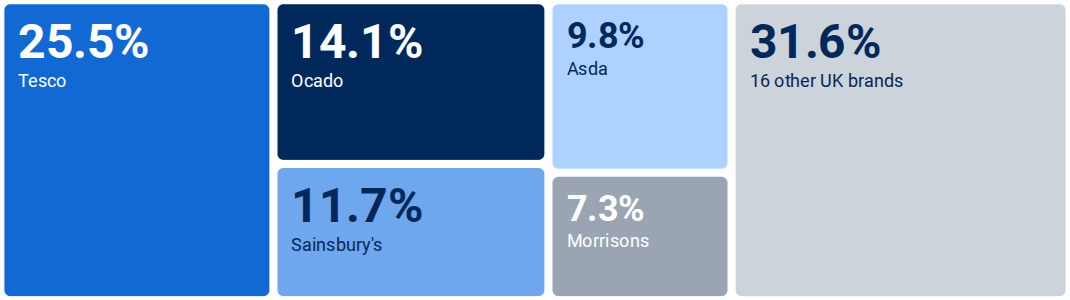
The winners in this study look familiar – A site selling fresh truffle and Japanese wagyu, and a site selling French groceries you can’t get in a UK supermarket. Both have a narrow focus and deep category coverage. That’s the pattern we see in most Visibility Leaders analyses and it holds here.
What’s different is who isn’t winning? The supermarkets own almost all the commercial demand in food and drink and they do appear in the directory set, but none of them takes a top spot. Their performance is also skewed by brand demand.
Part of that is just how the metric works. We measure the proportion of a directory’s ranking keywords that sit on page one, so a site covering every category in the shop is carrying a lot of pages that are never going to get there. Breadth works against you here. That’s not the whole story though, and the rest of it comes down to how people search for food.
The short version is that general grocery search isn’t product research, it’s fulfilment research. In fashion or consumer electronics the search is the decision, you’re working out what to buy. In grocery, the customer generally knows what they want already.
As with previous analyses we’ve used our High Performance Content Format methodology to find the directories performing most efficiently. The keyword set surfaces the candidates, so any directory ranking for terms in it comes into the dataset, and each one is then measured on the proportion of all its ranking keywords that sit on page one rather than on total visibility. The keyword set itself is built around the products in the UK’s RPI shopping basket, expanded to cover natural product searches, category terms and transactional variants.
Alongside that we built a second dataset for AI search, using transactional prompts generated from the same keyword universe and run across ChatGPT and Google AI Mode. That one measures citations rather than rankings, showing which websites the models actually use to build an answer.
Also available: 105 leading directories from the food and drink sector.
The Winners in Organic Search
FineFoodSpecialist.co.uk
The large winner for Google organic search is Fine Food Specialist with their /collections/ directory. They’re an online retailer selling luxury and hard to find ingredients, such as fresh truffle, caviar, Japanese wagyu, foie gras, wild mushrooms and similar, largely to chefs and home cooks who can’t pick these things up in a supermarket.
The directory ranks for 3,907 keywords in the UK with 62.5% of those sitting on the first page of Google. It’s estimated to bring in around 92,000 clicks per month, which is 34% of all organic traffic to the site. Domain visibility has also grown from 2.99 to 3.79 since December, so this directory is still growing.
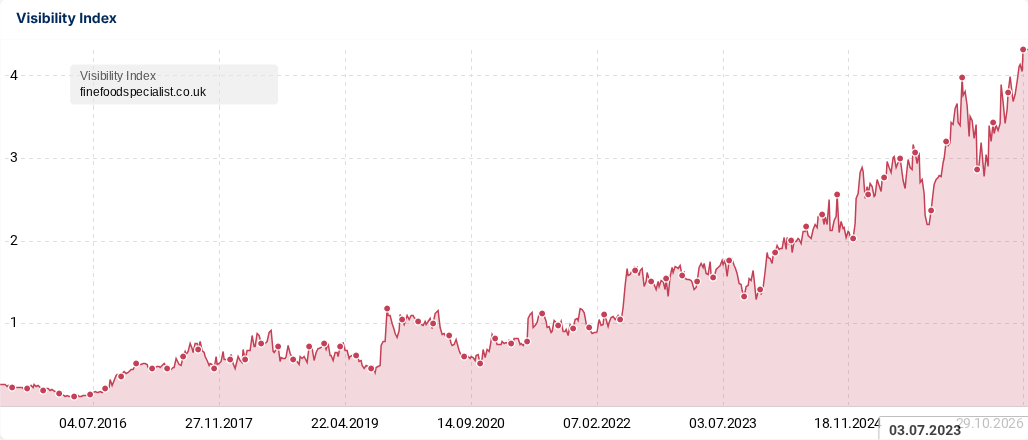
What makes this one interesting is who they’re not competing with. They rank first or second for caviar, white truffle, black truffle, Japanese wagyu, foie gras, iberico pork, girolles, morels and bluefin tuna. Across those SERPs there isn’t a single supermarket in the results. The competition is entirely other specialists, such as Wiltshire Truffles, TruffleHunter, Attilus Caviar and Dukeshill.
That’s a supply gap rather than a ranking gap. Tesco and Sainsbury’s aren’t ranking badly for truffles, they have no page to rank at all, because they don’t sell them. Where supermarkets do stock the product the picture changes, on “dried mushrooms” Fine Food Specialist are first and Tesco appear at 17th, behind four other specialists.
So, what are Fine Food Specialist doing well?
- Category coverage, the Japanese wagyu page sits alongside separate collections for wagyu beef, wagyu steaks, wagyu ribeye, sirloin, fillet and specialist beef. Truffles work the same way, with white truffle, fresh truffle, black and white truffles, fresh and frozen, and luxury truffle products all getting their own page.
- Internal linking does a lot of the work. Category pages carry an “our range” module linking across to the related collections, there’s a recommended products module on most of them, and a classic SEO footer pointing out to the rest of the range.
- On-page copy is more detailed than the competition and clearly written with search in mind. The final heading in the copy block on the wagyu page is “buy Japanese wagyu online”, so they’re covering the transactional variant on the category page rather than leaving it to the product pages.
- FAQs are used selectively. Black truffles has them and white truffle doesn’t, which suggests the effort goes into the categories that earn it. The bluefin tuna page is the clearest example, it ranks for “bluefin tuna price” and the second FAQ on the page is “how much does bluefin tuna cost in the UK”.
- Social proof is there through a site-wide review rating that appears on every category page and opens a pop-up with the detail. Product reviews sit on the product pages and aren’t pulled through to the category pages, though with the category pages doing the winning that matters less here than it would elsewhere.
- The filtering is the weak spot. It’s availability and price and not much else, so the performance is coming from structure and content rather than the browsing experience.
It’s worth noting that the competition doesn’t line up one for one. Most of the sites they’re up against are meat only, or meat with a few accessories alongside, with Fine & Wild the main exception. Fine Food Specialist are covering a whole category where their competitors are covering a slice of it.
In summary, Fine Food Specialist are in a fairly carved out niche. There aren’t many large players in luxury ingredients and the supermarkets aren’t in the category at all. What separates them is that they’re also ahead of the other fine food specialists they do compete with. The category coverage, the internal linking and the FAQs that map onto real search demand are all deliberate. I think that’s the best way to explain this one, they take organic search seriously and it shows.
EpicerieCorner.co.uk
The small winner is Épicerie Corner with their /collections/ directory. They’re a UK based online French grocer, stocking the everyday brands you’d find in a French supermarket but can’t easily buy here.
Their /collections/ directory ranks for 1,350 keywords with 56% of those on page one, bringing in an estimated 7,800 clicks per month. This directory is 17.7% of their organic traffic rather than the bulk of it, their product pages and homepage carry more, so the efficiency here sits in a smaller slice of the site than with Fine Food Specialist.
Domain visibility has roughly doubled since April, from 0.27 to 0.55, so this is a small site that’s growing quickly.
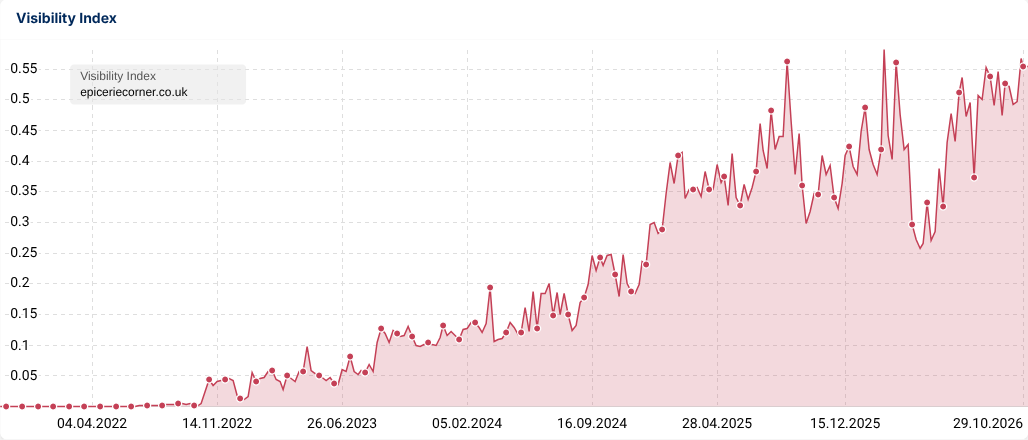
Their winning keywords are almost all French brand names like Teisseire, Blédina, Carambar, Carte Noire, Ducros, Kiri, Lutti, Justin Bridou and Champomy, alongside a smaller group of generic terms like “french butter” and “french biscuits uk”.
That’s a different gap to Fine Food Specialist. It’s a distribution gap rather than a product gap, these are mainstream products in their home market that simply aren’t sold here. The mechanism is the same though, demand that exists in the UK with no mainstream route to buy it. Where supermarkets do compete they lose, on “french butter” Épicerie Corner are first and M&S are ninth.
So, what are Épicerie Corner doing well?
- The navigation is basic and they seem to lean on site search for actual users. For a crawler it’s a different story, the internal linking is doing the work the nav isn’t.
- Click depth is the thing they’ve got right. Every main category page sits about two clicks from the homepage, helped along by a French food brands page that is essentially a wall of internal links.
- Category coverage is broad for what is a pretty small niche. Drinks splits into water, milk, cordials, soft drinks and fizzy drinks, and cordials splits again into berry, citrus and mint through quick links at the top of the page.
- Those quick links are all category level, and there’s no filtering producing static URLs, so everything that ranks is a collection page somebody has deliberately created rather than a facet Google has found.
- The /collections/ directory has 241 ranking URLs, though the domain as a whole holds 1,699 URLs in the top 100 with 1,247 of those in the top 10. It’s likely they have more collection pages than that, in which case the rest simply aren’t ranking.
- Competition is thin on the terms they win. On Teisseire they may well be the only UK retailer carrying the French version at that range and stock depth, and the SERPs behind these terms aren’t heavily contested.
This is a very different win to Fine Food Specialist. There’s no deep on-page copy, no FAQ layer and the user experience is more basic. Épicerie Corner are winning on site structure and on carrying a range nobody else does, which is arguably the purest example of the point this analysis keeps coming back to.
In summary, Épicerie Corner’s site is fairly basic, and if a supermarket picked up distribution on their most popular lines they would very likely lose most of that traffic. What they do have is a lot of authority in imported French groceries, and a linking structure that gets deep, niche categories surfaced. They’re winning on range, with the site making sure that range gets found. That’s a different thing to out-performing your competition on SEO quality.
The Winners in AI search citations
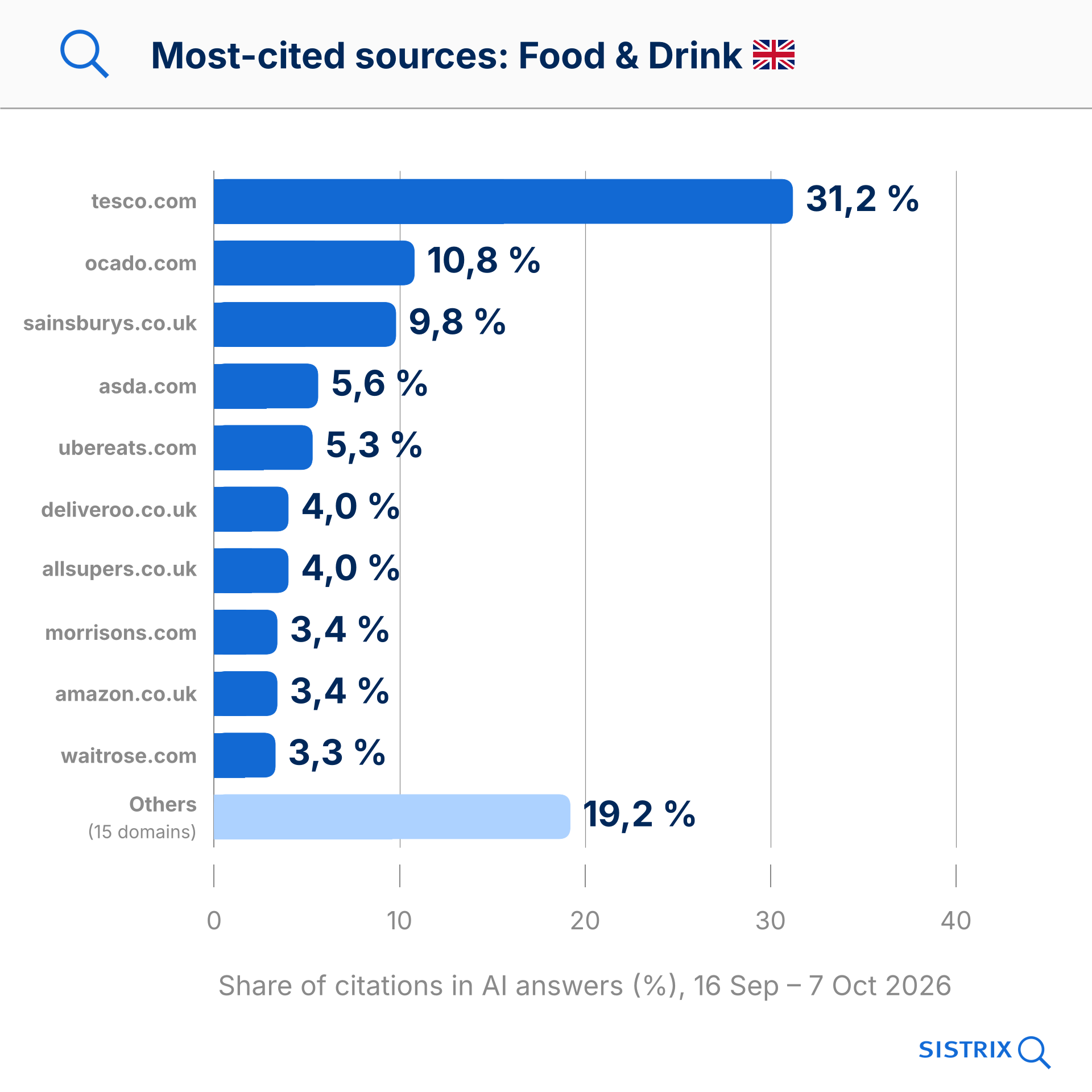
For the AI dataset we’re not measuring rankings, we’re measuring which websites the models repeatedly use as sources when they build an answer. The two winners are the two most cited domains across the prompt set.
The headline is that the top of the list is almost entirely retailers and delivery services, and the highest placed publisher is Which? down in 11th.
Tesco.com
Tesco is the most cited source by a long way, 610 citations and cited in all prompts, which is more than Ocado, Sainsbury’s and Uber Eats put together.
The pages being cited are the interesting part. They’re operational rather than commercial, e.g. the Whoosh rapid delivery zone, a “how to do online shopping” guide and internal search results pages. A handful of these keep reappearing across completely unrelated prompts.
Tesco is also cited far more often than it’s named as a brand, 610 citations against 237 brand mentions, so the models are using Tesco pages as source material rather than simply recommending them.
What Tesco are doing well:
- Internal search is left open to crawlers. A query like “clementines” returns a page listing fifteen matching products with names, prices and unit pricing as plain text, and the page is set to index. Most retailers noindex internal search or block it outright. I’m not entirely sure this is intentional as their search is canonicalised to the root, but it’s working in their favour.
- Product data is readable. Names, prices, promotions and availability all come through as text rather than sitting behind JavaScript, so there’s something there for a model to actually take.
- They hold real organic visibility on branded grocery terms, so the product pages back up the search pages. A lot of what gets cited is exactly that, the potatoes page, the Walkers crisps page.
- The operational content is there too. The Whoosh delivery zone and the how to shop online guides answer the service half of these prompts, which is a good chunk of them.
In summary, Tesco have built a site where any product query a user can think of resolves to a page a crawler can read. Keeping the product data in the HTML is a deliberate choice. Leaving internal search crawlable probably isn’t. That’s the interesting part for me, because it means AI visibility here is being decided by architecture choices that were probably made for different reasons.
Ocado.com
Ocado is the second most cited source with 181 citations across 72 prompts, but the pattern behind that is the opposite of Tesco’s.
Ocado is named as a brand in 105 of the answers, which is more prompts than it’s actually cited in. The models are reaching for Ocado as the answer even when they’re building that answer from somebody else’s page. You can see it in the sources, Ocado comes up in answers built on the Which? supermarket delivery comparison, a Guardian taste test, Creamline, Grocefully and Morrisons category pages.
No single Ocado URL makes the top 130 cited pages either. Their citations are spread thinly across the catalogue rather than concentrated on a few hub pages. And their own organic position is nothing like as strong, the /categories/ directory only ranks page one for 28.8% of its keywords.
The odd thing about Ocado is that the citations are nearly all at category level, and the pages themselves are fairly plain.
What Ocado are doing well:
- The category tree goes a long way down and every node is its own crawlable URL. Fresh & Chilled Food > Yoghurts > Big Pots > Organic is a real page with 23 products on it, and it’s self-canonical.
- That granularity means very specific questions have an exact matching page. Tesco has a page for organic yoghurts, Ocado has one for organic yoghurts in big pots, and when ChatGPT runs a search to find a category page it’s the closer match that wins.
- Product data comes through as readable text, names, prices and per-kilo pricing, same as Tesco.
- They often carry more products in a category than Asda or Tesco do, so the page answers the question more completely.
- Brand affinity is doing some of the work. Ocado is online only, so a prompt like “where can I buy fresh kiwis online” points at them before anyone looks at a page. They’re named in 105 of the answers, more prompts than they’re actually cited in.
In summary, Ocado and Tesco get to the same place by opposite routes. Tesco lets any query resolve to a search page that a crawler can read. Ocado has already built a page for the query. Neither of them is winning on content.
Allsupers and Grocefully are also worth a mention. Both sit near the top of the citation list, yet neither has much organic visibility, and Allsupers barely registers in organic search at all.
Both are grocery aggregators holding no stock of their own, which raises a question about whether AI is favouring aggregator structures.
Example prompts include:
- Which uk websites deliver breakfast cereal to my home?
- Can i order frozen chips online?
- How do i book a supermarket delivery slot online?
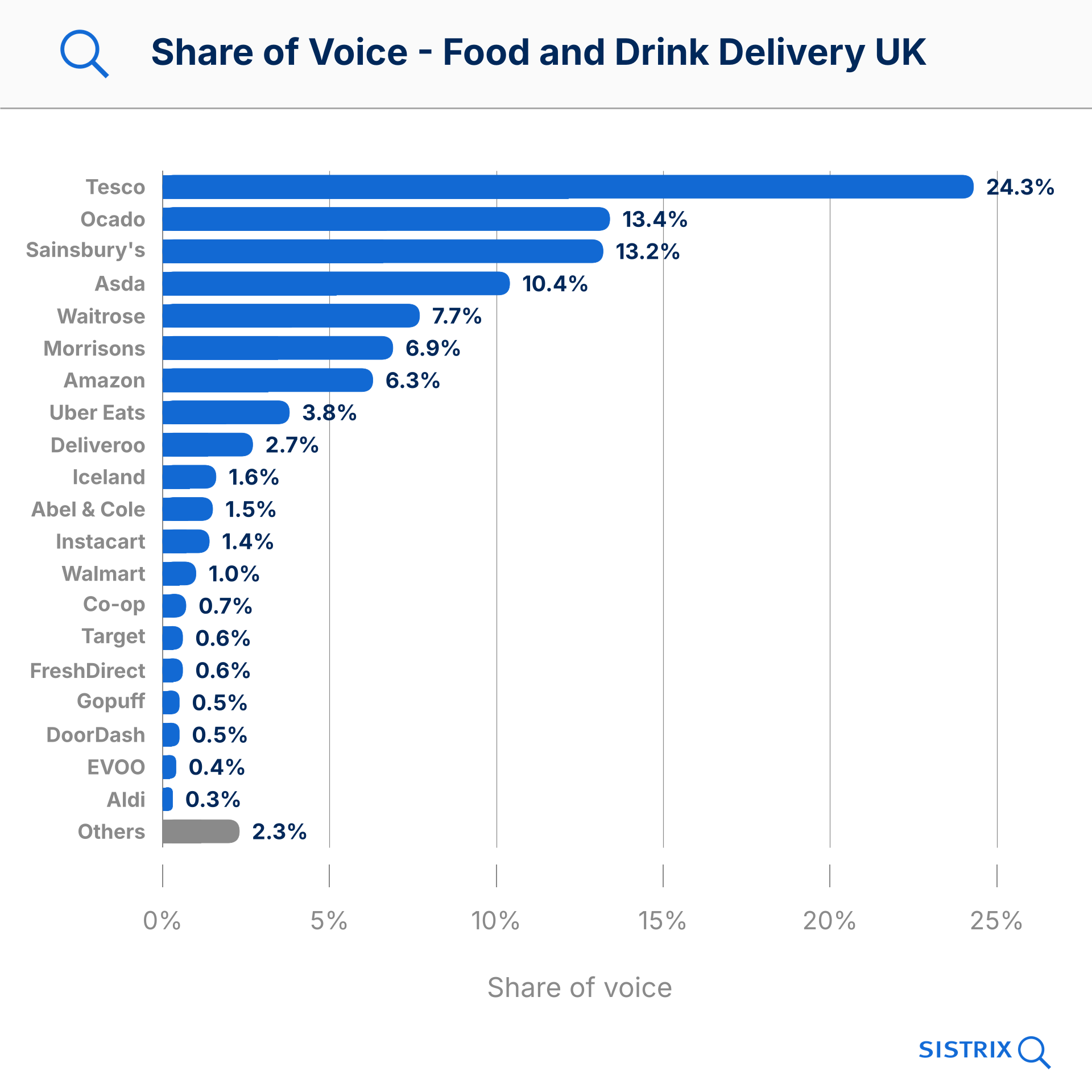
Share of mentions
Mentions are the north star AI metric for the biggest brands and during the research we captured those too. Here is the share of mentions over 6 checks with 199 prompts through ChatGPT and AI Mode.
Summary & additional interesting observations
Grocery search isn’t product research, it’s fulfilment research
This is the finding that explains most of the others. “Milk” does 64,200 searches a month and “trainers” does 85,700, so comparable demand. The trainers top 10 is ten retailers, Adidas, Schuh, JD Sports, ASOS, Office, John Lewis and TK Maxx. The milk top 10 has no supermarket in it at all, it’s McQueens Dairies, Wikipedia, Milk & More, the BBC Good Food glossary, a Carnation tablet recipe and a dairy nutrition page.
Same volume, completely different results. Nobody is sat researching milk, which is obvious enough, but it’s worth following through on what that actually does. There’s no product research phase for a retailer to capture, so what’s left to compete on is where it comes from and when it arrives, which is exactly what the AI dataset rewards.
There’s a lot of demand sat outside generic product search
The keyword set behind this study is built on generic product and category terms. There’s another layer of demand sat in brand searches, and on volume alone it is very likely the larger of the two.
| Brand term | Volume | Generic term | Volume |
|---|---|---|---|
| walkers crisps | 25,800 | crisps | 8,650 |
| red bull | 15,200 | energy drink | 1,650 |
| cadbury | 44,100 | chocolate | 69,300 |
| heinz | 16,200 | baked beans | 21,700 |
Walkers on its own does three times the volume of “crisps” and Red Bull does nine times “energy drink”. Cadbury alone is nearly two thirds of the entire “chocolate” term, and there are dozens of chocolate brands. Build that layer properly and the keyword universe runs into tens of thousands of terms rather than the 1,500 we’ve used here, which is why it sits outside the scope of this study. Volume isn’t the same as buying intent either. Somebody searching Cadbury or Heinz isn’t necessarily looking to put one in a basket, so the brand layer is bigger rather than automatically more valuable.
Organic and AI visibility are held by different companies
Fine Food Specialist, our organic large winner, is cited five times across two prompts in the AI data. Épicerie Corner doesn’t appear in the top 200 sources at all. Going the other way, Allsupers is the 8th most cited domain in AI and failed our organic screen entirely, and Milk & More, The Modern Milkman, Creamline and Beelivery never appeared in the organic directory analysis.
Riverford is the only site that performs credibly in both, 57 AI citations alongside a 50.3% page one ratio on their /shop/ directory. Ocado makes the same point from inside the supermarket set. Their /categories/ directory sits at a 28.8% page one ratio, comfortably the weakest of any supermarket in the data, and they’re still one of the two most cited sources in AI.
There isn’t much of a specialist middle ground in UK grocery
Only four specialist retailers clear the screen at any scale, and most of the ones that fell out of the set were specialists too. In other categories you get a spread of specialists doing this well and badly. Here it’s supermarkets or micro sites with very little in between, which looks like a structural feature of the sector rather than a skills gap.
There are some HPCF’s from large supermarkets but they’re largely brand driven
There’s a number of large supermarkets that technically have high performance content formats, a couple of them scoring above Épicerie Corner. The ratio is measured against each directory’s own ranking keywords though, so the same percentage means something very different across hundreds of thousands of terms than it does across a thousand.
The discounters are a different case again. Aldi’s /product/ directory has a 63.4% page one ratio across its whole keyword universe, which on the raw numbers makes it a high performance content format. Look at what it actually ranks for though and 25 of its top 30 page one keywords contain the word aldi, and two of them are non-food lines (“magnetic window cleaner” and “dishwasher tablets”). Iceland has two directories clearing the ratio bar in much the same way. On the numbers these qualify, but what they’re actually ranking for is brand searches.
The people selling the products are the ones getting cited
This is the one that stands out most when you put it next to other verticals. In the top 40 cited domains, retailers, delivery platforms and aggregators account for around 2,377 citations between them. Publishers and review sites account for 105. That’s a ratio of roughly 23 to 1, and the first third party source is Which? down in 11th on 59 citations, against Tesco’s 610.
Anyone who has looked at AI citations in other verticals will recognise how unusual that is. Third parties normally hold a lot of the weight, often most of it, and review sites and comparison content are what the models tend to lean on. Food and drink is doing something different, the retailers themselves are the source material. Part of that will be the prompt set, these are all buying questions, so you’d expect retailers to feature. Even allowing for that though, a 23 to 1 split is a lot.
I think that comes back to the same point as the rest of this analysis. There’s no product research phase here for a third party to own. Nobody is writing the definitive guide to buying milk, so there’s very little for the models to cite other than the people who will actually deliver it.
Test SISTRIX for Free
- Free 14-day test account
- Non-binding. No termination necessary
- Personalised on-boarding with experts


