
For this Visibility Leaders report SectorWatch is getting ready for a workout. We’re analysing women’s leggings, a category that has sprinted from gym bag staple to everyday wardrobe essential. Gymshark, Nike, lululemon, M&S and a rising wave of D2C challengers are all locked in a close race for searchers’ attention. Which brands have stitched together a seamless organic strategy? And whose organic visibility is showing signs of chafing?
- The top domains in the UK for women’s leggings
- Top 20 domains for searches for women’s leggings:
- Sector search and click volume
- Brand demand for women’s leggings
- Content examples: What type of content is performing?
- The top URLs for women’s leggings
- High-performance content directories
- Gymshark: category architecture as SEO strategy
- Nike: brand authority meets a structural challenge
- Fabletics: the bottoms directory near the top of the rankings
- Summary and takeaways
- Keyword research in the leggings sector
- Our SectorWatch process
Discover how SISTRIX can be used to improve your search marketing. Use a no-commitment trial with all data and tools: Test SISTRIX for free. This report is part of our Visibility Leaders Fashion project.
The UK tights and leggings market generates around £650 million a year – and the cultural shift driving that figure shows no signs of reversing.
Leggings have left the gym far behind.
Fashion editors at Who What Wear are now running annual trend guides dedicated entirely to leggings, covering bootcut silhouettes, chocolate brown colourways and equestrian-inspired styles. In their words, leggings have “never been chicer” than in 2026, and Vogue regularly advises which leggings are in fashion.
This has created an enormous commercial opportunity, and the numbers back it up. Gymshark – founded in a Solihull garage in 2012 – broke the £600 million annual revenue barrier in FY2024, its twelfth consecutive year of growth. Gymshark is not the only winner: Sweaty Betty, lululemon, Adanola, Lovall and Oner Active are all chasing brand-loyal, fashion-conscious shoppers.
It is within this fast-moving, high-value market that we are examining which brands and retailers have secured the strongest positions in Google’s search results for women’s leggings.
The top domains in the UK for women’s leggings
So, who’s tailored a strategy fit for the top? And who’s finding their rankings a little loose around the waist?
To understand whose visibility is on trend, we curated a set of ‘do’ keywords, representing shopping terms for the most common types of women’s leggings (based on the categories listed by various retailers). This gave us a list of 3,440 commercial keywords representing the most popular UK searches for women’s leggings: Everything from broad category terms to brand-specific and product-specific queries. The most visible domains across these searches are:
Winning domains for ‘Do’ searches:
- amazon.co.uk
- next.co.uk
- gymshark.com
The top domains are a mix of e-commerce giants, high street names, sports retailers, and manufacturers.
Amazon leads the table, appearing in the top 10 rankings for 56% of all keywords in our set. That kind of dominance is typical for this giant marketplace..
What is far more interesting is what happens below it. Next and Gymshark are nearly as visible for our keyword set. How they get there is very different. Next is one of the UK’s largest fashion retailers, both a huge high-street name and an online marketplace open to third-party sellers.
Gymshark sells activewear exclusively and was founded thirteen years ago. That a specialist brand can match a retail giant of Next’s scale, across a keyword set of over 3,000 terms, is one of the notable findings of our research and partly thanks to the growth in their brand demand.
The rest of the top 10 is a mix of marketplaces, high-street retailers and sports specialists: eBay (#4), M&S (#5), Sports Direct (#6), ASOS (#7), H&M (#8), Fabletics (#9) and Decathlon (#10). Further down, a cluster of sports performance brands – adidas, Nike, Sweaty Betty and lululemon – sit within a tight band between positions 11 and 14, all earning top-ten rankings for between 8% and 17% of our keyword set.
Top 20 domains for searches for women’s leggings:
| # | Domain | Project Visibility Index |
|---|---|---|
| 1 | amazon.co.uk | 654.77 |
| 2 | gymshark.com | 312.56 |
| 3 | next.co.uk | 297.24 |
| 4 | ebay.co.uk | 213.46 |
| 5 | marksandspencer.com | 212.69 |
| 6 | sportsdirect.com | 173.66 |
| 7 | asos.com | 166.26 |
| 8 | fabletics.co.uk | 143.95 |
| 9 | hm.com | 143.89 |
| 10 | nike.com | 125.02 |
| 11 | adidas.co.uk | 118.68 |
| 12 | sweatybetty.com | 113.80 |
| 13 | lululemon.co.uk | 98.40 |
| 14 | pinterest.com | 91.24 |
| 15 | decathlon.co.uk | 89.90 |
| 16 | lovall.com | 87.36 |
| 17 | boohoo.com | 85.59 |
| 18 | reddit.com | 83.43 |
| 20 | newlook.com | 72.87 |
| 19 | llamaleisure.com | 72.86 |
Sector search and click volume
Our keyword set of 3,440 commercial searches accounts for over 900,000 organic searches a month in the UK. Unlike some previous SectorWatch research, this is a single commercial list rather than a split between “know” and “do” intent — reflecting the nature of leggings searches, which are mostly purchase-focused. The “Clicks” figure in the table below is an estimate of what a domain could achieve through successful SEO across this keyword set.
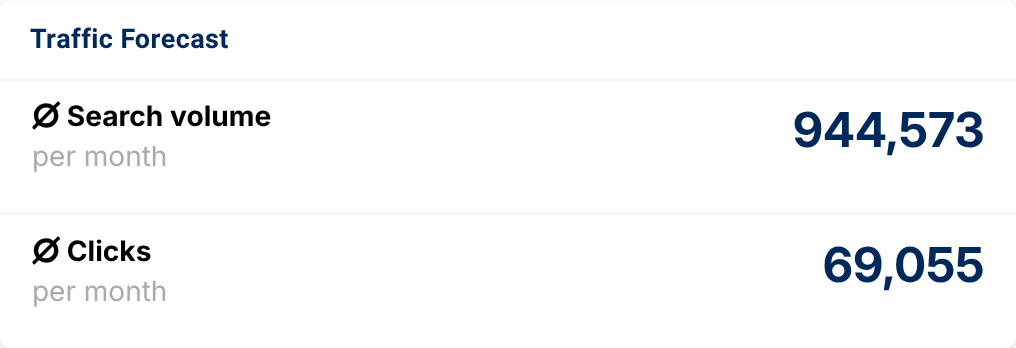
One notable characteristic of this keyword set is the relative absence of AI Overviews. Fewer than 5% of keywords trigger an AI Overview in Google’s results, a striking contrast to categories like protein supplements, where AI Overviews appear for more than half of informational queries. For a product category this commercial and visual, Google largely trusts retailers and brands to answer searchers directly, without an AI-generated summary getting in the way. For the domains competing here, that is good news: organic listings carry more weight, and the click opportunity remains largely intact.
Of course, Google makes up for this through prominent use of ‘Sponsored products’ and ‘popular products’ panels. A staggering 98.57% of our keywords (3,389) have a products panel somewhere in their results page.
This means that for competitors in this sector, having well-optimised product feeds or structured data on relevant pages is paramount.
Brand demand for women’s leggings
As we’re taking a look at the world of fashion, we have to ask: Which brands are in season – and who’s been quietly marked down?
318,360 monthly searches – almost a third of our keyword set’s total – are branded searches: UK shoppers specifically seeking out a named brand’s leggings. That level of branded demand tells its own story about how effectively certain brands have built awareness.
Nike leads the individual brand rankings by some distance, accounting for 18% of all branded search volume. That’s more than Gymshark (#2), lululemon (#3) and adidas (#4) combined. As the world’s biggest sportswear brand with a tight grip on youth leggings, it’s not surprising.
What is more striking is how closely a group of D2C and premium specialist brands cluster behind it. Gymshark (7.6%), lululemon (4.8%), adidas (4.7%) and Sweaty Betty (4.5%) round out the top five. Sweaty Betty’s UK presence is notable. Originally a pure D2C brand, Sweaty Betty has since expanded into high street retail, giving it a physical presence that reinforces the brand recognition driving those search numbers.
| Brand name | Number of keywords | % of branded keywords | Search volume | % of branded search volume |
|---|---|---|---|---|
| Nike | 160 | 11.87% | 57,420 | 18.04% |
| Gymshark | 77 | 5.71% | 24,080 | 7.56% |
| lululemon | 57 | 4.23% | 15,150 | 4.76% |
| adidas | 102 | 7.57% | 14,980 | 4.71% |
| Sweaty Betty | 40 | 2.97% | 14,210 | 4.46% |
| Next | 47 | 3.49% | 11,830 | 3.72% |
| Marks & Spencer | 57 | 4.23% | 9,990 | 3.14% |
| Adanola | 16 | 1.19% | 9,060 | 2.85% |
| Halara | 6 | 0.45% | 9,050 | 2.84% |
| Primark | 35 | 2.60% | 7,540 | 2.37% |
We also classified all the brands by business type to see which are capturing the public’s affection. D2C activewear brands collectively dominate branded demand, accounting for 43% of all branded search volume, comfortably ahead of sports performance brands (28%) and high-street retailers (21%). The D2C wave has not just disrupted retail; it has reshaped what UK shoppers actively search for by name. Brands like Adanola, Halara, Dfyne and Lovall, as well as the big names noted above, are all generating meaningful branded search volume, built almost entirely through social media, influencer marketing and community-led growth.
| Brand category | Number of keywords | % of branded keywords | Search volume | % of branded search volume |
|---|---|---|---|---|
| D2C | 406 | 30.12% | 136,950 | 43.02% |
| Sports Performance Brand | 376 | 27.89% | 90,620 | 28.46% |
| High Street Retailer | 395 | 29.30% | 66,610 | 20.92% |
| Fast Fashion/Online Retailer | 61 | 4.53% | 10,140 | 3.19% |
| Marketplace/Multi-Brand | 56 | 4.15% | 7,950 | 2.50% |
| Luxury/Designer | 32 | 2.37% | 3,880 | 1.22% |
| Specialist/Niche | 22 | 1.63% | 2,210 | 0.69% |
Content examples: What type of content is performing?
The women’s leggings SERPs reveal a market shaped almost entirely by product listings, category architecture and brand authority. Unlike sectors where editorial content competes, this commercial keyword set is won by retailers and brands who have built deep, well-structured product directories. Google is sending shoppers directly to the shop aisle and often showing a range of product options directly in the results.
- Marketplace giants set the ceiling: Amazon (#1), eBay (#4) and Etsy (#25) sit across the top and tail of our leaderboard, their vast product ranges giving them top-10 rankings across more than 60%, 43% and 13% of our keyword set, respectively. Etsy’s presence is a reminder that handmade and print-on-demand products have carved out a genuine corner of this market, ranking well for novelty, niche and occasion-specific leggings queries that mainstream retailers don’t prioritise
- High-street and fast-fashion retailers win through range & reputation: Next (#2), M&S (#5), ASOS (#7), H&M (#8), Pretty Little Thing (#15), Boohoo (#16), New Look (#21) and ASDA (#23) all feature in the top 25 domains
- These retailers’ legging ranges span from value basics to premium activewear, and broad category and subcategory PLP structures give them wide keyword coverage
- M&S is the standout performer in this group: 6 of their URLs appear in our top-60 pages, covering everything from main leggings and gym leggings through to cropped, thermal, maternity and black subcategories
- Sports retailers and performance brands own activity-specific and brand queries: Sports Direct (#6), Decathlon (#10), JD Sports (#22), adidas (#11) and Nike (#12) all earn their positions through a combination of multi-brand breadth and activity-specific subcategory pages
- Decathlon wins sport or activity terms (such as running, hiking and yoga) that generalist retailers can’t always target
- Nike and adidas, meanwhile, face a notable challenge: Sports Direct’s brand-specific category pages (Nike leggings, adidas leggings) compete directly with and in some cases outrank the brands’ own sites for their own terms
- D2C activewear specialists punch well above their size: Gymshark (#3), Fabletics (#9), Sweaty Betty (#13), lululemon (#14), Lovall (#17) and AYBL (#24) all break into the top 25 against retailers with far broader product ranges. Their shared advantage is two-fold: a systematic subcategory architecture that mirrors the precise language shoppers use and brand association with the sector
- Pinterest, Reddit and niche specialists claim the long tail: Pinterest (#18) and Reddit (#19) both break the top 25 in a keyword set that is entirely commercial in nature — Pinterest earning top-10 rankings for 15% of keywords, Reddit for nearly 18%. Google treats inspirational content and peer recommendation threads as legitimate responses to purchase-oriented queries in this sector. Similarly, Llama Leisure (#20) — a brand that sells leggings exclusively — holds its ground against retailers of every scale through three high-performing URLs targeting its main range, pocket leggings and Christmas leggings. Focus, it turns out, is its own competitive advantage
- One notable high-performance content format: The dominant theme across this entire keyword set is straightforward: product listing pages win. This is not a sector where editorial buying guides, recipe content or how-to articles claim top spots. It is one where well-structured, deeply categorised PLPs do the heavy lifting from top to bottom of the results
- Whether it is Gymshark’s eight subcategory collection pages, M&S’s thermal and maternity leggings directories, Decathlon’s activity-specific landing pages or Llama Leisure’s pocket and Christmas leggings collections, the pages that earn the most visibility share the same fundamental format: a clean, filterable product listing page targeting a specific leggings subcategory
- Some editorial content ranks. The Telegraph, Women’s Health, Glamour and Women’s Running all earn top-60 URL positions for terms like “best gym leggings”, “running leggings”, and “scrunch bum leggings”
The top URLs for women’s leggings
Keyword lists do more than identify the strongest domains. They show which individual pages are doing the heavy lifting. For women’s leggings, that list cuts straight to the point: it is a near-complete catalogue of product listing pages, each targeting a specific slice of how UK shoppers search.
| # | URL | Top Keyword |
|---|---|---|
| 1 | https://www.sportsdirect.com/ladies/clothing/tights-and-leggings/nike | nike pro leggings |
| 2 | https://www.asos.com/women/a-to-z-of-brands/nike/refine/leggings/cat/?cid=5897&refine=attribute_1047:8385 | nike pro leggings |
| 3 | https://www.nike.com/gb/w/womens-tights-leggings-29sh2z5e1x6 | nike leggings |
| 4 | https://www.lululemon.co.uk/en-gb/c/womens/bottoms/leggings | lululemon leggings |
| 5 | https://www.sportsdirect.com/ladies/clothing/tights-and-leggings/adidas | adidas leggings |
| 6 | https://uk.gymshark.com/collections/leggings/womens | gymshark leggings |
| 7 | https://www.marksandspencer.com/l/women/trousers/leggings | m&s leggings |
| 8 | https://www.primark.com/en-gb/c/women/clothing/trousers-and-leggings/leggings | primark leggings |
| 9 | https://www.footasylum.com/brands/nike/leggings/ | nike pro leggings |
| 10 | https://www.adidas.co.uk/women-leggings | adidas leggings |
The top URLs list for women’s leggings makes for striking reading. Not because of its variety, but because of its consistency.
Almost every page in the top 25 follows the same format: a product listing page targeting a specific leggings category or subcategory. There are no blog posts, no editorial guides and no brand story pages in the upper reaches of this list. The Telegraph’s best gym leggings roundup at #22 is the sole exception.
Gymshark’s main women’s leggings collection page sits at #1, earning top-10 rankings for 174 keywords. A further five Gymshark subcategory pages appear in the top 25, covering ruched bum, high-waisted, flared, black and leggings with pockets. Each targets a specific search intent with its own dedicated URL and product set.
Sports Direct’s Nike-specific leggings page at #4 outperforms Nike’s own website for Nike leggings terms, a sharp illustration of the challenge performance brands face when their wholesale partners optimise more aggressively than they do.
High-performance content directories
The top URLs list is almost entirely product listing pages. But the routes each brand has taken to get there tell different stories. We’ll look at:
- The D2C brand that has hand-stitched an entire category map from scratch with a page per search intent, scaled across every cut, colour, size and style legging shoppers could possibly search for
- A global sports giant with dominant brand awareness and a single, well-optimised page whose branded search dominance masks a missed opportunity and the difficulties sites can face with product category organisation
- The activewear specialist with a subscription model whose single well-organised bottoms directory punches well above its weight
- And the high-street retailer turning faceted navigation into a long-tail visibility machine
Gymshark: category architecture as SEO strategy
Gymshark’s overall search credentials are impressive, with a global estimated monthly organic traffic of 4.6 million.
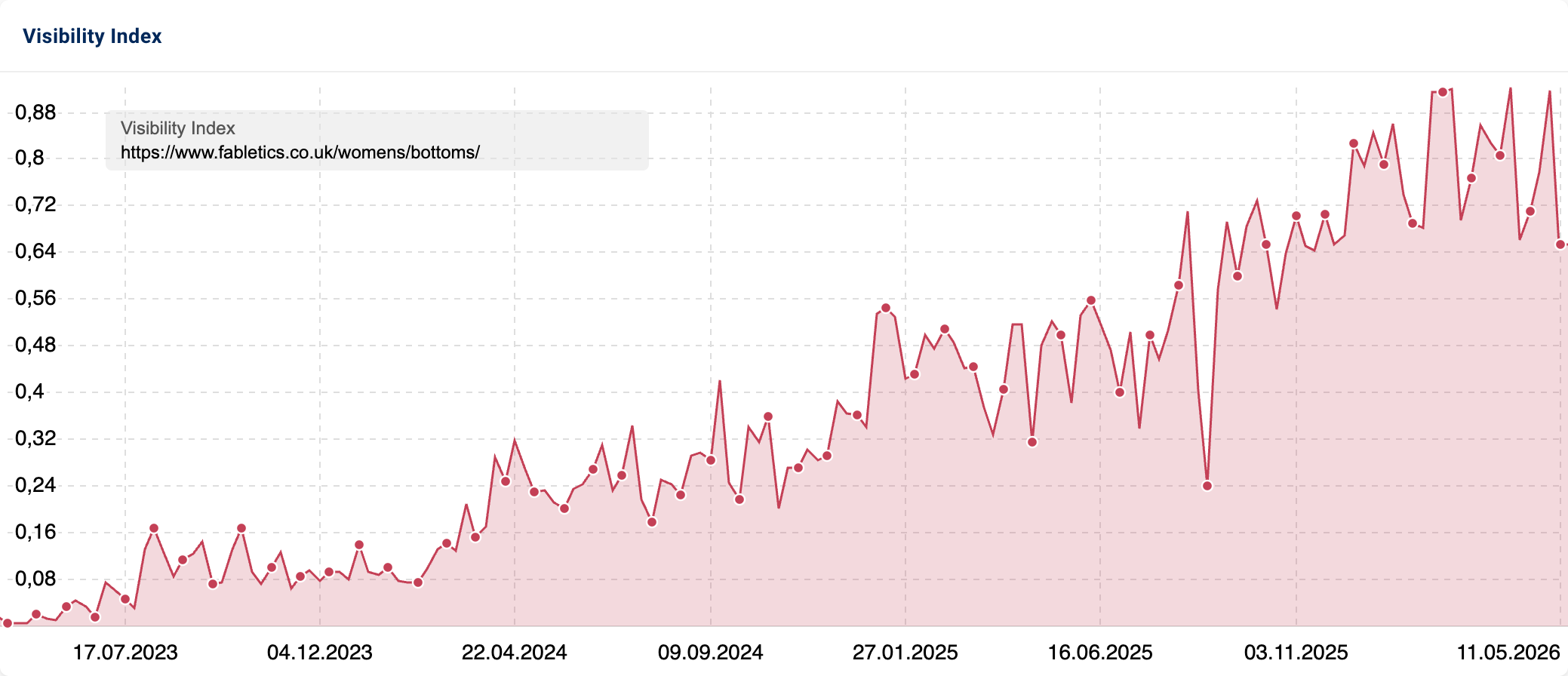
Its UK presence alone spans 37,913 ranking keywords, generating an estimated 896,551 organic visits a month – traffic worth £622,000. But it is in our leggings keyword set that the brand’s structural SEO approach is most clearly visible, with a sustained growth curve since late 2023, driven by a systematic expansion of its category architecture as well as brand authority.
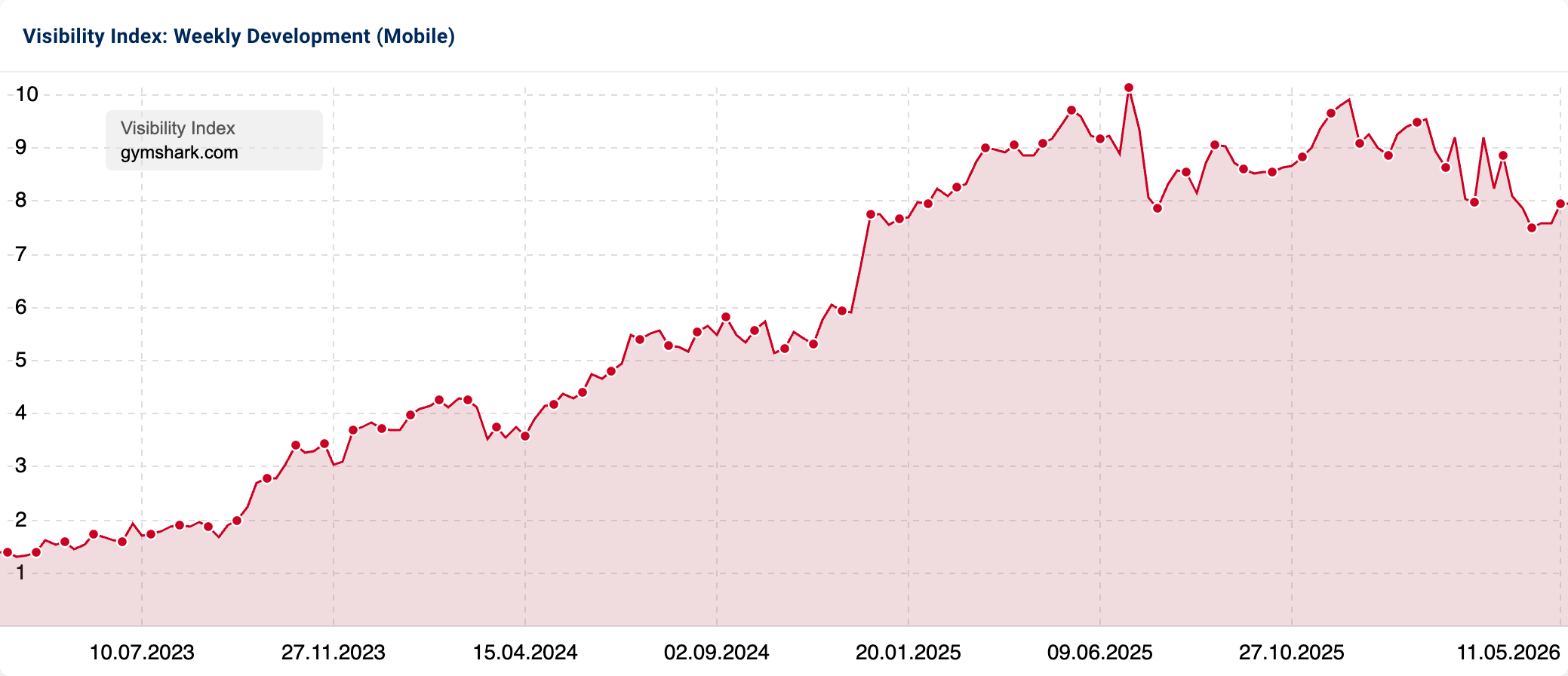
The main women’s leggings collection page sits at #1 in our entire URL dataset, ranking for 225 of our keywords, with 175 on page one.
But Gymshark does not rely on a single page. 8 individual Gymshark URLs appear in our top-60 pages, covering high-waisted, flared, black, ruched bum, pockets, petite, tall and compression leggings (with 16 appearances in our top 300 pages).
Gymshark uses Shopify, so it relies on that platform’s collections/structure for PLPs. Within the 562 URLs ranking in the UK for at least one keyword, 45 contain “leggings”. This gives Gymshark a wide selection of dedicated pages for different ways its customers shop. For example, there are different collection pages by colour (for example, blue), by purpose (such as running) and by style, such as seamless.
There are also other pages with leggings that don’t include that term in the URL, such as https://uk.gymshark.com/collections/ruched-bum/womens.
This is a category map built to match Google’s own understanding of how this market searches. It puts Gymshark very close to Next’s visibility for our sample keyword set, despite selling a fraction of Next’s total product range.
The ruched bum subcategory illustrates how the model scales: that single directory now ranks for 266 keywords, driving close to 5,000 UK organic visits a month.
What makes their PLPs work?
- Each Gymshark subcategory page goes well beyond a filtered product grid. The high-waisted leggings page, for example, opens with descriptive copy explaining what high-waisted leggings are and why the fit works
- The extra copy at the bottom of the page expands on this, naturally incorporating terms like “high-rise leggings”, “elasticated waistband” and “sculpting effect” — before moving into styling advice and a link to a dedicated blog guide
- The black leggings page follows the same template: product copy, FAQ-style content on the difference between gym and regular black leggings, styling suggestions and cross-links to related subcategories
- The copy is written in Gymshark’s distinctly community-led voice, which reinforces brand signals while earning the long-tail keyword coverage that more generic copy would miss
- Every page also carries rich filter options by feature, fit, range and activity, making them easy to use (satisfying user intent & helping keep customers on the page for longer by being useful)
- The link amongst the product listings to their legging fit guide also adds more ‘usefulness’ signals and likely keeps more customers on the site for longer
- The layout on both desktop and mobile devices is strong, with products high up on the page, clear photography, and key information about each product, such as colour, price, and available sizes, either immediately available or when you hover over the product
- Each PLP also features many cross-merchandising links to related categories. This not only helps users but also adds powerful internal link signals
- Gymshark also often carries an impressive product range. For example, there are 210 options for high-waisted leggings, more than you might expect from a single manufacturer
- And the PLPs are well optimised, utilising foundation elements like title tags, descriptions, and H1s effectively (though it’s worth noting that as the ‘runched bum’ PLP doesn’t specify leggings, it isn’t nearly as well optimised, despite only having legwear as a product type)
Nike: brand authority meets a structural challenge
Nike accounts for 18% of all branded search volume in this keyword set, the most of any individual brand. Its main women’s leggings page performs well in isolation: 35 of our keywords rank, 32 on page one, with a strong overall footprint of 455 UK ranking keywords.
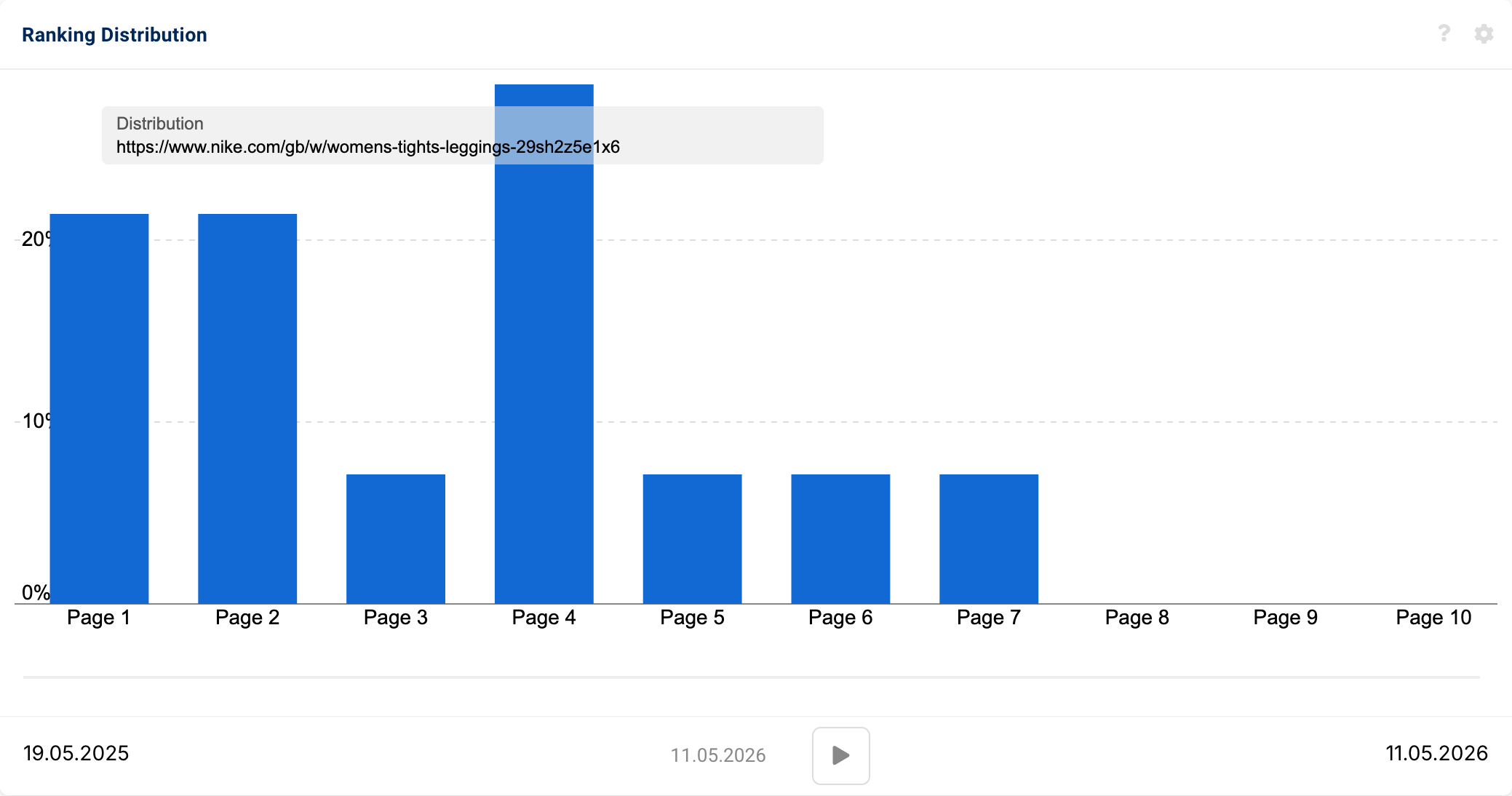
The structural challenge becomes clear when you look beyond that single page. Nike’s subcategory pages each sit on individual, disconnected URLs rather than within a shared directory. There is no coherent /womens/leggings/ hub for Google to parse as a category cluster, and no architecture consolidating legging subcategories back to a parent leggings page.
For example, on the page on running leggings, the breadcrumbs highlight the store’s organisation. The breadcrumbs on the page point up to running trousers and tights, then running clothing and then up to ‘running’ at the top.
Notably, Nike does have a consistent approach. The women’s leggings and tights page sits under women’s trousers and tights, which sit under women’s clothing.
Nike uses the sport as the defining department within its store structure.
Within each sport, or each gender, there is a consistent structure of how product types are organised.
This isn’t an incorrect approach at all. It’s just an excellent example of how sites with a large product catalogue need to make decisions on how they will organise their categories, subcategories, and product types. It also shows how sites need to work around a limited URL structure without subfolders.
Importantly, Nike is making the most of some internal linking opportunities. On the women’s leggings PLPs, the faceted navigation displays a range of filtering options. These contain HTML links to the subcategory page, such as leggings for basketball or black leggings. This cross-merchandising helps add internal links to these different options, even though they are crossing sport departments.
However, sometimes Nike’s subcategory pages aren’t indexable, leaving a big opportunity on the search table.
At the top of the PLP’s faceted navigation are legging options by length. We can see from our keyword research that searches for 7-8 length leggings or capri leggings are very popular. Nike has options for these, positioned prominently on the page. However, these URLs canonicalise back up to the main women’s leggings page, meaning they’re not indexable. The site has a range of pages targeting “crops and capris” searches for sets, but not a page for capri leggings alone.
So, while Nike doesn’t have a specific leggings directory they can optimise around, they have built something of a hub, but they’re not allowed important parts of that group to appear in the search results.
Fabletics: the bottoms directory near the top of the rankings
Another interesting story is Fabletics, the US active lifestyle brand that runs a membership program that gives access to discounts and perks.
The /womens/bottoms/ directory ranks 15 times in our top 300 URLs, including 7 times in the top ten. The Directory ranks for 2,239 keywords in the UK at the time of writing, bringing in an estimated 31,495 organic business a month, thanks to ranking on page one for 35.45% of them. Traffic is worth £30,000.
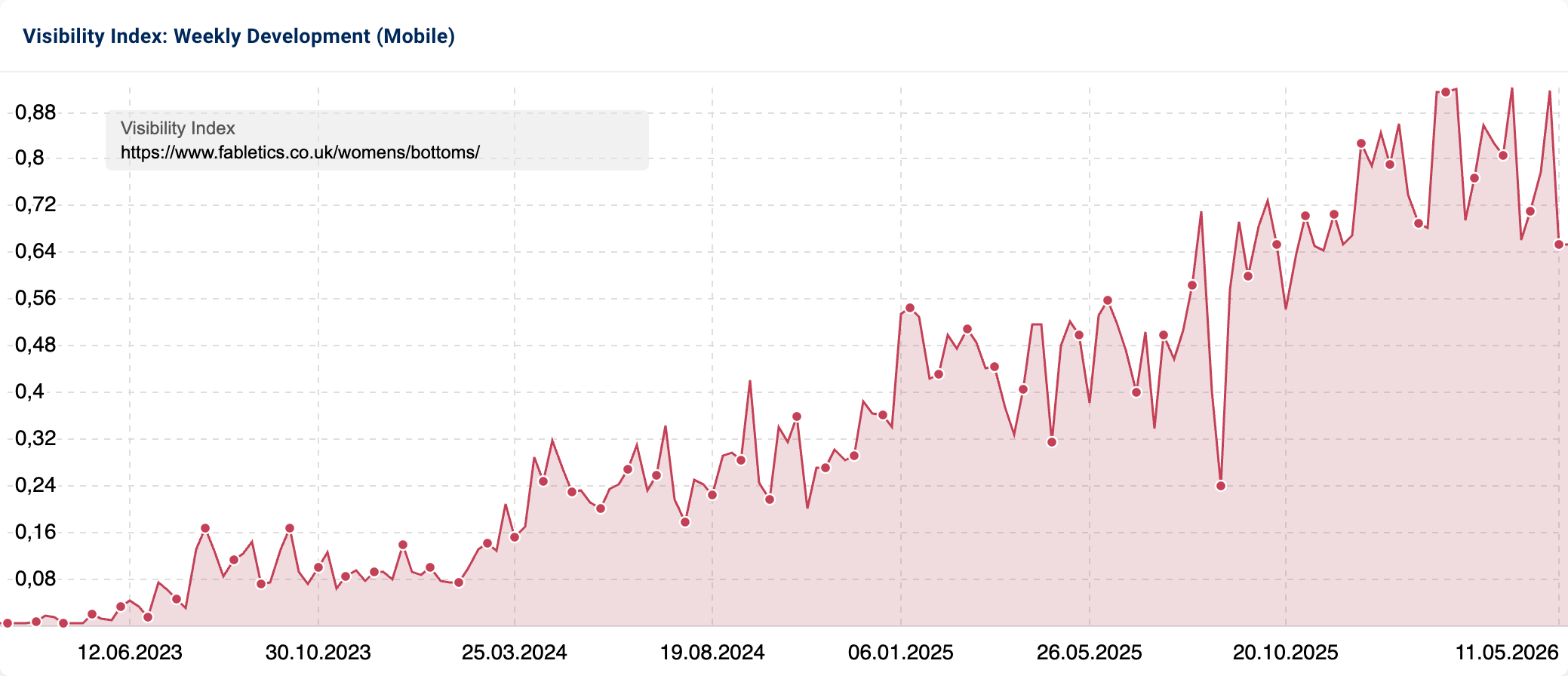
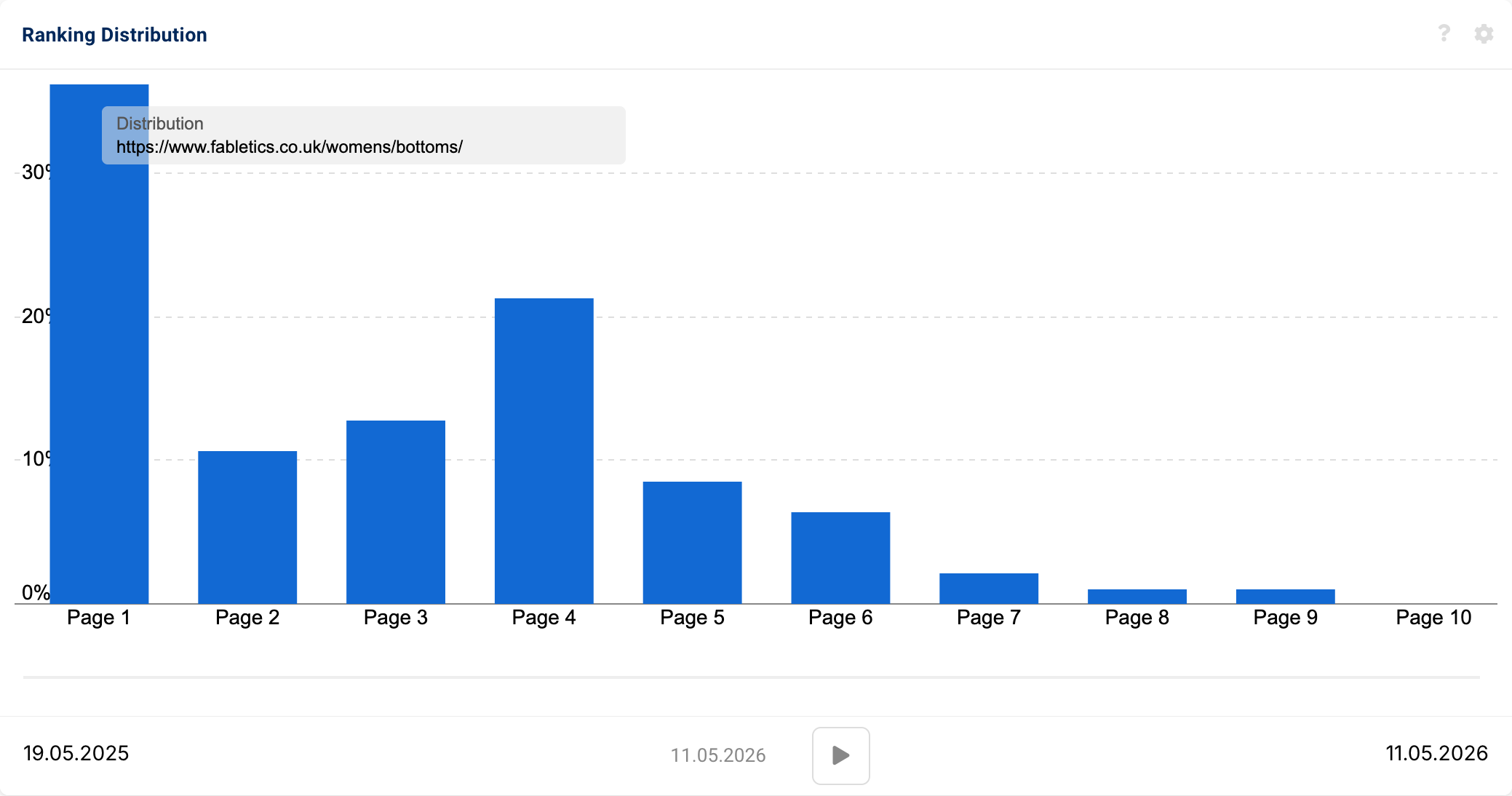
The core leggings page ranks for 177 of our keywords with 110 on page one, and beneath it you find 42 child pages segmented by style, cut, season and colour.
The Fabletics leggings PLPs are great examples. Below the product grid, each page carries several hundred words of copy covering styling guidance by occasion, fabric and fit advice, and FAQ answers on quality and squat-proofness, all written to match the natural language of search queries.
There is also a grid of internal links pointing to all the different leggings by style pages the site has, with everything from summer to wetsuit to TikTok leggings. There’s another grid with links to each legging colour. While useful – and likely notes by search engines – having these at the bottom of the page reduces their prominence. Highlighting key cross-merchandising products at the top of the page could further boost their visibility.
Colour, activity and rise filters are clearly structured, and the child pages (black, scrunch bum, high-waisted, everyday, workout) each carry their own variant of this copy template, tailored to the specific intent of that subcategory.
Fabletics’ site structure is the neatest example we’re looking at today, with a clear hierarchy such as /womens/bottoms/leggings/high-waisted and/womens/bottoms/leggings/printed.
One note of caution: a parallel page at /womens/gym/leggings exists but performs comparatively poorly. But overall, it’s clear to see why Fabletics’ visiblity for our keyword set has improved notably over the past several years:
H&M: faceted navigation as a visibility multiplier
H&M’s women’s trousers directory ranks for 4,821 keywords in the UK, generating 87,334 monthly visits worth £52,000 thanks to a 47.62% page-one rate – the highest of any directory in this research.
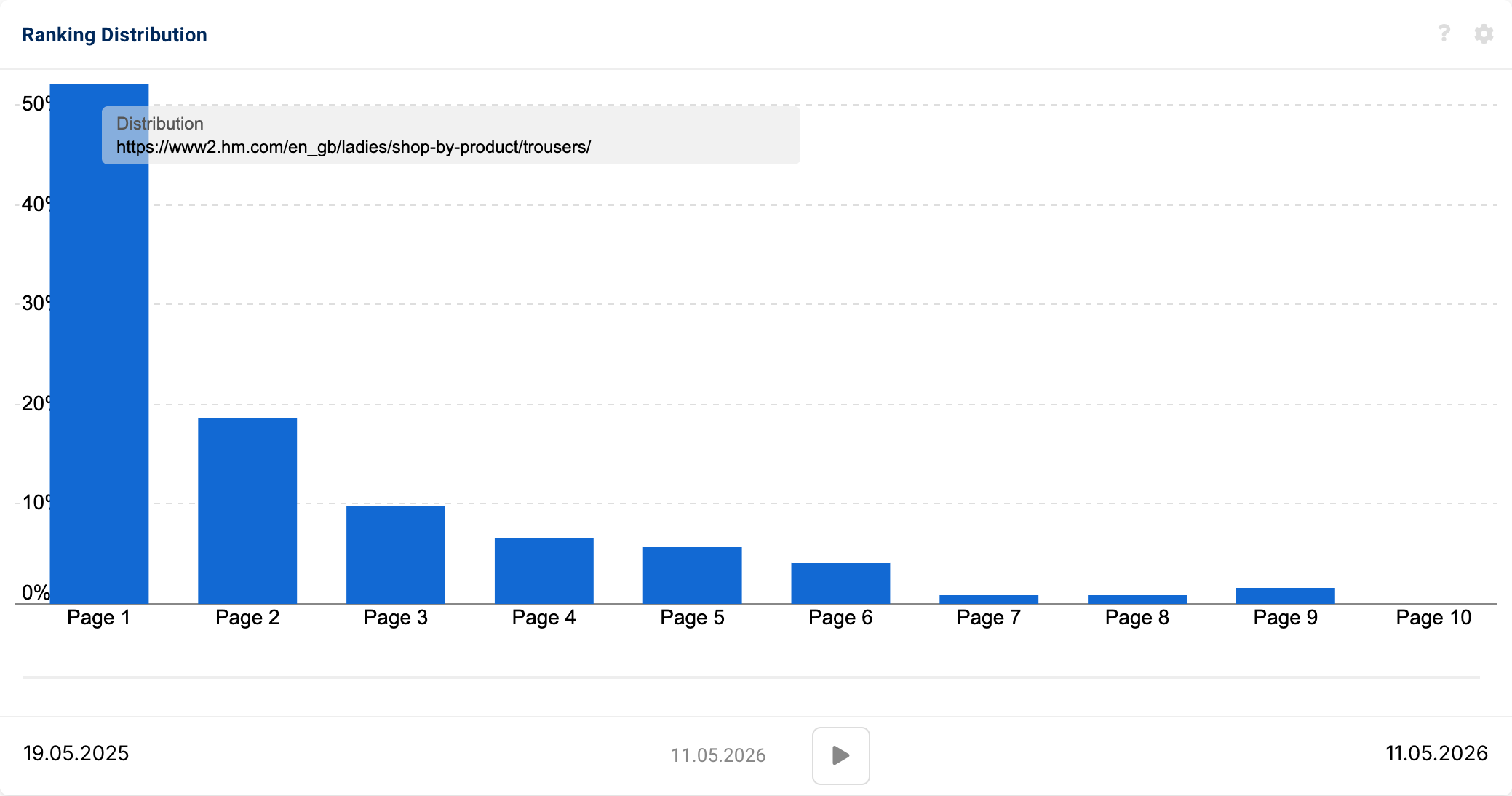
13 H&M URLs appear in our top-300 pages, and the majority are not hand-crafted pages: they are indexed parameter variants of a single base URL at /trousers/leggings.html, generated through faceted navigation.
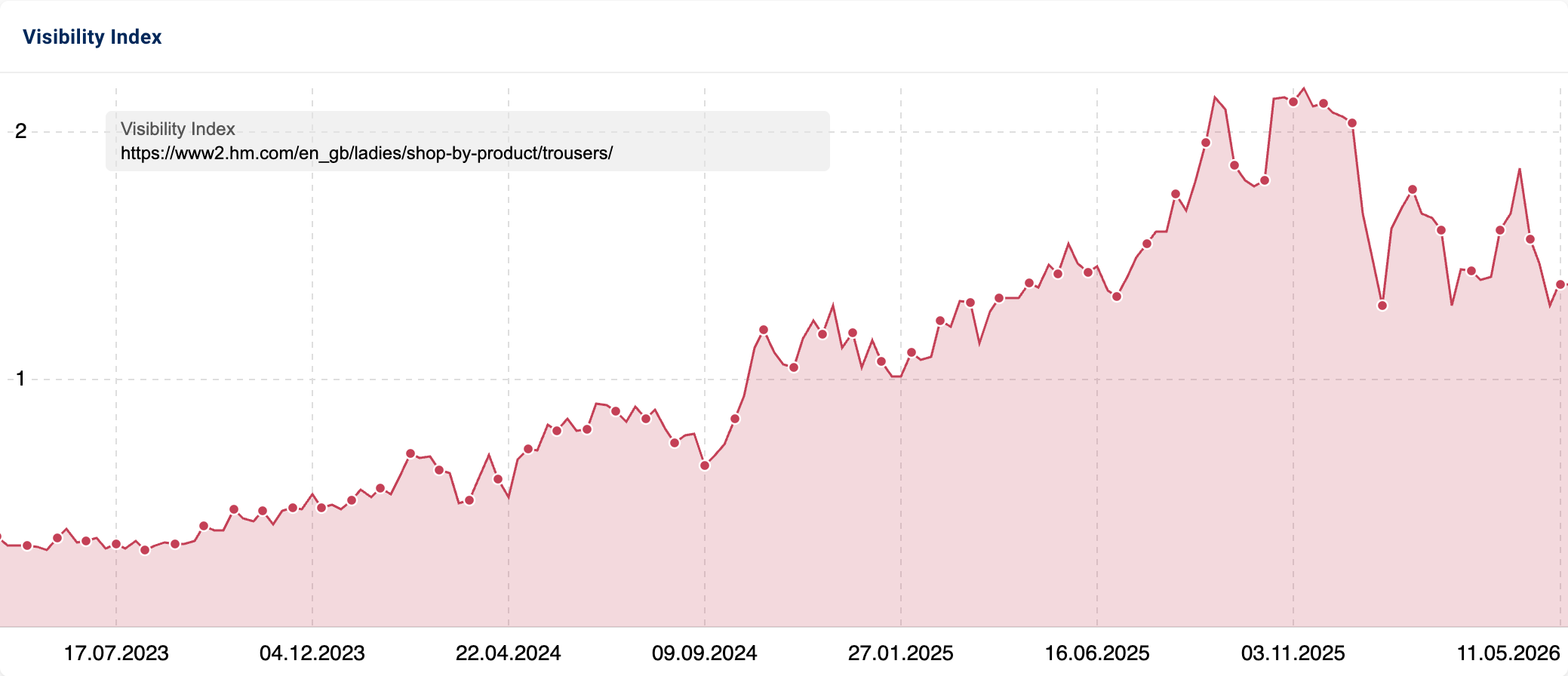
Colour, style and seasonal variants each have their own ranking URL – grey, brown, white, black, beige, navy, burgundy and warm winter leggings all appear in our top-300, alongside a flared leggings style variant, a maternity leggings page and a dedicated sport leggings URL. The flared variant alone earns top-10 rankings for 25 of our sample keywords; even the beige parameter URL ranks in the top 10 for 9.
What H&M demonstrates is that a strong parent directory with genuine topical authority can make faceted navigation do serious SEO work. Each colour and style variant inherits that authority while targeting its own specific long-tail query. It is a fundamentally different approach to Gymshark’s hand-built subcategory architecture, but the outcome is similar: broad keyword coverage through systematic category coverage.
Summary and takeaways
From a Solihull garage to the top of Google’s results, the women’s leggings category tells a clear story about how search visibility is won in a commercial, product-led sector. D2C brands have reshaped not just the retail landscape but the search landscape — building brand demand and structural SEO depth simultaneously, while established names and high-street giants compete through range, reputation and category breadth.
So, what can we squeeze out of the data from the brands dominating Google’s leggings results?
- The paths are different, the destination is the same: Gymshark hand-builds a dedicated subcategory page for every cut, colour, style and size its customers search for. Fabletics constructs a clean hierarchical directory with 42 child pages beneath a single parent. H&M lets faceted navigation generate indexed colour and style variants from one base URL. Three completely different structural approaches – but each arrives at the same place: a store with a dedicated, optimised page for every distinct way a shopper might search
- Whatever your platform or architecture, the lesson is consistent: breadth of category coverage through dedicated pages wins
- Brand awareness and SEO are the same investment: D2C brands dominate both the branded search rankings and the organic visibility leaderboard. Gymshark, Sweaty Betty, lululemon and Fabletics have built brand loyalty through social media, influencer marketing and community – and that brand demand feeds directly into the search signals Google rewards. Winning hearts and mind-share on Instagram and TikTok leads to more brand demand, which leads to winning rankings on Google, too
- Specialist depth beats generalist breadth, if the structure is right: Gymshark sits within Next’s visibility for our keyword set despite selling a fraction of Next’s product range. Llama Leisure, a brand that sells nothing but leggings, outranks Nike.com for multiple keywords. A tightly focused product range, paired with a subcategory architecture that maps to real search demand, competes with retailers of any scale
- Brand authority without structural depth leaves rankings on the table: Nike owns 18% of branded search demand in this category, more than any other individual brand. But Sports Direct’s Nike leggings category page competes with them for branded terms, and they lose some important opportunities thanks to their technical setup
- Google is a product finder in this sector: Fewer than 5% of keywords in this set trigger an AI Overview, but 98.57% feature a product panel. The organic opportunity is real, but only partly in the traditional links. The rest is in prominent shopping placements that reward well-structured product feeds and clean on-page data just as well as traditional ranking signals. Winning in leggings means being found both in the blue links and in the product carousels around them
Keyword research in the leggings sector
To explore Google’s results for the best-performing content and sites, we curated a set of commercial keywords representing the most popular UK searches for women’s leggings. Our final list contained 3,438 keywords covering everything from broad category terms to brand-specific queries, style-specific searches and activity-led terms.
For this research, we took a deliberately product-led approach to seed keyword generation. Rather than starting from a broad category term and expanding outward, we began by auditing the category structures of several leading leggings retailers, examining how they organise their own stores, which subcategory pages they have built and which product types they deem significant enough to warrant a dedicated URL. This gave us a structured map of the leggings market as retailers themselves understand it: by style (high-waisted, flared, cropped, seamless), by activity (running, yoga, hiking, gym), by fit (petite, tall, plus-size), by feature (pockets, scrunch bum, thermal) and by colour.
We used these categories as seeds, expanding each into the full range of related search terms using SISTRIX’s keyword tools and harvesting the ranking keywords from the top-performing URLs in each category’s SERPs. We then sanitised the list by hand to remove irrelevant, duplicate or mixed-intent terms, leaving a clean, commercially focused set representative of how UK shoppers actually search for leggings.
Core keywords: leggings, gym leggings, women’s leggings, high waisted leggings, black leggings, running leggings, yoga leggings, leggings with pockets, seamless leggings, flared leggings.
Our SectorWatch process
For this research, we started by building a comprehensive leggings keyword set from SISTRIX’s databases, refined using the retailer category-led seeding process described above.
We selected keywords with a clear commercial ‘do’ intent — representing shoppers looking to browse or buy. From these seeds, we harvested all ranking keywords for the URLs appearing in those SERPs, using SISTRIX’s Keyword Environment. We then re-filtered the list for commercial intent and sanitised it by hand to leave a focused, highly relevant set of searches representative of UK leggings shopping behaviour. The results are based only on organic search rankings for the chosen keywords.
We have a detailed, step-by-step article on keyword research with SISTRIX tools and data, in which you can see our list-building process.