


For this SectorWatch, as part of our latest Visibility Leaders project on the food and drink market, we’re tying on an apron and heading to the kitchen. Recipes are an evergreen search topic; from pancakes to pad thai, recipe search is a feast that never goes stale. Publishers, bloggers and global recipe sites are all fighting for a seat at the table so who is whisking up search success? And whose visibility has gone off the boil? Data and analyses, SEO and GEO visibility below.
- Leaders in organic and AI search
- Top organic domains in Google search for informational (‘know’) searches:
- Top organic domains in Chatbots for recipe requests:
- Exposure to AI Overviews
- Leading publishers in GEO, AI Chatbot answers:
- SEO visibility - The most visible URLs from organic search
- GEO visibility - the most visible URLs from AI chatbots
- Content analysis: What type of content is performing?
- Leading content formats:
- Leading domains for ‘know’ recipe searches:
- Good Food: the /recipes/ powerhouse
- RecipeTin Eats: the overseas blog Britain can’t resist
- A recipe for inspiration
- YouTube: the winner you can’t chart
- Summary and takeaways
- Our SectorWatch process for recipes
Curious who leads your sector? Try SISTRIX for free and see who’s winning in your market. You get the full toolkit and all the data, with no commitment.
💡Half of UK households cook from scratch every day or most days, and 16% say they cook from scratch more because of the cost of living.
Leaders in organic and AI search
To find out who’s cooking up the most visibility, we built two sample sets that mirror how the UK searches for recipes.
First, a set of 2,857 informational “know” queries: the searches people run when they want to cook a dish. These cover recipe searches like “yorkshire pudding recipe” and “carbonara recipe”, plus “how to make” and “ingredients” queries, across over 900 popular dishes. Together, they account for almost 5.8 million searches a month in the UK. We loaded them into a SISTRIX list, which compiles a range of data for the keywords, including the top-performing domains and pages.
Second, we built an AI prompt tracker to see whose recipes the chatbots dish out. A recipe is a list of ingredients and a set of steps, exactly the kind of answer a chatbot loves to serve up. So we turned the 250 most-searched dishes from our keyword list into prompts, such as “What ingredients do I need for mac and cheese?” and “Can you give me a recipe for patatas bravas?”, and added 19 general recipe questions from Google’s “People Also Ask” boxes. That gave us 269 prompts, which we tracked across ChatGPT and AI Mode (with another project checking AI Overviews).
Full methodology sits at the end of the article. For now, let’s meet our iron chefs.
Top organic domains in Google search for informational (‘know’) searches:
- bbcgoodfood.com
- bbc.co.uk
- recipetineats.com
Top organic domains in Chatbots for recipe requests:
- youtube.com
- recipetineats.com
- allrecipes.com
Two brands with BBC roots rule the recipe results. Good Food ranks for 80.4% of our keywords and sits on page one for 76.9% of them. BBC Food ranks for 60.2%. Good Food dropped “BBC” from its name in 2024 but has (so far) kept the domain.
RecipeTin Eats takes third, ranking for 42.2% of our set. Behind it, UK bloggers Taming Twins (5th) and Kitchen Sanctuary (7th) mix with US recipe giants Allrecipes and Serious Eats. Jamie Oliver is the only celebrity chef in the top ten. Video and social join the table too: YouTube ranks 4th (appearing for 63.5% of our keywords) and Facebook 10th.
Visibility is also concentrated. The most visible single page, Good Food’s chilli con carne recipe, holds 26 page-one rankings, and just 41 domains make up the top 200 URLs in our sample set.
UK bloggers out-rank big brands: Taming Twins (5th), Kitchen Sanctuary (7th), Easy Peasy Foodie (17th) and Don’t Go Bacon My Heart (18th) all sit above The Guardian, Waitrose and Tesco.
Exposure to AI Overviews
Any examination of SERP results has to consider AI Overviews, especially for informational queries like recipes that are ripe for an AI-generated summary.
For recipes, AI Overview reach is huge. In our snapshot, 1,897 of our 2,857 keywords trigger an AI Overview. That’s 66.4%, so nearly two in three of our recipe searches serve up an AI summary before a single recipe site gets a look in.
The list includes our two biggest searches of all: “yorkshire pudding recipe” (290,000 searches a month) and “pancake recipe” (220,000).
The more direct the question, the more likely Google is to answer it. 1,355 of our 2,202 “recipe” keywords trigger an AI Overview (61.5%). That rises to 78% for “how to make” queries (312 of 398), and to 86% for “ingredients” and “how to cook” searches. When someone asks what goes into a carbonara, Google would rather answer than send them elsewhere.
The AI Overview isn’t the only feature competing for attention. 2,664 of our keywords (93.2%) show recipe cards, the photo-led results with ratings and cooking times. And 2,682 (93.9%) show “People also search for” links. On a typical recipe results page, the classic blue link sits below a stack of Google features.
That’s a real challenge for recipe publishers, who rely on page views to earn ad revenue. When Google can list the ingredients and steps itself, the click becomes optional. Recipe cards offer some relief, as they still send searchers to the publisher’s page. To appear in them, a page needs recipe structured data, so clean markup is now the price of entry for any recipe site.
💡More than half (54%) of UK adults now use AI tools such as ChatGPT and Gemini, rising to 79% of 16 to 24-year-olds.
Leading publishers in GEO, AI Chatbot answers:
Next, we turned to our AI prompt tracker. In most sectors, we look at the brands the chatbots name. Recipes are different. Ask ChatGPT or AI Mode for a cottage pie recipe, and it doesn’t recommend a brand. It hands you the recipe. So instead, we counted the sources: the sites cited most often across our 269 prompts.
The five most-cited sources in our set at time of research, October 1, 2026.
- YouTube: cited 629 times across 337 different videos. More than three times the citations of any recipe site, and spread so wide that no single video dominates
- Allrecipes: the giant US recipe community, cited 175 times. It also owns the single most-cited page in our set, its “Good Old-Fashioned Pancakes”
- RecipeTin Eats: the Australian food blog, cited 160 times. It’s third in Google too, making it the most consistent performer across both
- The Kitchn: the US cooking site, cited 127 times. Its pages land in AI answers far more often than in Google, where it ranks 15th
- Good Food: cited 95 times. A top-five spot, but a long way below its first place in Google
Here are the top 10 domains for recipe content requests, based on updated data, 12th November.
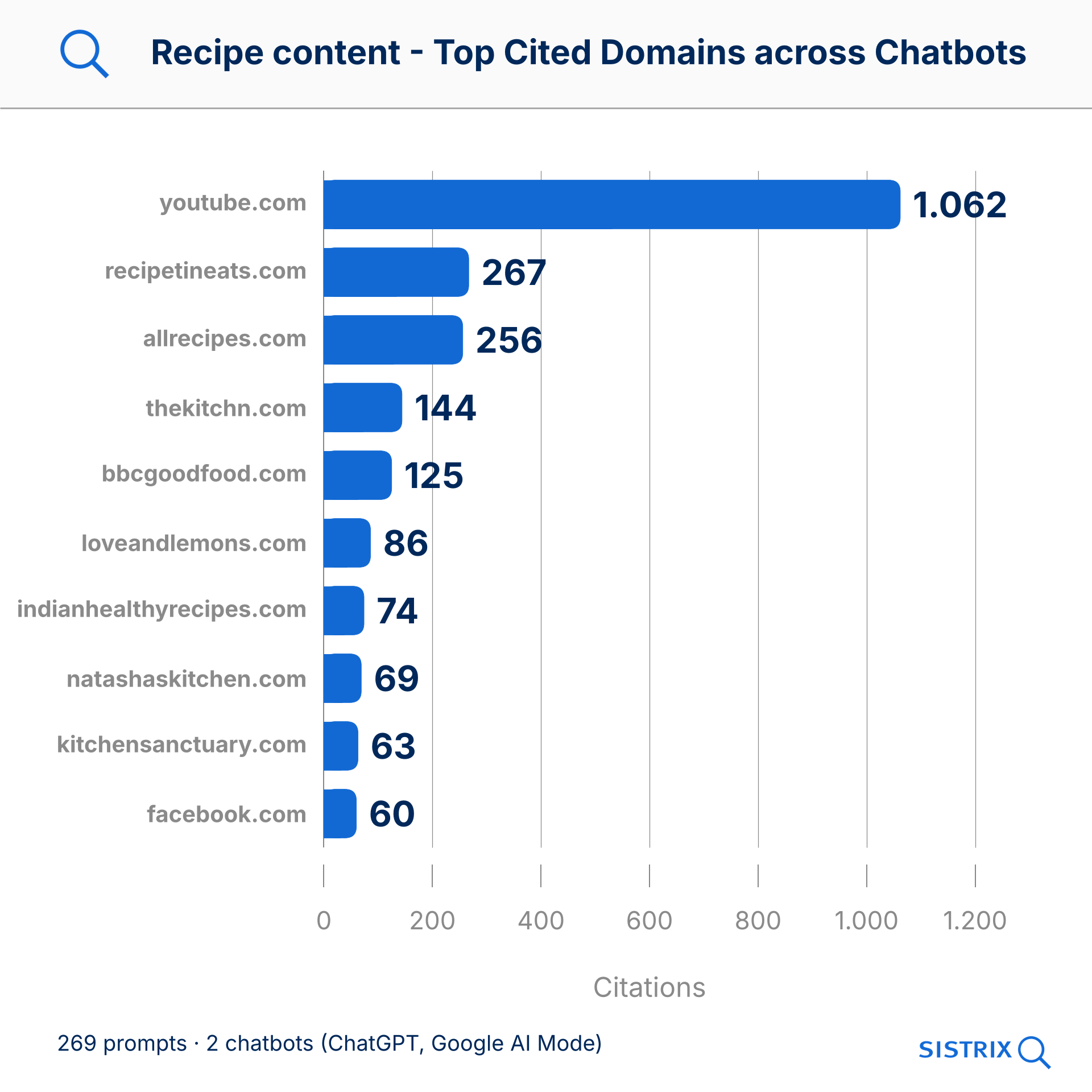
The names overlap with Google’s leaderboard, but the order looks very different. Good Food ranks for 80.4% of our keywords in Google, yet it earns fewer than a sixth of YouTube’s AI citations. BBC Food falls even further, from second in Google to 24th in AI answers, with just 24 citations.
Jamie Oliver (8th in Google) and the Hairy Bikers (24th) prove a famous name still earns Google visibility, while Waitrose (20th) and Tesco (21st) use recipe hubs to win searches that lead to the basket. In AI answers, they barely register. Jamie Oliver, the Hairy Bikers and Waitrose don’t appear in our 100 most-cited sources, and Tesco earns just six citations.
Among the 100 most-cited sources, only around one in ten citations points to a UK site. Australian and New Zealand sites, such as taste.com.au and New World, appear regularly.
SEO visibility – The most visible URLs from organic search
When you build a keyword list or a prompt tracker in SISTRIX, one of the most useful reports shows the best-performing URLs for that set. These are the individual pages doing the heavy lifting, the ones earning the biggest share of visibility. So we pulled the top URLs from both our Google set and our AI prompt set to see which pages win.
| URL | Top Keyword | Top 10 Rankings |
|---|---|---|
| https://www.bbcgoodfood.com/recipes/chilli-con-carne-recipe | chilli con carne recipe | 26 |
| https://www.bbc.co.uk/food/recipes/easy_spaghetti_bolognese_93639 | bolognese recipe | 25 |
| https://www.bbcgoodfood.com/recipes/easy-pancakes | pancake recipe | 20 |
| https://www.bbcgoodfood.com/recipes/best-spaghetti-bolognese-recipe | bolognese recipe | 24 |
| https://www.bbc.co.uk/food/recipes/fluffyamericanpancak_74828 | pancake recipe | 18 |
| https://www.bbcgoodfood.com/recipes/classic-lasagne-0 | lasagne recipe | 15 |
| https://www.recipetineats.com/spaghetti-bolognese/ | bolognese recipe | 24 |
| https://www.inspiredtaste.net/15938/easy-and-smooth-hummus-recipe/ | hummus recipe | 15 |
| https://www.bbcgoodfood.com/recipes/best-ever-macaroni-cheese-recipe | mac and cheese recipe | 16 |
| https://www.bbcgoodfood.com/recipes/easy-chicken-fajitas | fajita recipe | 11 |
| https://www.bbc.co.uk/food/recipes/macaronicheese_83521 | mac and cheese recipe | 15 |
| https://www.bbcgoodfood.com/recipes/chicken-korma | chicken korma recipe | 11 |
| https://www.bbcgoodfood.com/recipes/butternut-squash-soup-chilli-creme-fraiche | butternut squash soup recipe | 11 |
| https://www.allrecipes.com/recipe/21014/good-old-fashioned-pancakes/ | pancake recipe | 21 |
| https://www.bbcgoodfood.com/recipes/ultimate-spaghetti-carbonara-recipe | carbonara recipe | 11 |
| https://www.bbcgoodfood.com/recipes/no-fuss-shepherds-pie | shepherd's pie recipe | 10 |
| https://www.bbcgoodfood.com/recipes/egg-fried-rice | how to make egg fried rice | 11 |
| https://www.bbc.co.uk/food/recipes/chilliconcarne_67875 | chilli con carne recipe | 19 |
| https://www.allrecipes.com/recipe/16248/easy-homemade-chili/ | chilli recipe | 15 |
| https://www.bbcgoodfood.com/recipes/ultimate-tomato-salsa | salsa recipe | 11 |
Google’s top ten reads like a menu of British midweek favourites, and the BBC-born brands serve most of it. Good Food holds six spots and BBC Food two, with Good Food’s chilli con carne leading with 26 page-one rankings.
Bolognese recipes take three places, with BBC Food, Good Food and RecipeTin Eats each holding over 20 page-one rankings across the many popular variants we examined.
RecipeTin Eats’ bolognese and Inspired Taste’s hummus are the only two pages to break the Good Food/BBC dominance. Every page in the list is a single recipe for a single dish.
GEO visibility – the most visible URLs from AI chatbots
| URL | Domain Type | Content Type |
|---|---|---|
| https://www.allrecipes.com/recipe/16248/easy-homemade-chili/ | Publisher | Article |
| https://farmerxfoodie.com/katsu-curry/ | Publisher | Unknown |
| https://foodnevercomes.com/recipes/katsu-curry.html | Compare | Article |
| https://pixelatedprovisions.com/2018/04/11/castlevania-curry-of-sorrow/ | Publisher | Unknown |
| https://www.wellplated.com/jamaican-jerk-chicken/ | Publisher | Unknown |
| https://downshiftology.com/recipes/best-ever-guacamole/ | Publisher | Article |
| https://feelgoodfoodie.net/recipe/ground-chicken-burgers/ | Publisher | Article |
| https://holycowvegan.net/easy-vegetable-curry/ | Publisher | Review |
| https://japan.recipetineats.com/katsu-curry-japanese-curry-rice-with-chicken-cutlet/ | Publisher | Review |
| https://sweetandsavorymeals.com/jerk-chicken-recipe/ | Publisher | Article |
| https://www.allrecipes.com/recipe/21014/good-old-fashioned-pancakes/ | Publisher | Article |
| https://www.allrecipes.com/recipe/238691/simple-macaroni-and-cheese/ | Publisher | Article |
| https://www.bbcgoodfood.com/recipes/carrot-coriander-soup | Publisher | Article |
| https://www.cookingclassy.com/vegetable-soup/ | Publisher | Article |
| https://www.kitchensanctuary.com/bubble-and-squeak/ | Publisher | Article |
| https://www.recipetineats.com/lamb-tagine/ | Publisher | Article |
| https://www.seriouseats.com/ingredient-stovetop-mac-and-cheese-recipe | Publisher | Article |
| https://www.youtube.com/watch?v=fxVceqcmshw | Community | Media |
| https://cookieandkate.com/roasted-carrot-soup-recipe/ | Publisher | Review |
| https://cooking.nytimes.com/recipes/1024427-vegetable-soup | Publisher | Article |
The AI table is made from different ingredients. No single page dominates. The most-cited page, Allrecipes’ “Good Old-Fashioned Pancakes”, earns just nine mentions across four prompts, and most of the list sits on four or five mentions. Where Google crowns a clear winner for each dish, the chatbots spread their sources across dozens of sites.
Here, US food blogs dominate the source list: Allrecipes, Spend With Pennies, The Kitchn, Cookie and Kate and Budget Bytes. Chilli shows the gap best. Google’s top recipe page is Good Food’s chilli con carne. In AI answers, the top three chilli pages are all American “chili” recipes. Only two UK sites make the top 25: Good Food’s coronation chicken and Kitchen Sanctuary’s crispy chilli beef.
There is little overlap between our two tables. None of Google’s top ten makes the AI top 25. Across the top 200 URLs on each side, just 25 pages appear on both lists (12.5%). RecipeTin Eats’ bolognese, Google’s seventh most visible page, doesn’t appear in the AI set at all.
The format is the same on both sides: a single recipe page for a single dish. The difference is who writes it.
Content analysis: What type of content is performing?
Leading content formats:
The leaderboard tells us who’s in the kitchen. The content formats tell us what they’re cooking. So we took the top 200 URLs from our Google set and the top 200 from our AI prompt set, tagged each one by format, and weighed up the results.
The headline: in recipe search, one format rules everywhere. The difference is what sneaks in around it and who ranks.
| Category | Number of pages | % |
|---|---|---|
| How-to (single recipe page) | 199 | 99.5% |
| Listicle | 1 | 0.5% |
Google’s recipe results are as close to a one-format market as we’ve seen in SectorWatch. 199 of the top 200 URLs are single recipe pages: one dish, one set of ingredients, one method. The only exception is Good Food’s enchilada collection, a curated list of recipes. There are no videos, forums or “best of” roundups. When someone searches for a recipe, Google gives them a recipe.
| Category | Number of pages | % |
|---|---|---|
| How-to (single recipe page) | 171 | 85.5% |
| Video | 21 | 10.5% |
| Social media | 5 | 2.5% |
| Listicle | 1 | 0.5% |
| Reference | 1 | 0.5% |
| Forum | 1 | 0.5% |
AI answers still lean hard on recipe pages, at 85.5%. But video and social take 13% of the cited pages, where Google’s top 200 has none. All 21 videos come from YouTube, and the social posts are mostly Facebook recipe videos. A few one-offs complete the list: a Wikipedia entry for hummus, a Reddit thread on chia pudding and a Spanish chicken recipe roundup.
That gap is striking because YouTube is no stranger to Google. It ranks for 63.5% of our keywords, more than BBC Food, yet not one YouTube video makes our top 500 Google URLs. AI tools pick specific videos and cite them as options for the recipe itself. Google SERPs position videos as an alternative format for the same information.
Across both lists, one theme stands out: recipe search rewards the page that gets straight to the dish. The format is settled. The battle is over who owns it, and whether it’s your video or written version that does best.
Leading domains for ‘know’ recipe searches:
Step back from individual pages, and the recipe leaderboard sorts into a few clear camps. We’ve met the leaders already, but among the many cooks are some surprising chefs.
For example, UK bloggers Easy Peasy Foodie and Don’t Go Bacon My Heart both out-rank The Guardian, Waitrose and Tesco.
| Domain | Project Visibility Index |
|---|---|
| bbcgoodfood.com | 1098.86 |
| bbc.co.uk | 545.3 |
| recipetineats.com | 368.37 |
| youtube.com | 194.19 |
| tamingtwins.com | 163.47 |
| allrecipes.com | 156.52 |
| kitchensanctuary.com | 153.74 |
| jamieoliver.com | 126.67 |
| seriouseats.com | 105.16 |
| facebook.com | 97.83 |
| indianhealthyrecipes.com | 89.16 |
| loveandlemons.com | 82.5 |
| theguardian.com | 77.44 |
| themediterraneandish.com | 74.69 |
| thekitchn.com | 73.39 |
| delish.com | 71.12 |
| easypeasyfoodie.com | 69.69 |
| dontgobaconmyheart.co.uk | 57.05 |
| waitrose.com | 54.8 |
| simplyrecipes.com | 53.51 |
We’ve seen who wins and which formats they use. Now let’s lift the lid on two standout performers and see what’s cooking.
Good Food: the /recipes/ powerhouse
Our first example is the site that owns recipe search in Google. Good Food rebranded from BBC Good Food in April 2024 but still uses the bbcgoodfood.com domain. It ranks for 608,216 keywords in the UK and 917,344 worldwide, bringing in an estimated 22.6 million organic visits a month.
It holds 92 of the top 200 URLs in our set, and 168 of the top 500. Every one of them sits in a single directory: /recipes/.
That directory is the site’s bread and butter. /recipes/ ranks for 404,910 UK keywords, with 26.96% of them on page one. It drives an estimated 18.58 million visits a month, traffic worth £7.13 million, and 16,168 of its pages rank for at least one keyword in the UK. Next to it, the rest of the site seems small, though the /review/, /howto/, /health/ and /glossary/ directories still account for many rankings.
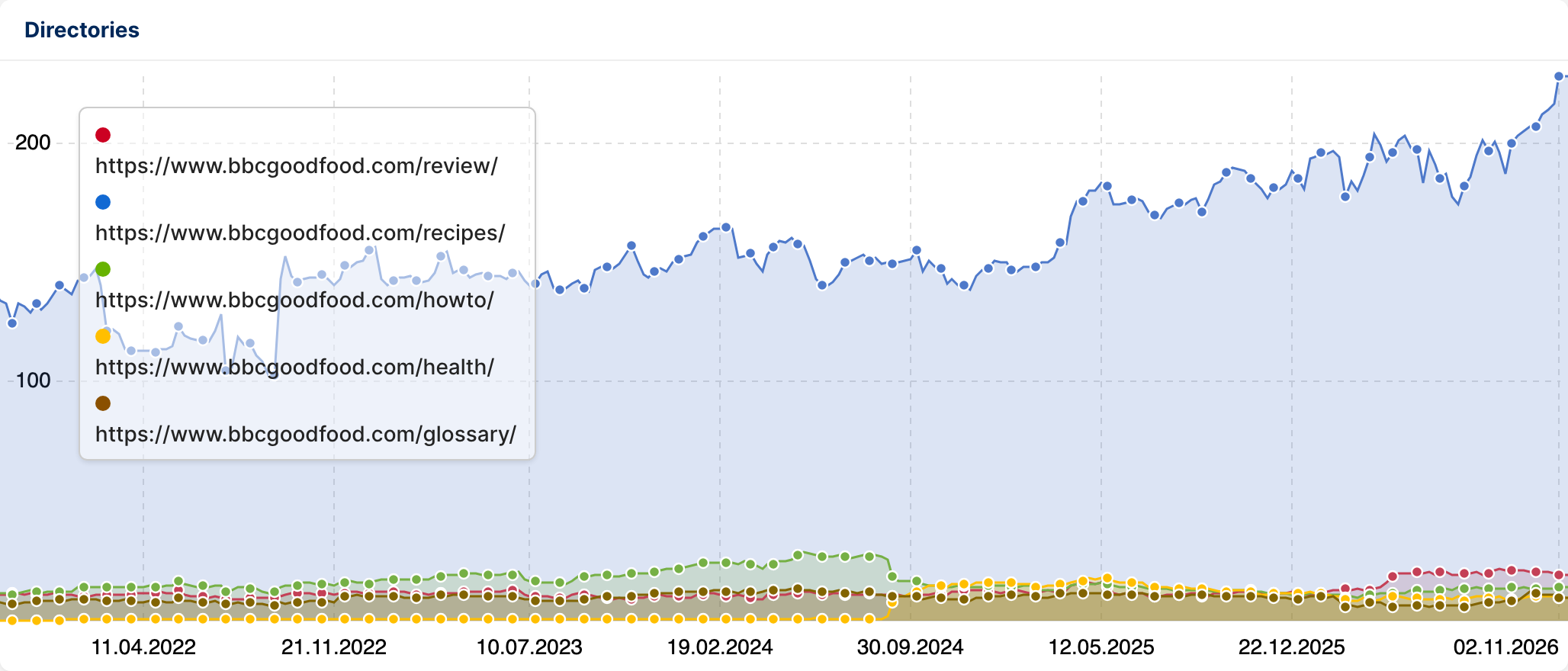
The /recipes/ directory’s visibility has climbed steadily since 2022 and is at a record high right now.
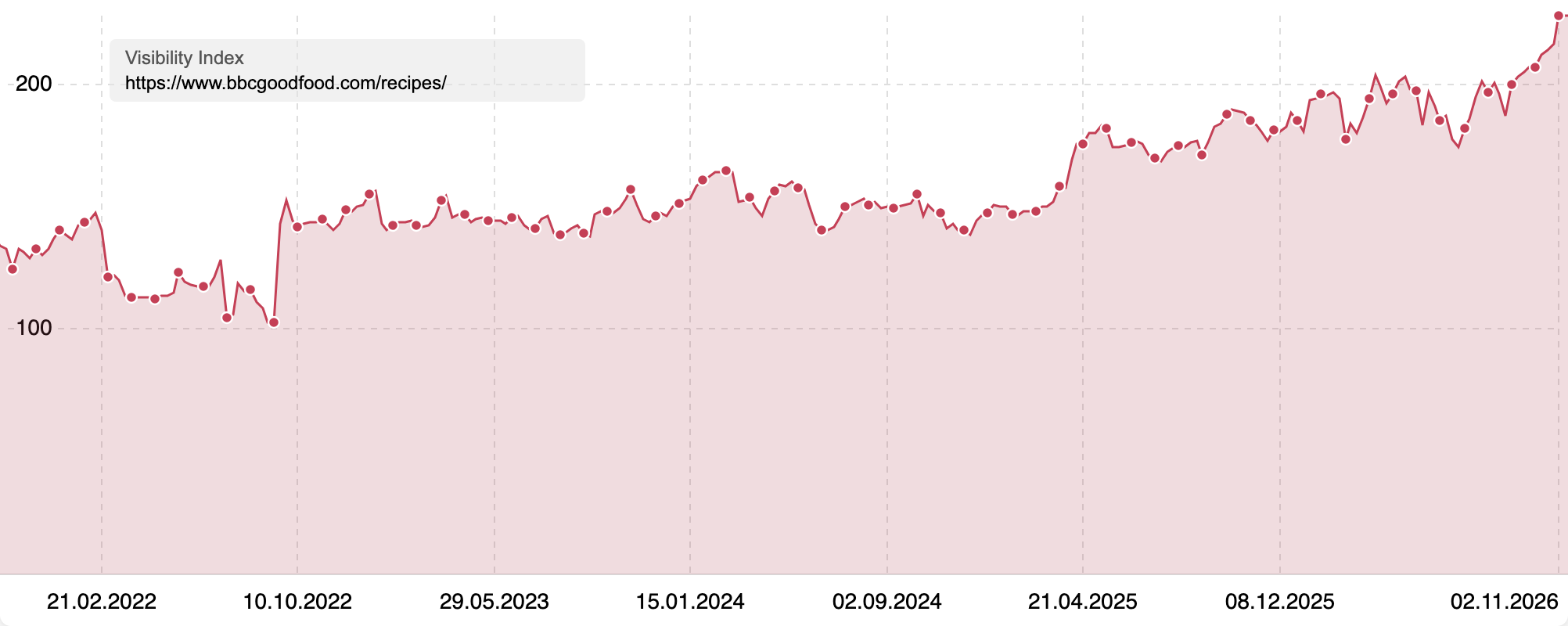
This includes for our sample keyword set where we can see its continual grwoth over the past two years:
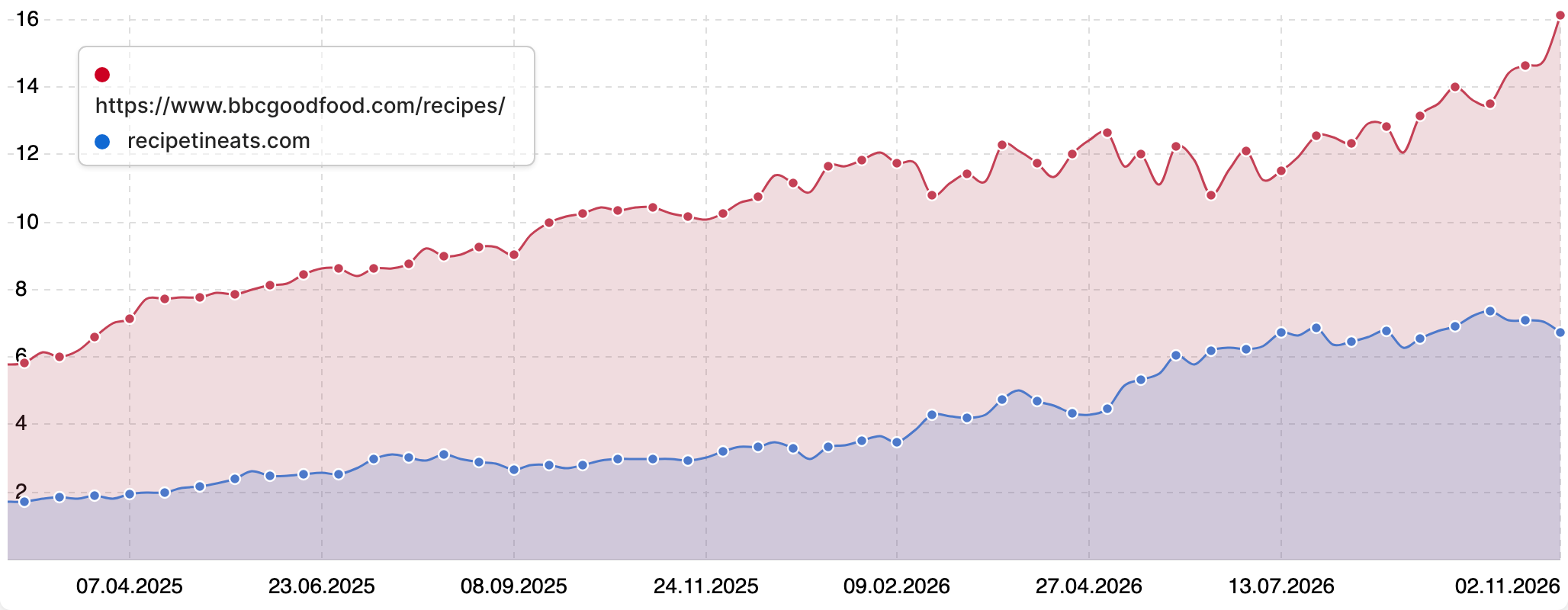
Inside /recipes/ sits a second engine: /recipes/collection/.
These pages curate recipes around a theme. That could be a meal type like desserts, a food type like soups, a diet, a piece of kit like the slow cooker, or an occasion like Christmas. The collection section alone ranks for 110,801 keywords and drives 4.1 million visits a month, worth £2.1 million.
These pages catch the searcher who hasn’t picked a dish yet, whether they want easy vegetarian recipes or ideas for a party this weekend.
This smart structure means the site captures searches at different stages of their cooking job: those who know exactly what they want to cook and those still seeking inspiration. As these are simply landing pages that list recipes, Good Food is using its leftovers to make brand new meals without much extra effort.
Good Food’s most successful URL is its easy pancakes recipe, which holds 20 page-one rankings in our set. Brand authority helps, but the page itself does a lot right:
- It gets straight to the recipe: no cliché of a long story before the method here
- The ingredients and steps are clear and easy to scan
- The key facts sit up front: you can see how many people it serves, the prep time, cooking time and difficulty level before you scroll
- Links to alternatives and complementary dishes are built in: tips and swaps answer the “what if” questions before they come up
- The layout stays clean: no intrusive ads get between the cook and the method
- Real cooks back it up: almost 500 comments and tips, plus star ratings, show a genuine community that has made the recipe and rated it. That’s first-hand experience Google can see
- The page has FAQs, and not just generic ones. For pancakes, there are questions on using the best pan, how much batter to use and what to do if your batter is lumpy
- There’s even a printable version of the recipe (which links straight to a command to print, not to an alternative version that needs canonicalising)
In our AI answers, though, the same page earns just three citations, all from a single prompt. Allrecipes’ pancakes earn nine, across four prompts. Good Food built the page Google trusts most, but the chatbots look elsewhere.
RecipeTin Eats: the overseas blog Britain can’t resist
Our second example shows a foreign food blog can beat the locals on home turf.
RecipeTin Eats is the work of Sydney-based cook Nagi Maehashi. It’s third in our Google set, behind only the two huge recipe brands, and third for AI citations too. It cooks up 20 of our top 200 URLs and 44 of the top 500.
Across the UK, the site ranks for 143,829 keywords, bringing in 3.42 million visits a month, worth £1.34 million. Not bad for a site based over 10,000 miles away.
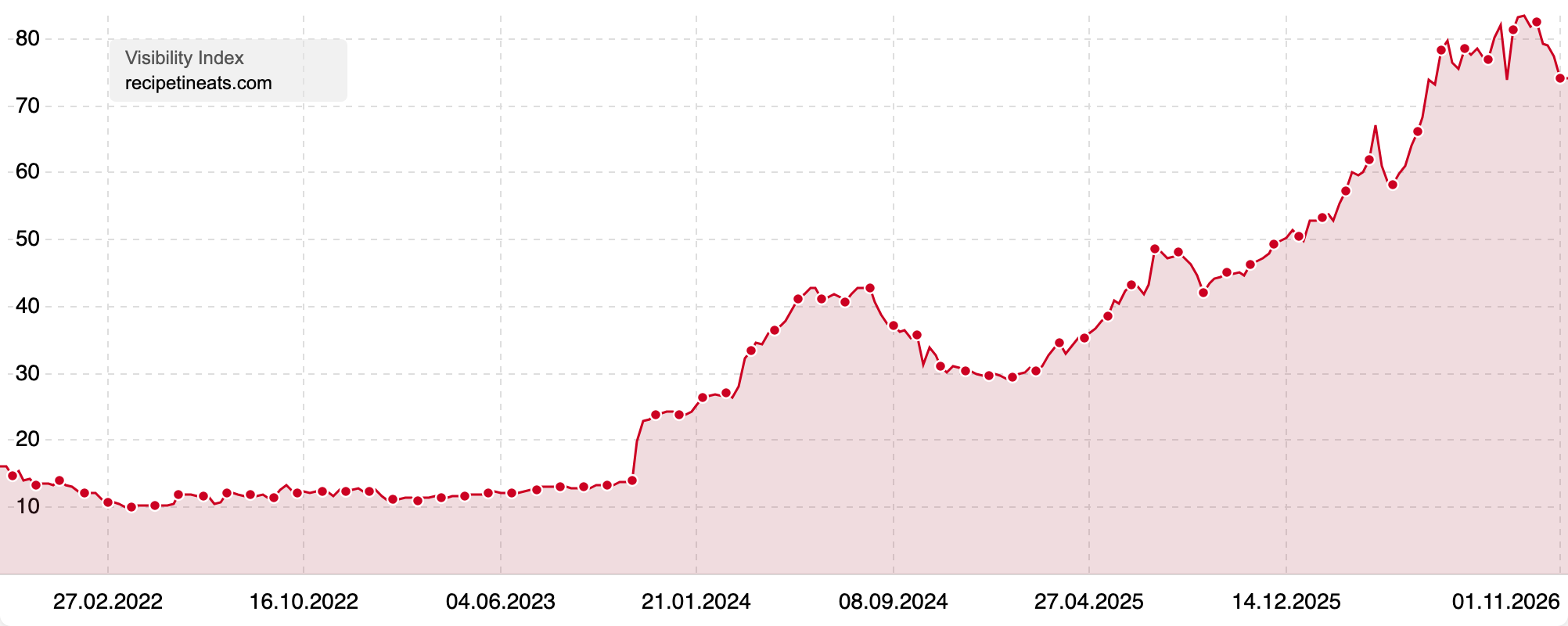
Its growth has been dramatic. Visibility sat flat through 2022 and 2023, then took off at the end of 2023. After a dip in early 2025, it climbed again to a peak this autumn of around seven times its 2023 level.
Most of its recipes live at the root of the domain, so it’s harder to see which sections do the work. But one directory stands out. /category/ houses listing pages that curate recipes around a need, such as cake recipes or recipes using beef mince. 184 of these pages rank in the UK. Together, the directory ranks for 11,215 keywords and drives 234,467 visits a month, worth £115,000. One of them, the dumplings category, even makes our top 500 URLs.
The site’s star page is its recipe for spaghetti bolognese. It’s the 7th most visible URL in our set, with 24 page-one rankings, and the site’s 6th most visible URL in the UK overall. Here’s what it does well:
- A named expert: Nagi’s byline and a nod to her debut cookbook show who’s behind the recipe (complete with link to the about page)
- The proof of the pudding: a 4.97 rating from 478 votes, and over 1,100 comments
- It answers the follow-up questions: sections cover what goes in, how to make the sauce, the difference between bolognese and meat sauce, how to toss pasta properly and what to serve with it
- It shows as well as tells: step-by-step photos and a full recipe video. The multi-format approach not only makes this page a more useful resource; it offers more ways for the brand to appear in different search results
- The recipe card does the heavy lifting: prep and cook times, servings, ingredient swaps, seven recipe notes and nutrition. A jump link takes impatient cooks straight there
- Two ways to learn: The longer-form ‘how to’ explains the process in detail (but still gets to the point quickly and doesn’t have unnecessary exposition getting in the way of the useful content), and the recipe has all the measurements and step-by-step instructions. Whatever level of detail you need, this recipe has you covered
- It’s kept fresh: first published in 2019 and updated in April 2025
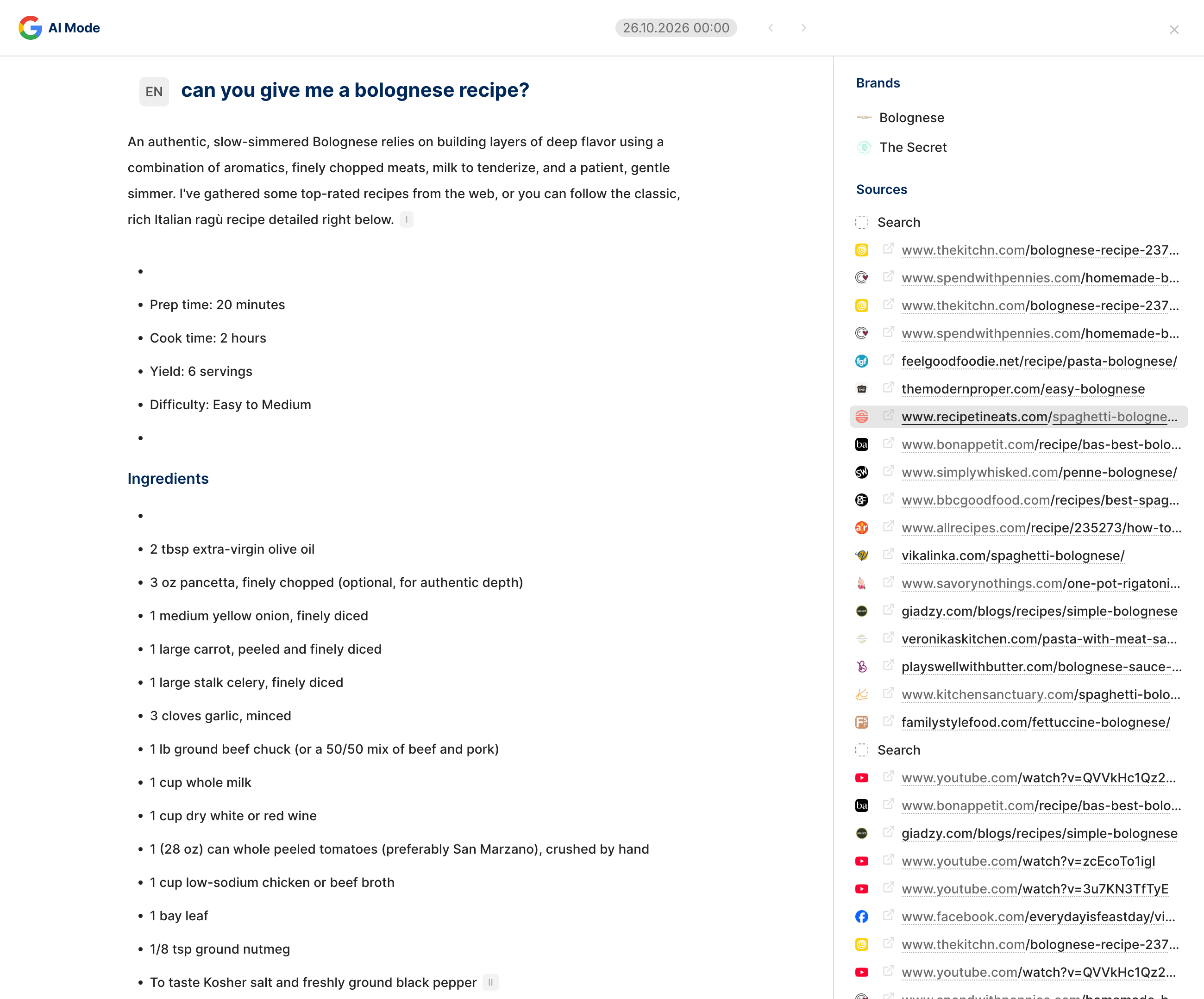
Here’s the twist. RecipeTin Eats is the third most-cited source in AI answers, with 160 citations across 85 URLs. Yet its bolognese, the site’s best page in Google, doesn’t appear in our AI set at all. For bolognese, ChatGPT and AI Mode went to Bon Appétit, Spend With Pennies and The Kitchn instead. A strong domain doesn’t guarantee your best page gets the citation.
A recipe for inspiration
UK blogger Taming Twins follows the same pattern. Its recipes also sit at the root of the domain, so its most successful directory is /category/. These listing pages group recipes by type and need, such as pasta main courses and meals under 30 minutes.
Across Good Food, RecipeTin Eats and Taming Twins, the lesson repeats: each recipe works twice. It ranks once as a page in its own right, then again inside curated and automated collections. Those collections target “idea” searches from people who know they want pasta or a quick dinner but haven’t picked a dish. We didn’t measure these searches in this study, but every winner we looked at has built for them.
YouTube: the winner you can’t chart
One name runs through both datasets without a single standout page.
YouTube is the 4th most visible domain in our Google set, ranking for 63.5% of our keywords, more than BBC Food. Yet it makes page one for only 26.6% of them, and not one individual video page reaches our top 500 Google URLs. Google sprinkles videos across lots of results without any one taking over.
AI answers flip that around. YouTube is the most-cited source in our tracker, with 629 citations across 337 different videos. That’s almost a quarter of all citations among our 100 most-cited sources, and more than Allrecipes, RecipeTin Eats and The Kitchn combined. Still, no single video dominates: the most-cited earns just four mentions.
Video is a prominent format in this sector. Many top brands publish their recipes as both written pages and videos, giving them more chances to rank.
For a “how to make” question, a chatbot is happy to point to someone showing you how. For recipe sites, that makes video less of an extra and more a second front door.
Summary and takeaways
From Yorkshire puddings to butter chicken, recipe searches are as crowded as a kitchen at Sunday lunch. And Google and the chatbots don’t always agree on who should be doing the cooking. So what can we learn from the sites serving up visibility in both?
- Ranking first doesn’t mean being cited first: Good Food and BBC Food own Google’s recipe results, yet they sit 5th and 24th for AI citations. Only 25 of the top 200 URLs appear in both our Google and AI sets. Track your AI visibility separately, because your Google rankings won’t tell you the full story
- Build the recipe page home cooks trust: Good Food’s pancakes and RecipeTin Eats’ bolognese both get straight to the recipe. They put the key facts up front and answer the follow-up questions. Ratings, hundreds of comments and a named expert give Google the first-hand experience it hungers for
- Make every recipe work twice: Good Food’s /collection/ pages drive 4.1 million visits a month by regrouping recipes it already has. RecipeTin Eats and Taming Twins do the same with /category/ pages. Collections catch the “what should I cook?” searches that a single recipe can’t
- Don’t put all your eggs in one format basket: YouTube is the most-cited source in AI answers, with 629 citations, and video and social make up 13% of AI-cited pages against none in Google’s top 200. Publish your recipes as video as well as text, and link the two together
- Earn the click Google no longer guarantees: Two in three of our recipe keywords trigger an AI Overview, and over 93% show recipe cards. Clean structured data gets you into the cards. Give yourself as many ways to appear as possible. Tips, swaps, FAQs and videos give cooks a reason to visit again once they’re there
Our SectorWatch process for recipes
To find the best-performing content and sites, we first needed a keyword set that reflects how the UK actually searches for recipes. So we seeded it from real popularity data.
Our core source was YouGov Ratings’ most popular dishes, topped up with YouGov’s most popular British dishes. We then cooked up a SISTRIX deep dive for the seed term “recipe” to identify the most popular searches containing it. YouGov tells us what Britain loves. SISTRIX tells us what Britain searches for. They don’t always match: roast chicken tops YouGov’s poll, yet draws just 22,400 recipe searches a month.
That left 2,857 keywords with at least 50 searches a month on average across 947 dishes, worth almost 5.8 million searches a month in the UK. Some examples from the list:
- yorkshire pudding recipe: 290,000 searches a month, our biggest keyword
- pancake recipe: 220,000. Add American (80,100), banana (23,950) and protein pancakes (10,050), and pancakes account for over 8% of the whole set
- lasagne recipe: 86,500. “Lasagna recipe” adds another 53,600, so the US spelling takes 38% of the demand
- tzatziki recipe: 31,700, proof that dips punch above their weight
For our AI prompt tracker, we turned the 250 most-searched dishes into natural-language questions, such as “Can you give me a recipe for patatas bravas?” We then added 19 general recipe questions from Google’s ‘People Also Ask’ panels. We tracked all 269 prompts across ChatGPT and Google’s AI mode.
Want to run this process on your own sector? The method is repeatable: seed from real bestseller and top-rated lists, expand and filter in SISTRIX, then track both organic and AI results. Try SISTRIX for free and see who’s winning in your market. Full toolkit, all the data, no commitment.


