
This month, SectorWatch is heading to the departure lounge and checking in on the world of international flights. With aggregators, airlines and comparison sites all jostling for pole position on the runway, the battle for visibility is fiercer than the scramble for an overhead locker on a full EasyJet.
Whose organic strategy has cleared for take-off? And whose visibility has been delayed indefinitely?
- The top domains in the UK for international flights
- Top 20 domains for searches for international flights:
- Sector search and click volume
- What’s trending in the flight destination search market?
- Content examples: What type of content is performing?
- The top URLs for international flights
- High-performance content directories
- Skyscanner’s dual-directory strategy
- The best airline structure in the results
- Summary and takeaways
- Keyword research in the international flights sector
- Our SectorWatch process
💡 According to the CAA’s annual airport data for 2025, published in March, UK airports handled 263.5 million international passenger journeys in 2025 – a 2.9% increase on the year before. Factor in domestic routes and the total climbs to over 302 million, a new record.
The top domains in the UK for international flights
So, who has secured their boarding pass to the top of Google’s results, and who is still waiting at the gate?
To understand whose visibility is taking off, we built our keyword set to represent some of the UK’s most popular international flight searches.
Rather than splitting queries by intent, we used the CAA’s freshly-published 2025 UK airport international passenger data to identify the most popular 100 destinations, top 25 countries and busiest UK departure airports by passenger number. From these most popular travel choices, we built a keyword matrix covering a range of flight booking searches, such as routes, destinations, departure airports and price-led queries. We then filtered the list to keywords with at least 50 monthly UK searches on average.
Winning domains for ‘Do’ searches:
- skyscanner.net
- easyjet.com
- ryanair.com
Flight and travel aggregator platforms hold commanding positions, and it is not that close.
Skyscanner appears on page one for 76.2% of our sample keyword set, a level of dominance that is rare in any sector we’ve analysed (apart from Amazon in some ecommerce sectors). Expedia and Kayak are also formidable players, ranking in the top 10 for 58.4% and 56.0% of queries, respectively. Cheap Flights and Booking.com also appear in the top 10.
The two airlines in the top three – EasyJet and Ryanair – are notable exceptions, both punching well above their weight compared. British Airways, by contrast, ranks at 13 and reaches the top 10 for just 15.8% of our keyword set. Thanks to serving popular routes, KLM and Jet2 also appear in the top 10 winning domains.
The travel platforms are battling the airlines for search visibility, with one striking asterisk: Google ranks itself sixth, appearing for 61.57% of our keywords, and on page one for 49.92%, through its Google Flights service (which has long been a source of complaints from the travel industry).
💡 Spain is the runaway favourite destination, drawing 47.7 million UK passengers in 2025 alone, more than double that of the USA in second place. At a city level, Dublin leads with over 10 million passengers, followed by Amsterdam (8.6 million) and Alicante (6.5 million). Heathrow handles around 31% of all UK international departures (79.5m international passengers in 2025), while Manchester is the dominant force outside London with 30.2 million international passengers.
Top 20 domains for searches for international flights:
| # | Domain | Project Visibility Index |
|---|---|---|
| 1 | skyscanner.net | 1745.64 |
| 2 | kayak.co.uk | 632.85 |
| 3 | easyjet.com | 613.07 |
| 4 | expedia.co.uk | 604 |
| 5 | ryanair.com | 579.74 |
| 6 | cheapflights.co.uk | 546.86 |
| 7 | google.com | 476.77 |
| 8 | klm.co.uk | 315.38 |
| 9 | booking.com | 270.82 |
| 10 | jet2.com | 261.65 |
| 11 | lastminute.com | 214.83 |
| 12 | britishairways.com | 185.37 |
| 13 | opodo.co.uk | 173.72 |
| 14 | airfrance.co.uk | 156.65 |
| 15 | edreams.co.uk | 135.65 |
| 16 | wizzair.com | 130.89 |
| 17 | virginatlantic.com | 130.87 |
| 18 | momondo.co.uk | 113.99 |
| 19 | lufthansa.com | 104.57 |
| 20 | flightaware.com | 85.11 |
Sector search and click volume
Our market research set out to capture a representative sample of how UK travellers search for international flights, from high-volume generic queries like “flights to Amsterdam” (34,900 searches/month) down to specific route searches like “flights from Manchester to Madrid” (50). The result is a single, transactional keyword set of 4,763 queries accounting for over 2.8 million searches per month.
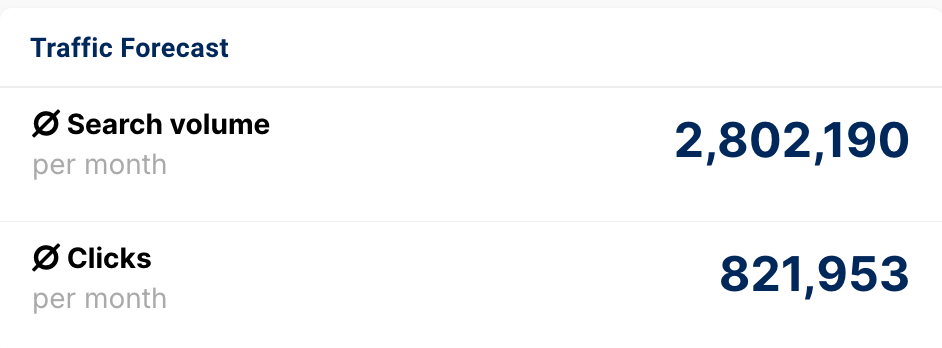
An important part of any keyword analysis in today’s Google search results is to account for AI Overviews. These summarise key information at the top of the page, often answering the query directly in the SERP (search engine results page). 51.1% of our ‘do’ keywords contain an AI overview, showing Google attempting to add extra insight even into commercial brand searches.
💡According to the ONS Travel Trends 2024, UK residents made 94.6 million trips abroad in 2024, spending an estimated £78.6 billion in the process.
What’s trending in the flight destination search market?
By analysing the trend and seasonality data within our keyword set, we can identify which destinations, routes and search topics have surged in interest.
Flight searches follow some of the most predictable seasonal patterns in all of UK consumer search. January brings a wave of “holiday inspiration” queries as people plan their breaks, Easter and summer booking windows drive huge spikes in destination and route-specific searches, and Black Friday and New Year sales trigger sharp bursts of price-led demand. But beyond the seasonal rhythm, flight search is also highly reactive. New route announcements, changes in holiday trends or visa rules, or a spike in fuel prices can all move search volumes.
Here are some of the trending search terms and themes we identified from this sector:
- Flights to Paris (Including queries about flights to Paris from London and from regional airports such as Birmingham and Leeds)
- Flights to New York with a big jump for many queries in December 2025
- Flights to Hong Kong (including queries like “London to Hong Kong” and especially on flying from Manchester to Hong Kong)
- Flights to Dublin (including variants like “cheap plane tickets dublin” and “cheap flights dublin“)
- “Egypt flights“
- “Naples flights“
- “Flights to Hamburg“
Content examples: What type of content is performing?
The UK flight search SERPs reveal a sector where the rules are unusually consistent. Across 4,763 transactional queries, Google overwhelmingly rewards one type of page: the dedicated route page. Tightly-targeted pages built around a specific customer query are the currency of this sector. And in a market where the content format is somewhat commoditised, the sites that have built the most of them, most effectively, are the ones dominating the results.
- OTCs, metasearch and aggregator platforms own the top of the results: Skyscanner, Expedia, Kayak, CheapFlights and their peers collectively account for the majority of page-one visibility across our keyword set
- These act as comparison engines, and Google treats them as the most useful first stop for searchers whose intent is to find and book a flight. Their breadth of coverage, ability to surface live pricing, and sheer depth of route-level pages make them structurally difficult for airlines and other sites to outrank at scale
- Skyscanner’s dominance is in a category of its own: Ranking on page one for 76.2% of our keyword set, Skyscanner’s Visibility Index score of 1,239.98 is more than 2.5 times that of its nearest rival, easyJet (484.7). The engine behind this is its /routes/ directory – a vast library of city-pair pages (and airport pair pages), each laser-focused on what the user wants: price, carriers, and a quick path to booking
- Airlines still take flight: The route-page model that makes aggregators successful translates well for low-cost airlines that cover many routes, but less so for legacy carriers
- easyJet (#2) and Ryanair (#3) have both built strong directories of origin-destination pages and country pages that reflect how their customers search, with easyJet’s /en/cheap-flights/ directory adding country and city-level hubs to capture departure airport agnostic destination queries
- British Airways, by contrast, ranks in the top 10 for just 15.8% of our keyword set despite being the UK’s flag carrier. Air France (14.6%), Lufthansa (13.6%) and Virgin Atlantic (8.5%) tell a similar story, mainly ranking for high-value long-haul routes which short-haul carriers can’t cover, and their brand authority carries more weight
- Google ranks its own product in its own results: Google.com sits sixth in our domain rankings, appearing in the top 10 for just under half of all queries through Google Flights. Google is simultaneously a distribution channel and a direct competitor, surfacing its own comparison tool ahead of many of the airlines and aggregators it – in theory – serves
- Airport websites and Jet2 represent two underappreciated angles: Bristol, Manchester, Birmingham and Stansted all appear in the top 25 domains, capturing meaningful visibility for departure-specific queries from users who know where they’re flying from before they know where they’re going
- Jet2 (ranking at #9) benefits from the overlap between flight-only and flight-plus-holiday intent beyond many of the searches for our keywords. Jet2 has an entire /flights/directory focused on the “cheap flights” subtopic. When you reach these pages, you can upgrade to a full holiday package via one of their brands
- The route page template is the sector’s defining content format: The highest-performing pages share a consistent structure: a clear origin-destination pairing in the URL and title, live or indicative pricing, carrier options, departure airport information and a direct path to booking. There is very little editorial content in the top results — this is a sector where utility wins, every time
The top URLs for international flights
When you build a keyword list in SISTRIX, one of the most revealing reports available is the top URLs – showing not just which domains win, but which individual pages are doing the heavy lifting. For a sector as structurally interesting as flights, the patterns of what works are particularly helpful.
| # | URL | Top Keyword |
|---|---|---|
| 1 | https://www.turkishairlines.com/en-gb/flights-from-london-to-istanbul | flights to istanbul |
| 2 | https://www.ryanair.com/flights/gb/en/flights-to-dublin | flights to dublin |
| 3 | https://www.easyjet.com/en/cheap-flights/italy | cheap flights to italy |
| 4 | https://wwws.airfrance.co.uk/en-gb/flights-from-london-to-paris | london to paris |
| 5 | https://flights.virginatlantic.com/en-gb/flights-from-london-to-new-york | flights from london to new york |
| 6 | https://www.wizzair.com/en-gb/cheap-flights-from-london-to-istanbul | flights to istanbul |
| 7 | https://www.easyjet.com/en/cheap-flights/italy/rome | flights to rome |
| 8 | https://www.britishairways.com/content/flights/france/paris | flights to paris |
| 9 | https://www.easyjet.com/en/cheap-flights/spain | flights to spain |
| 10 | https://www.google.com/travel/flights/flights-from-london-to-barcelona.html?gl=GB&hl=en-GB | flights to barcelona |
The patterns here are consistent and clear. Dedicated route pages dominate. Not homepages, not generic destination guides, but tightly targeted pages built around specific countries, destinations and especially origin-destination pairings.
Skyscanner’s /routes/ directory accounts for the majority of its top URLs, each page focused on a single city-pair, such as London-to-Barcelona or London-to-Athens. Ryanair and easyJet follow a similar logic, with their top pages built around specific routes (such as ryanair.com/flights/gb/en/flights-to-barcelona) or country-level hubs like easyjet.com/en/cheap-flights/italy.
Our top 300 pages only rank for up to 21 keywords each. It’s clear that in this market, having a breadth of specific URLs is key.
For example, Virgin Atlantic doesn’t serve the majority of the destinations we have included. But it has 16 route pages in our top 300 URLs, concentrated on high-value long-haul routes to the US, where premium fares and brand authority carry significant weight.
High-performance content directories
From our top URLs, the highest-performing pages cluster predictably around a small number of well-structured content directories. But the real insight is in understanding how each winning site has taken a distinct structural approach. We’ll look at:
- A metasearch giant that runs two flight paths in parallel, one targeting every specific route in the world and another going broader with destination-level pages
- An airline that builds a full departure lounge of country, city and area hubs to greet users wherever they are in their journey
- And a budget carrier that strips everything back to a single, lethally efficient directory
Skyscanner’s dual-directory strategy
Skyscanner appears 95 times in our top 300 pages. That’s the highest appearance rate of any domain in any SectorWatch study to date. This helps them rank for 76.3% of our keyword set, and on page one for 76.24% – if Skyscanner rank in this topic, they will almost certainly be on page one.
78 of those appearances come from a single directory: /routes/. The remaining 16 come from a second, structurally different directory: /flights-to/. Together, they represent a sophisticated two-pronged content strategy.
The /routes/ directory is a vast library of city-pair pages, each built around a specific origin-destination pairing, such as London-to-Barcelona, Edinburgh-to-Faro, or Manchester-to-Dubai. Skyscanner likely has a route page for every commercial flight path in the world.
With 12,393 URLs ranking for at least one keyword in the UK, the sheer breadth of coverage is staggering. Combined, these pages rank for 87,026 keywords and pull in an estimated 1.8 million organic visits a month, traffic worth £1.67 million.
The overall Visibility Index score for the directory at the time of writing is 1.024, reflecting the long-tail nature of the intent these pages target. Each individual page handles modest search volumes, but the aggregate effect of having a page for essentially every route a traveller might search is enormous.
What makes these /routes/ pages work? Having looked at several of the top-performing examples, the formula is consistent and deliberately functional:
- Immediate price signal: The lowest fare found is displayed prominently near the top of the page, with a clear recency note (“based on prices found in the last 4 days“). This is the first thing a user needs, and Skyscanner answers it before anything else
- Pre-populated booking engine: Making it easy to start finding options
- Key route facts above the fold: Average flight time, number of weekly flights, and which airlines fly direct are all surfaced immediately. This anticipates the three questions many customers will have before they decide to book
- Cheapest month tool: An integrated calendar feature shows the cheapest month (and day) to fly, directly addressing price-sensitivity for users who have flexibility
- Airport comparison module: Skyscanner shows alternative destination airports alongside their prices, capturing users who may be open to switching airports for a better fare. This is a nice example of clear information gain compared to rival pages, and a clever way to keep searchers on the site for longer. For London routes, Skyscanner surfaces alternative departure airports
- Price alert CTA: A prominent prompt to set up a price alert keeps users engaged even if they don’t book immediately, potentially helping earn return traffic
- A large amount of FAQs and key facts: These could be useful in helping someone decide what to book, but perhaps do a bigger job of adding content weight to the page to try and help it rank through offering topic depth
- Cross-selling: Car hire and hotel links appear after the booking content, offering cross-mechandising opportunities, but never in a way that competes with the core booking journey
Where /routes/ targets every specific city-pair, the /flights-to/ directory takes a destination-first approach.
This directory has 1,438 pages ranking in the UK, with each targeting a single destination airport – such as “cheap flights to Istanbul” or “cheap flights to New York JFK” – without specifying an origin. This makes them better suited to capturing users who know where they want to go but haven’t yet decided where they’re flying from, or for generally targeting these broader, and more popular, “flights to X” queries.
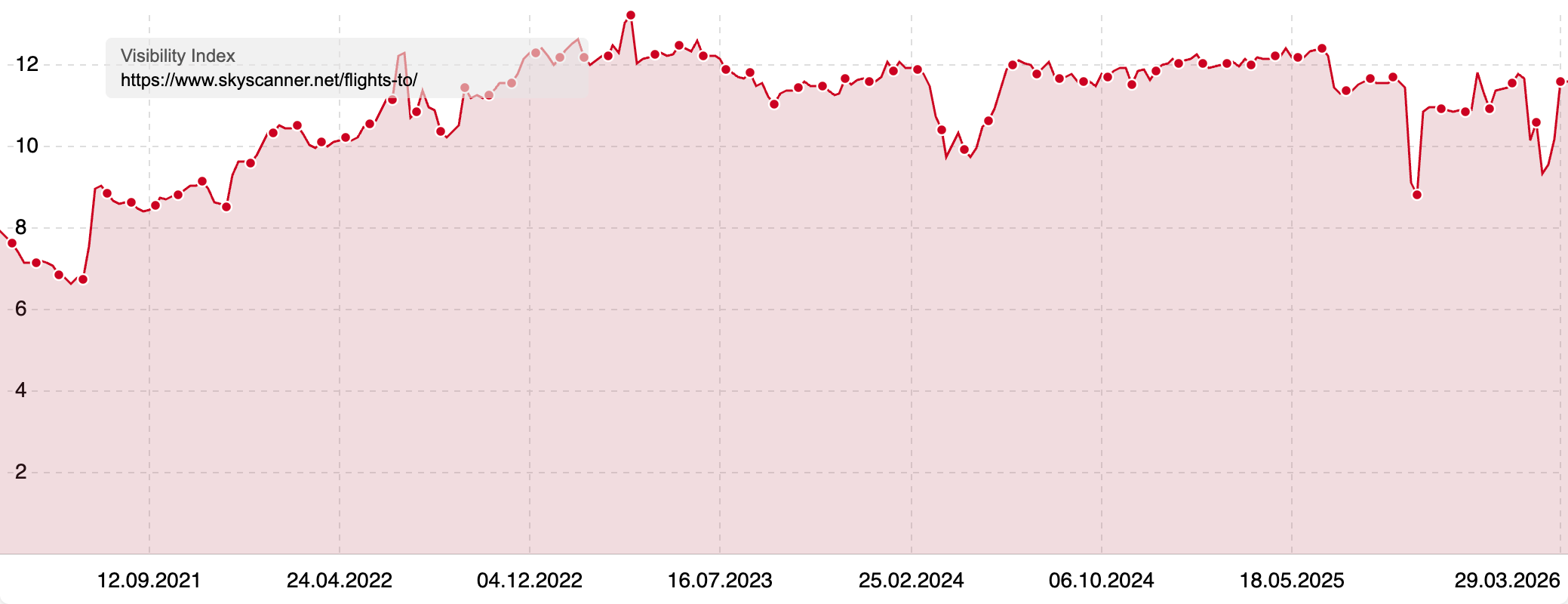
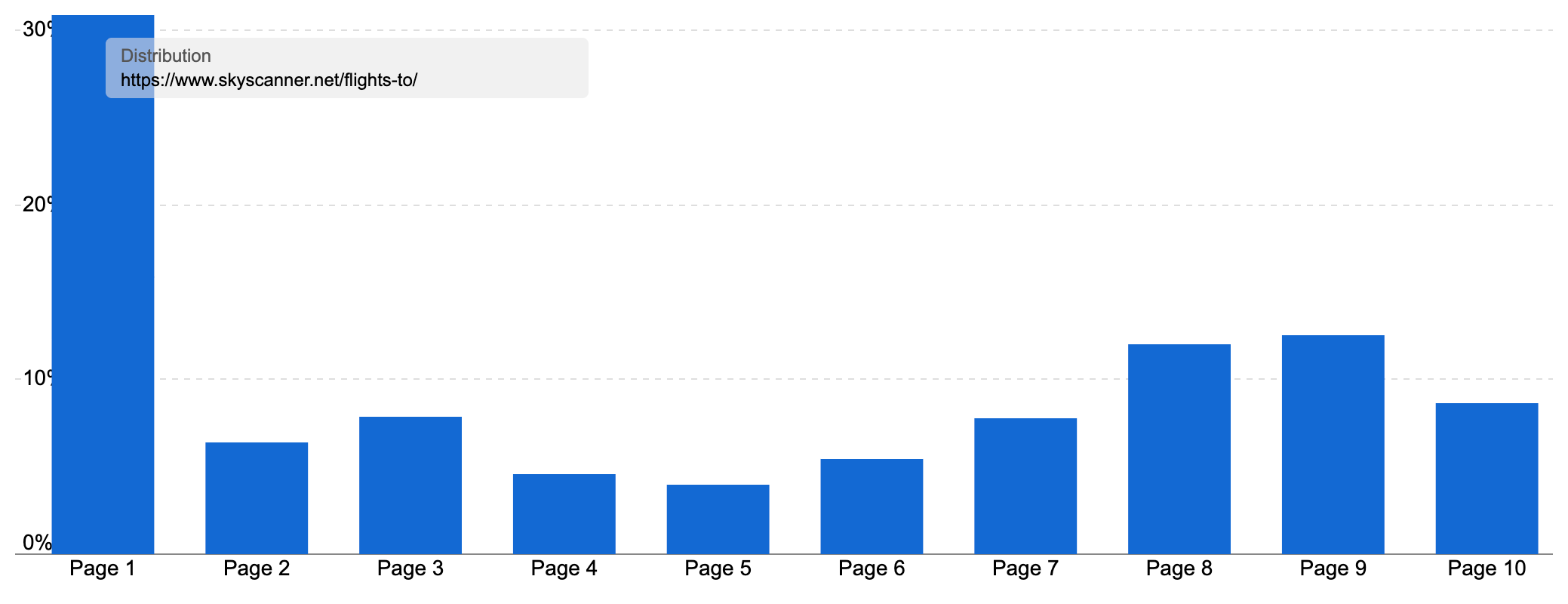
With 1,438 URLs against the /routes/ directory’s 12,393, it is a far smaller operation, but it targets broader, higher-volume head terms. The result is a VI score of 11.34, roughly ten times that of /routes/, reflecting the higher individual search volumes of the target queries. The directory brings in an estimated 1.4 million organic visits a month across 26,666 keywords, thanks to ranking on page one 30.88% of the time.
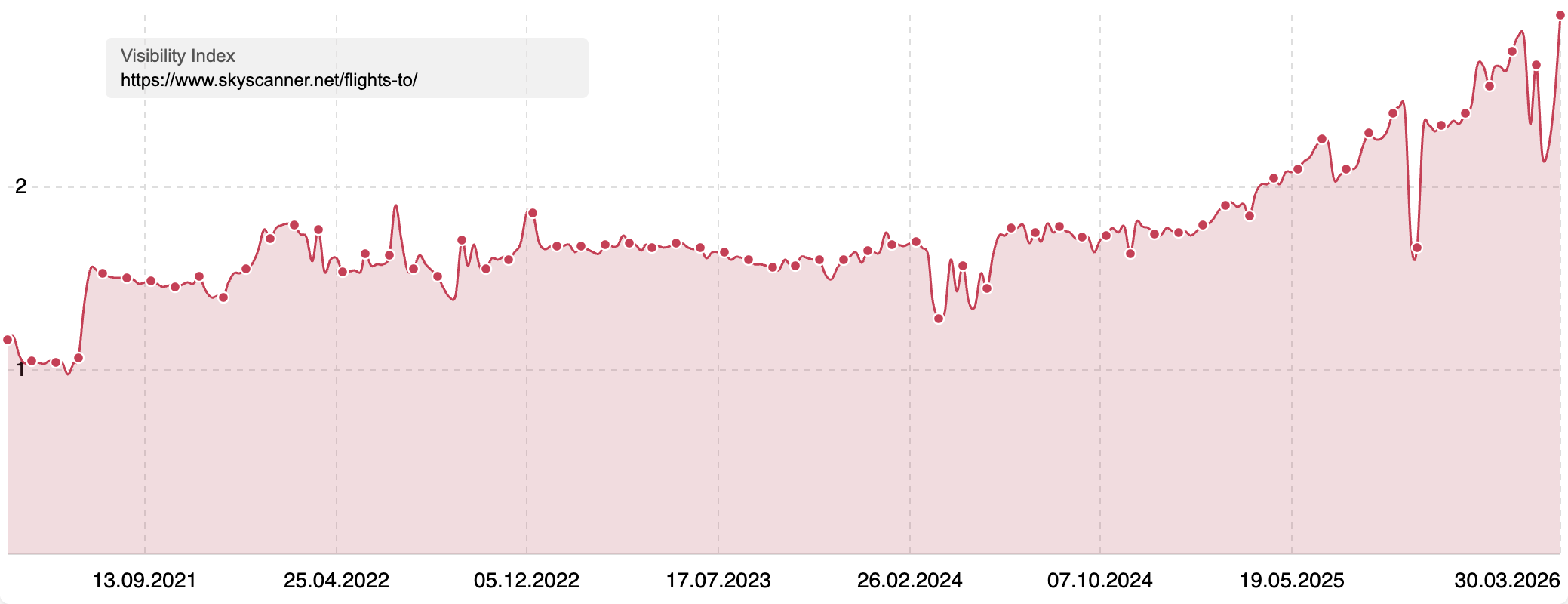
In fact, if we look at how this directory has performed for our sample keyword set, we can see how it has gradually but consistently improved over time:
The key story is Skyscanner’s deliberate dual approach:
- One directory is doing the long-tail work with extraordinary breadth, with every flight route across the world
- Another that focuses purely on the destination
Different pages do different jobs, together covering virtually every way a UK traveller might search for an international flight.
The best airline structure in the results
easyJet cannot compete with Skyscanner’s breadth; It can only rank for routes it actually operates. But within that constraint, it has built the most effective SEO content structure of any airline in our keyword set.
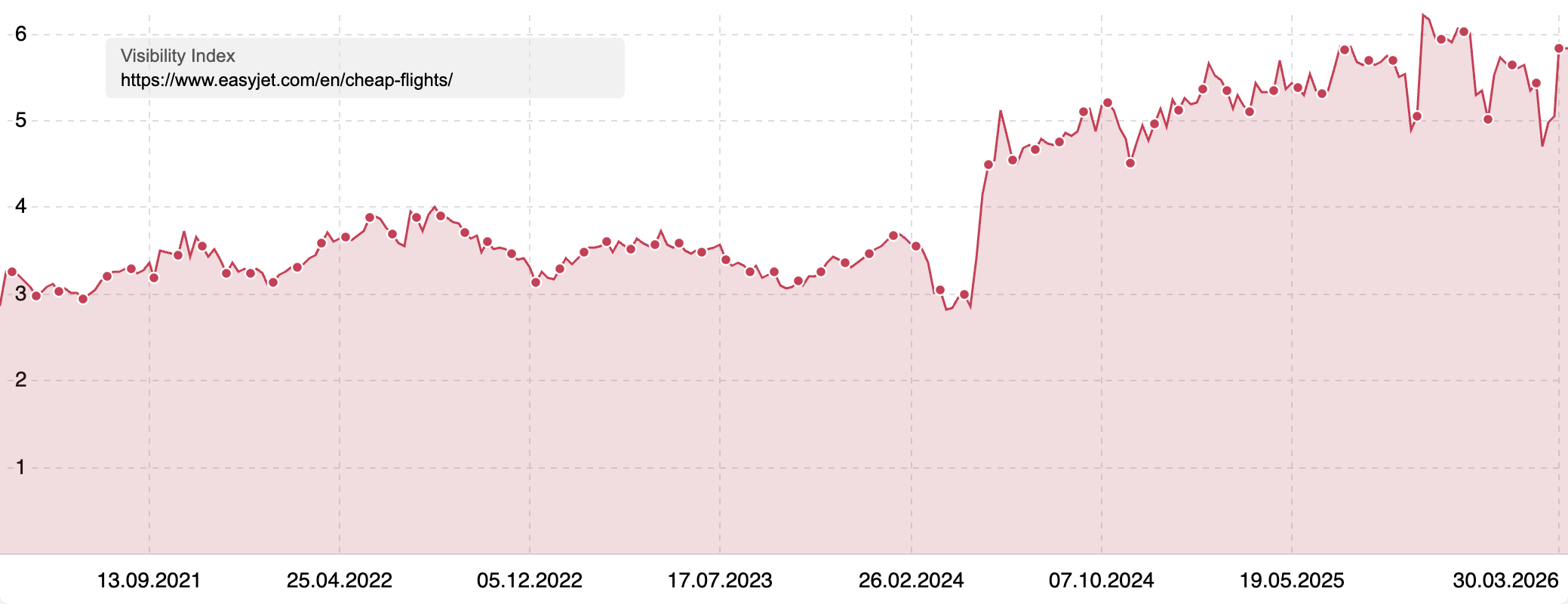
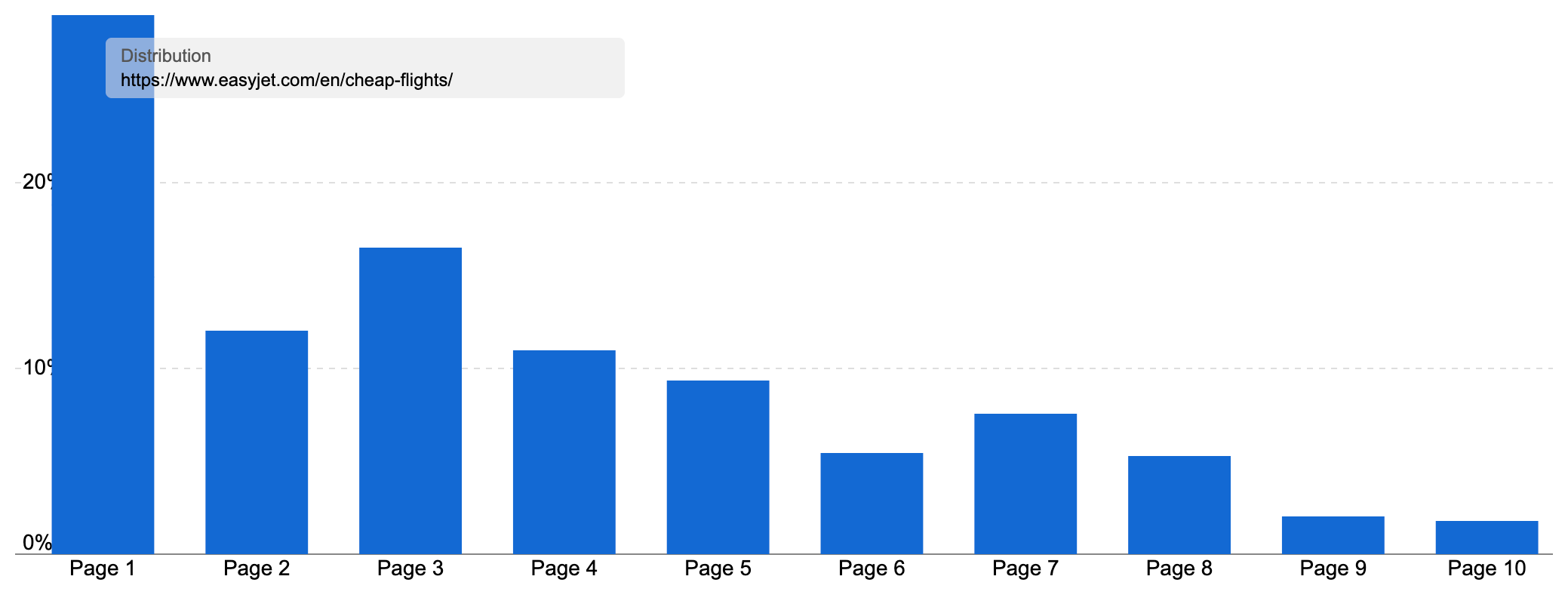
Pages from the /cheap-flights/ directory appear 44 times in our top 300 URLs, including 14 times in the top 100. The site ranks for 47.19% of our sample keywords, and on page one for 41.06%.
Overall, the directory ranks for 27,979 keywords in the UK, with an impressive 30.78% of those rankings appearing on page one. Together they drive an estimated 932,407 organic visits a month — traffic worth £895,000.
What makes the /cheap-flights/ directory structurally clever is its destination hubs with a three-tier hierarchy:
- Country hub pages (e.g. /cheap-flights/italy) capture broad destination intent
- City pages (e.g. /cheap-flights/italy/rome) target specific destination searches once intent narrows
- Area pages (e.g. /cheap-flights/italy/sicily) capture regional queries, particularly useful for island and resort destinations
This hierarchy means easyJet ranks across the entire funnel for any given destination, from early-stage exploration (“cheap flights to Italy“) through to specific intent (“cheap flights to Rome“).
easyJet has a hub for every country it serves. The Spanish section alone spans 38 URLs, ranks for just under 3,000 keywords, and brings in 86,200 visits a month.
The Italy country hub is one of the best examples of how easyJet balances SEO utility with genuine user value. It is worth examining in detail:
- Clear commercial intent matching: The page title (“Cheap flights to Italy”) and URL match the search query precisely. Basic, but the foundation of everything that follows
- Simple booking engine & example prices
- Brand strength and direct booking trust: As the airline, easyJet carries an implicit trust advantage. Users know the price shown is the real price, with no aggregator margin on top. The “Book direct with no added fees” message is front and centre in the meta description
- Destination editorial that earns its ranking: Rather than a thin page of flight listings, the Italy hub contains several hundred words of introductory destination content, covering regional contrasts (the industrial north vs the romantic south), seasonal guidance (when to go for weather vs crowds vs ski season), and practical travel tips. This is not filler; it provides contextual richness
- Smart internal linking to child pages: The Italy hub links naturally to city-level pages (Rome, Milan, Venice, Pisa, Naples, Sicily), each of which targets more specific queries. This creates a coherent internal linking structure that distributes authority downward through the hierarchy while giving users an obvious path to narrow their search
- Route links: To get even more specific, easyJet offers example prices and links for specific routes to Italy they offer
But easyJet doesn’t stop there. As we’ve seen, success in this sector also comes from getting more granular and specific via routes.
easyJet mirrors its hub structure for UK departure airports. Each has its own parent directory, with child pages for every destination served from that airport, creating specific route pages. For example, /cheap-flights/london-gatwick/barcelona.
Gatwick is a crucial airport for easyJet, and the site reflects this with a large hub. It contains 117 ranking pages generating 86,471 organic visits a month, covering every destination easyJet flies to from its key southern hub.
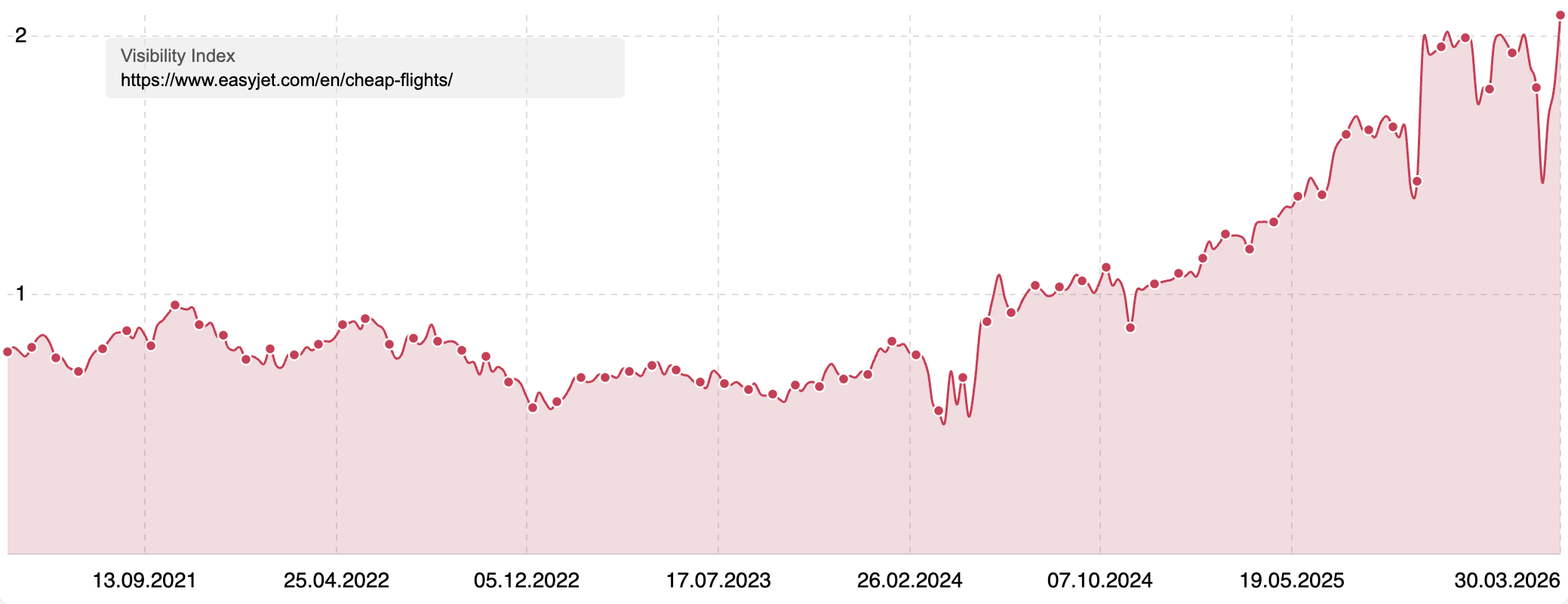
As with Skyscanner, easyJet’s formula for success is highly effective, as reflected in how visible the site has become for our keyword set, with a big increase over the past two years.
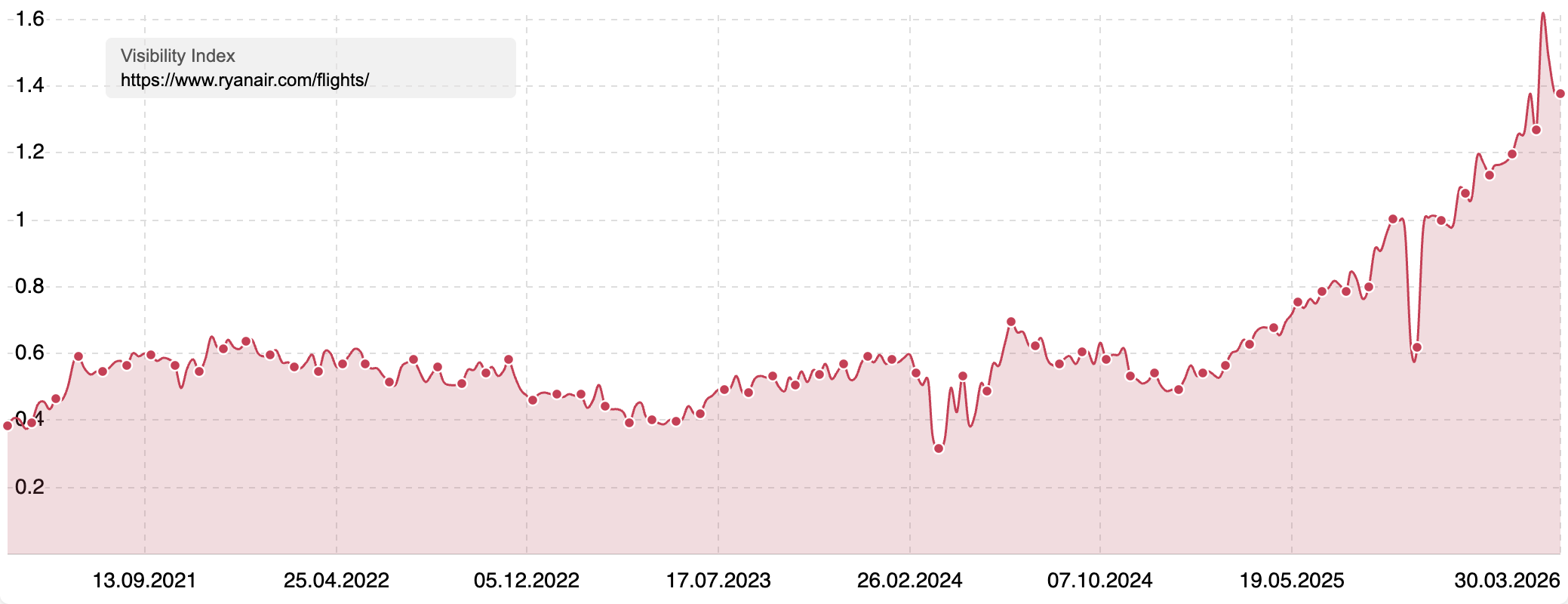
Ryanair takes a simpler but highly effective structural approach. All destination and route pages sit within a single /flights/ directory, with 5,191 pages ranking for at least one keyword in the UK at the time of writing.
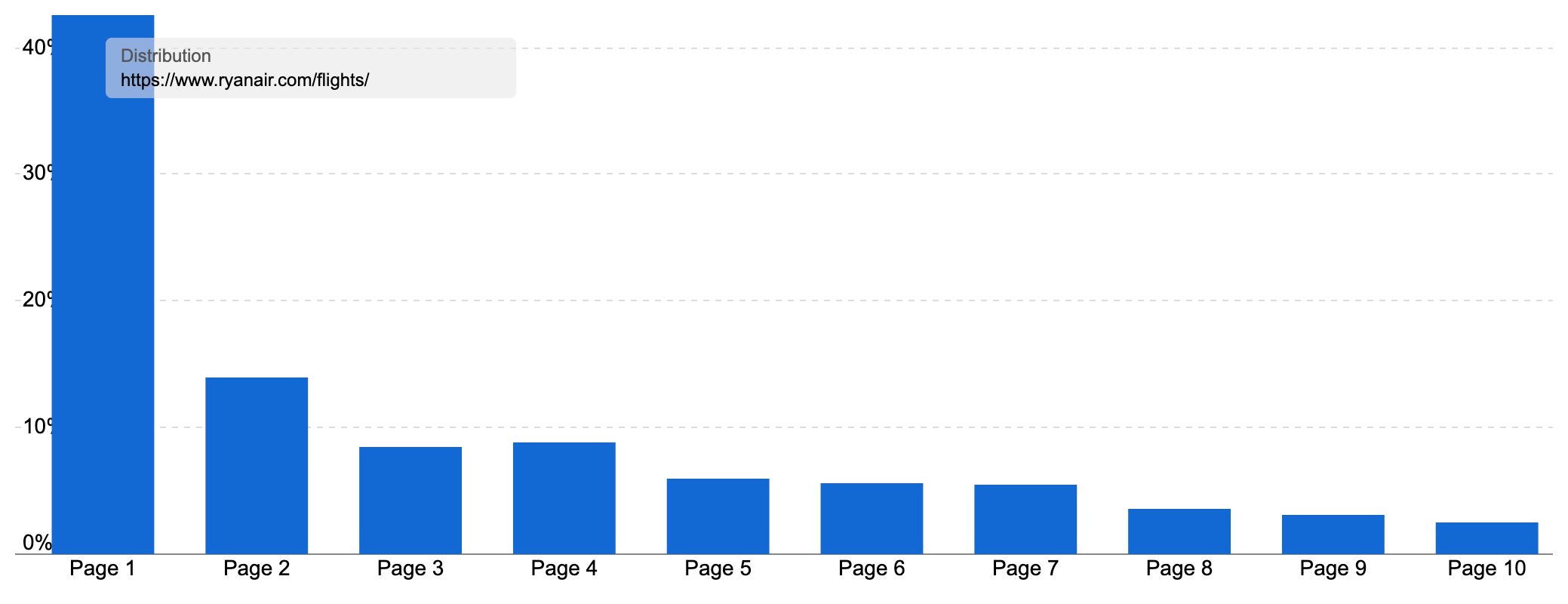
The headline number for Ryanair is its page-one rate: an outstanding 41.12% of this directory’s rankings appear on page one. The directory ranks for 28,851 keywords and drives an estimated 769,221 organic visits a month, worth £689,000.
Tightly structured route pages deliver exactly what a price-focused traveller wants. The higher page-one rate likely reflects both Ryanair’s brand authority in the flight travel space (especially for budget flights) and the precision with which Ryanair has created targeted pages with a page for “Flights to X” and then also for every route that Ryanair offers to that destination.
For example, Ryanair has a page for flights to Dublin, then a page for every UK airport they fly to Dublin from, such as Manchester or Newquay. Ryanair offers 23 destinations from Leeds Bradford airport, for example, so the site has 23 “from Leeds to X” route pages, all in the /flights/ directory.
As with Skyscanner and easyJet, Ryanair’s visibility for our sample keyword set has really taken off over the past year, securing that third place in our research.
Summary and takeaways
From a record 263.5 million international passenger journeys to 2.7 million monthly searches across our keyword set, the scale of UK flight search is remarkable. But the lesson from our analysis isn’t really about scale – it’s about structure. The winners in this sector have out-built the competition, with smarter, more systematic approaches to covering the full range of ways a traveller might search.
So what can the rest of the industry learn from the domains at the top of the runway?
- Breadth of coverage beats depth of content: This is a sector where having a page for every route, every destination and every departure airport matters more than having fewer, more polished pages. Skyscanner’s 12,393 /routes/ pages and Ryanair’s 5,191 /flights/ pages are not accidents – they are the entire strategy. If a user can search for it, there should be a page for it
- Every product or service you operate without a dedicated, indexed page is an organic opportunity you are handing to a competitor or aggregator
- Different pages should do different jobs: Skyscanner’s masterstroke is not one great directory; it’s using two, each designed for a distinct type of searcher. The /routes/ directory catches users who know their exact route; the /flights-to/ directory catches those who only know their destination. Map your content to the full search journey, not just the final booking query
- Utility is the only content format that counts – but utility at scale can be a differentiator: Route and destination pages are, in many ways, a commodity. Every airline, aggregator and comparison site can build them, and almost all of them do. The pages that win are not necessarily more beautifully designed or more richly written. They are more useful, more specific and more numerous
- Live pricing, route facts, carrier options, cheapest month tools and a frictionless path to booking are table stakes
- What separates Skyscanner from a mid-table aggregator is not the quality of any single page – it is having 12,393 of them, each precisely targeted at a different slice of search demand
- In a commoditised content format, scale and specificity become the only meaningful competitive advantages
- Airlines (suppliers) can compete with aggregators: easyJet and Ryanair prove that airlines can punch well above their weight in organic search, but only by accepting the same logic as the aggregators: systematic route coverage, clean URL structures and pages that match search intent precisely
- Google is a competitor, not just a channel: Google ranks on page one for just under half of our sample queries. For any brand competing in this space, or frankly in many online sectors, Google’s dual role as both the platform and a player in it is impossible to ignore and underlines why owning strong organic positions through well-structured content, rather than relying on Google to send traffic, has never been more important
Keyword research in the international flights sector
To explore Google’s results for the best-performing content and domains, we built a keyword set representing how UK travellers search for international flights. Rather than a traditional keyword research approach, we used the CAA’s Annual Airport Data 2025 (published 23 March 2026) as our foundation, ensuring our keyword set reflects actual UK passenger demand.
From Table 12.1 of the CAA data, we identified the top 100 international destination cities, top 25 destination countries and top UK departure airports by passenger volume. We then built a keyword matrix around each, covering the full range of flight booking queries: destination searches, origin-destination route pairs, departure airport queries and price-led variants. The list was filtered to keywords with a minimum of 50 average monthly UK searches, producing a final set of 4,763 keywords.
Some example keywords from our final list, illustrating the range of query types covered:
- flights to Amsterdam (34,900 searches per month in the UK on average)
- flights to Spain (21,400)
- cheap flights to India (16,300)
- London to Dublin flights (14,500)
- flights from Birmingham (9,850)
- cheap flights to Turkey (8,700)
- flights from Leeds Bradford to Alicante (250)
- cheap flights from Glasgow to Ibiza (50)
| Rank | Destination | 2025 Passengers | 2024 Passengers |
|---|---|---|---|
| 1 | Dublin | 10073716 | 9742852 |
| 2 | Amsterdam | 8555264 | 8581689 |
| 3 | Alicante | 6525196 | 6097994 |
| 4 | Dubai | 6372762 | 6231898 |
| 5 | Malaga | 6100517 | 5653464 |
| 6 | Palma de Mallorca | 5861578 | 5679858 |
| 7 | Tenerife (Surreina Sofia) | 5606949 | 5527165 |
| 8 | Barcelona | 4799831 | 4874397 |
| 9 | Paris (Charles de Gaulle) | 4610238 | 4353232 |
| 10 | Faro | 4497454 | 4369330 |
| 11 | New York (JFK) | 4003099 | 4206034 |
| 12 | Doha Hamad | 3739282 | 3593471 |
| 13 | Antyla | 3459672 | 3497653 |
| 14 | Arrecife | 3413538 | 3352699 |
| 15 | Madrid | 3376531 | 3307399 |
| 16 | Geneva | 3361555 | 3386520 |
| 17 | Lisbon | 3014505 | 3135416 |
| 18 | Istanbul | 2985575 | 2893638 |
| 19 | Copenhagen | 2768219 | 2748358 |
| 20 | Frankfurt | 2672757 | 2796064 |
| Rank | Airport | International Passengers 2025 |
|---|---|---|
| 1 | London Heathrow | 79,566,301 |
| 2 | London Gatwick | 39,805,101 |
| 3 | Manchester | 30,195,215 |
| 4 | London Stansted | 28,190,509 |
| 5 | London Luton | 16,472,156 |
| 6 | Birmingham | 12,510,504 |
| 7 | Edinburgh | 12,305,344 |
| 8 | Bristol | 9,458,248 |
| 9 | Glasgow | 4,879,970 |
| 10 | Liverpool John Lennon | 4,867,132 |
| 11 | Newcastle | 4,537,242 |
| 12 | Leeds Bradford | 4,254,229 |
Our SectorWatch process
For this SectorWatch, we began with the CAA’s 2025 international passenger route data to identify the destinations, countries and departure airports that matter most to UK travellers. From these, we built a structured keyword matrix and filtered for relevance and minimum search volume, leaving a tightly curated set of transactional queries reflecting real UK flight booking behaviour. The results are based solely on organic search rankings for the chosen keywords at the time of analysis.
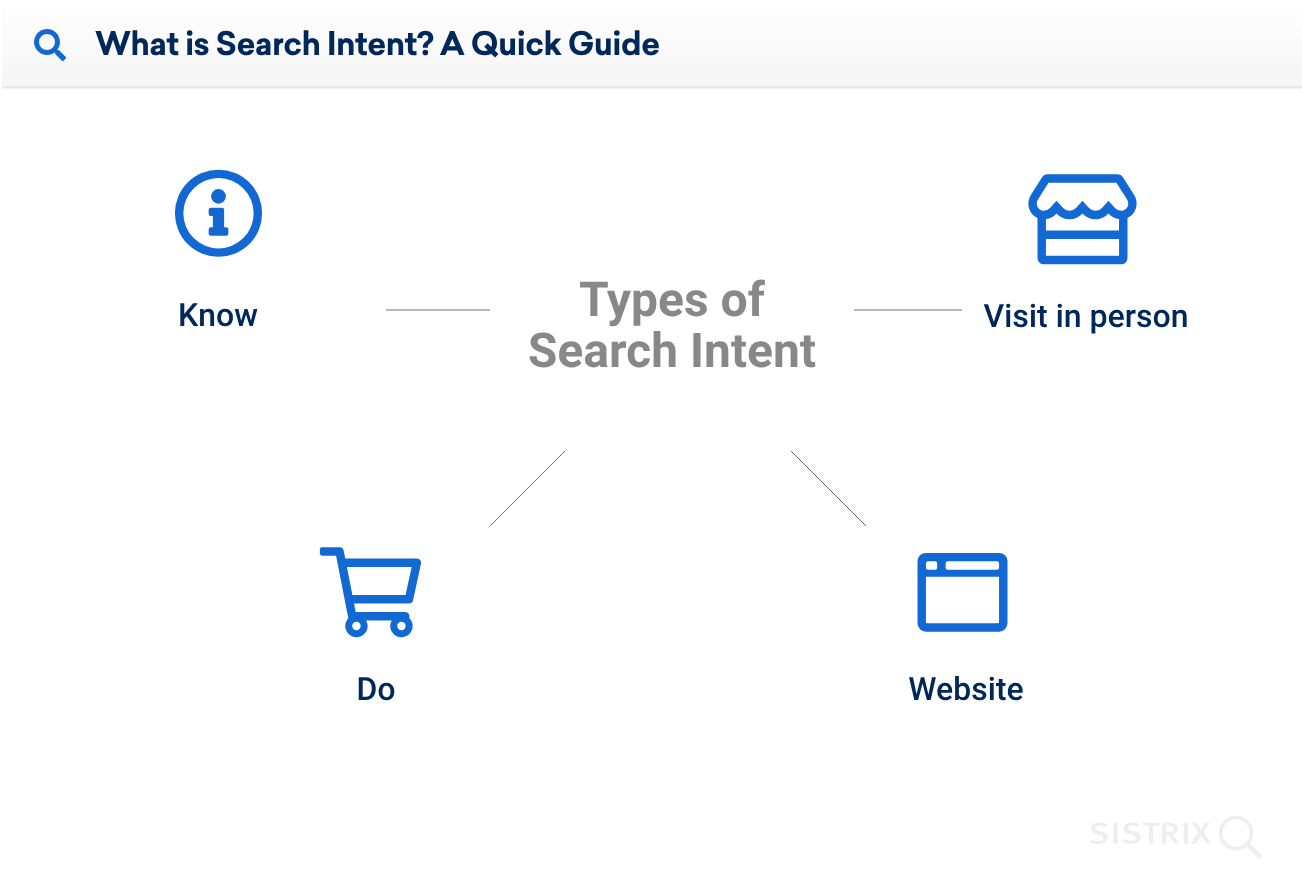
We have a detailed, step-by-step article on keyword research with SISTRIX tools and data, in which you can see our list-building process.