
AI answers change constantly and are highly individual. Even so, you can measure how visible your brand is. In the first part of our tutorial series, you’ll learn what matters and run your first visibility check in the SISTRIX AI Check.
- What AI visibility means
- Why you should measure AI visibility
- Why checking once isn’t enough
- The AI Check as the starting point of your GEO strategy
- Step 1: Define who you are
- Step 2: Your first check at a glance
- Why the AI Check reliably shows the status quo
- Step 3: Reading the trend
- Step 4: Compare yourself with competitors
- What’s next
Measuring AI visibility: the tutorial series
Part 1: Where does your brand stand? The basics and your first check in the SISTRIX AI Check (this article)
Part 2: Finding the right prompts with Prompt Research
Part 3: Tracking visibility with Prompt Tracking (in development)
What AI visibility means
Ask an AI search which gravel bike is suitable for beginners, and you get a ready-made answer. It mentions a few brands and links to websites as sources. Which ones is up to the AI platform. AI visibility, then, describes how often your brand appears in answers like these.
Optimising for these answers is called GEO (Generative Engine Optimization). We explain what’s behind it in detail in the AI basics on Ask SISTRIX. You can measure AI visibility with SISTRIX. To get started, three terms are all you need:
- Prompt: what someone types into an AI search, usually a question
- Mention: when a brand is named in the text of an AI search answer
- Citation: when a website is linked as a source in an AI search answer
Why you should measure AI visibility
Users are coming across AI answers more and more often. Google alone now shows AI Overviews, the AI answers above the Google search results, for 81 per cent of the keywords we monitor at SISTRIX in the UK (as of 14 November 2026).
For you, this means that a growing share of the questions relevant to what you offer is answered with an AI answer. The only way to find out whether your brand appears in them is to measure it. Measuring shows you three things:
- which AI searches and which questions your brand appears in,
- how you compare with your competitors, and
- whether measures such as new content make a difference.
Why checking once isn’t enough
Unlike a Google ranking, AI answers don’t have a (relatively) fixed position that you can look up once. AI searches work with probabilities and phrase every answer anew. If you ask the same question today and tomorrow, you’ll therefore often get two different answers, sometimes with your brand, sometimes without.
An example from our Prompt Tracking: every day, we ask ChatGPT ‘Which robot vacuum is currently the best?’ Over four weeks, Roborock and Dreame are mentioned almost daily. Ecovacs, on the other hand, only appears on 12 of 28 days, Mova on 11 and Xiaomi on 3, with no recognisable pattern.
This isn’t an isolated case. In our analysis of 10,826 daily measurement series, 70 per cent of the brands mentioned appear on fewer than one in five days. Only 6 per cent are almost always there, meaning on at least four out of five days. So if you check once whether your brand is mentioned, you’re seeing chance rather than a reliable result.
Measurement only becomes valid across many answers. What matters most is querying many different prompts rather than the same one over and over. Part 3 of our tutorial series explains why this is the case and how to put it into practice in Prompt Tracking.
The AI Check as the starting point of your GEO strategy
Every strategy answers two questions: Where am I, and where do I want to go? Only once you know both can you plan the route in between. With GEO, the first question is often skipped, even though everything else builds on it.
AI searches have long since formed a picture of your brand, whether you pay attention to it or not. For some questions they mention you, for others they don’t. They place you alongside certain competitors, show you in a particular context and link to specific pages on your website. The current state shows you where you actually stand. That doesn’t have to be where you want to be.
The AI Check measures this current state. And it isn’t a one-off look: SISTRIX regularly queries a large set of prompts across several AI models and checks which answers mention your brand or link to your domain. You’ll be familiar with the principle from our Visibility Index, which measures every domain against the same large keyword set. This gives you a reliable picture of how visible you are overall and for which topics.
Building on this, you define your target state: Which topics should your brand appear in? Where are you currently invisible? Where are competitors ahead?
Prompt Research shows you which questions users actually ask about your topics. You then use Prompt Tracking to check whether your measures are working along the way. It works like a rank tracking project: you decide which prompts you’re interested in, and SISTRIX queries them regularly.
The three pillars of our GEO product therefore cover the entire strategy cycle:
- AI Check: Where do you stand?
- Prompt Research: Where do you want to go?
- Prompt Tracking: Are you making progress?
This part covers the first step, the current state. Throughout the series, we use the brand Cannondale as an example.
Step 1: Define who you are
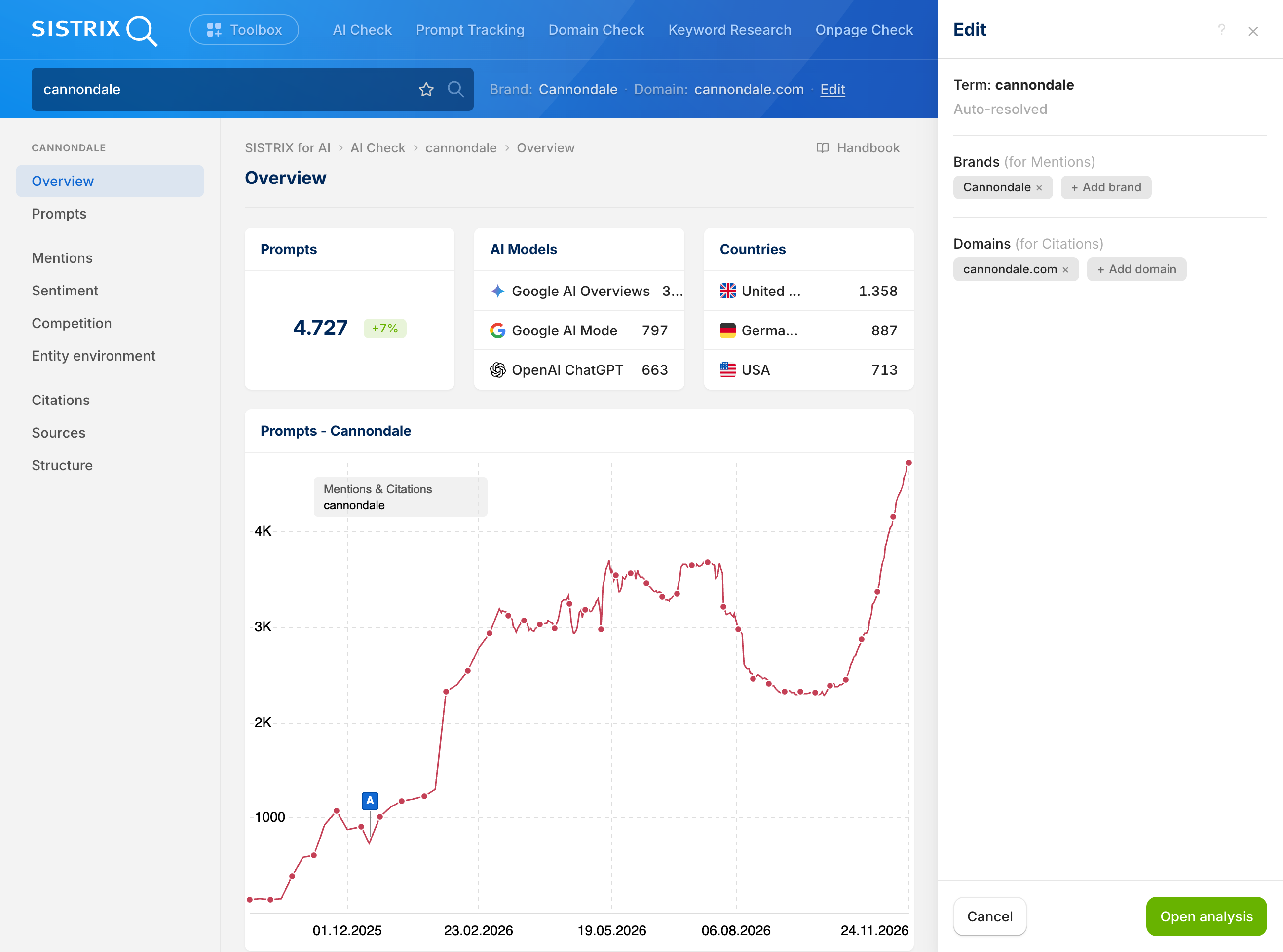
Enter your domain or brand in the AI Check. At the top, you can see which brand and which domains SISTRIX assigns to you. For Cannondale, that’s the brand ‘Cannondale’ and the domain cannondale.com. Click ‘Edit’ to adjust both.
It’s worth doing this before you look at the figures for the first time, because all the figures depend on it. If your brand name is too generic, answers that don’t refer to your brand at all are counted too. If one of your domains is missing, so are the citations in which it is linked. Also consider whether you want an overall picture or want to check your AI visibility for specific markets.
Step 2: Your first check at a glance
The ‘Prompts’ box in the overview shows you how many prompts from the SISTRIX prompt set mention your brand or link to your domain. SISTRIX draws on more than 61 million prompts for this. This broad data basis is what makes the figures reliable.
For Cannondale, we can currently identify 4,727 prompts.
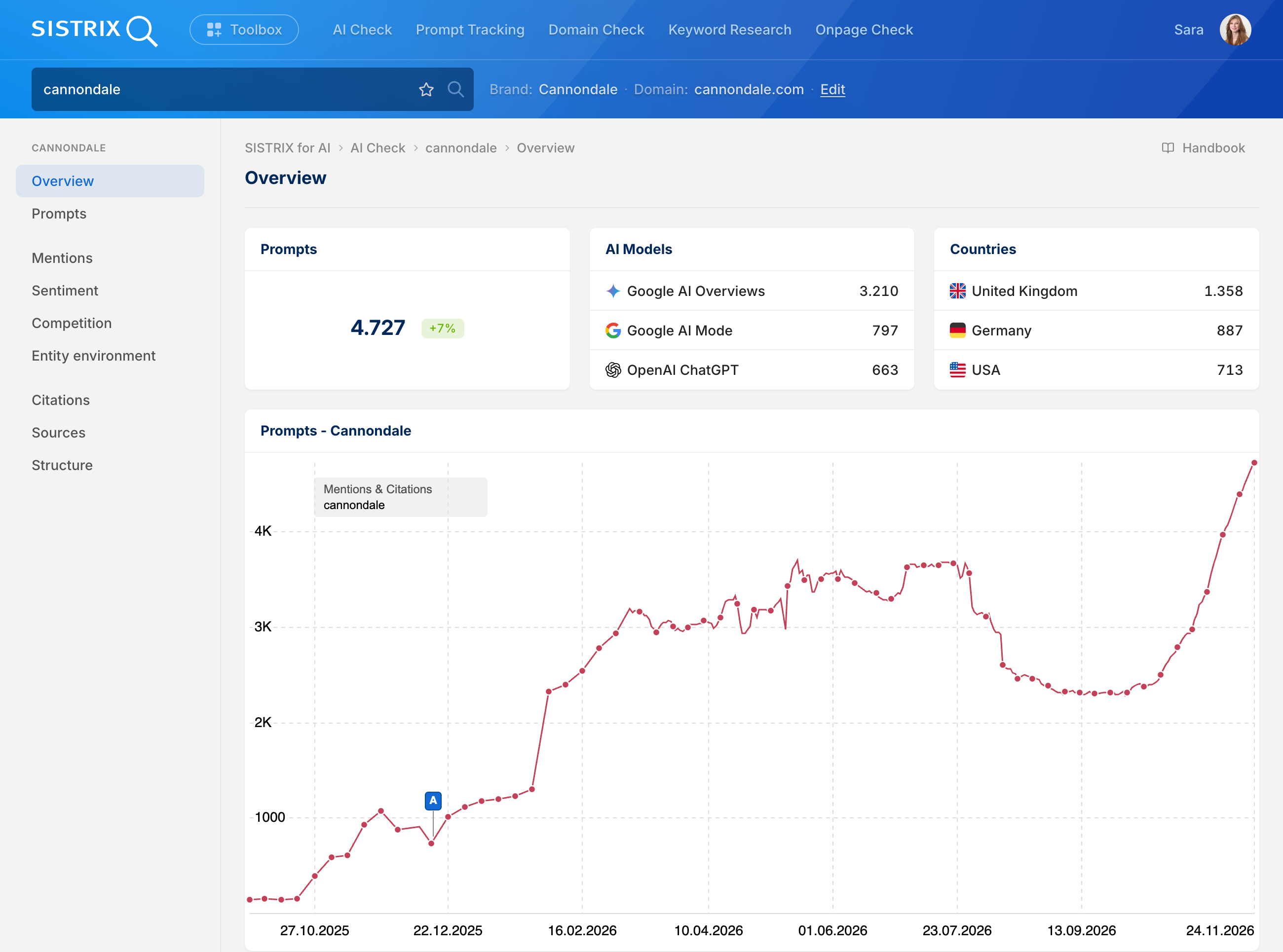
Next to it, you can see how these prompts are distributed across AI models and countries. For Cannondale, most hits come from the AI Overviews (3,210), 797 from the AI Mode and 663 from ChatGPT. By country, the UK leads with 1,358 prompts, ahead of Germany (887) and the US (713). The figures per model show you where your brand appears at all. Whether it performs well or poorly in a model only becomes clear when you compare it with competitors in the same model (Step 4).
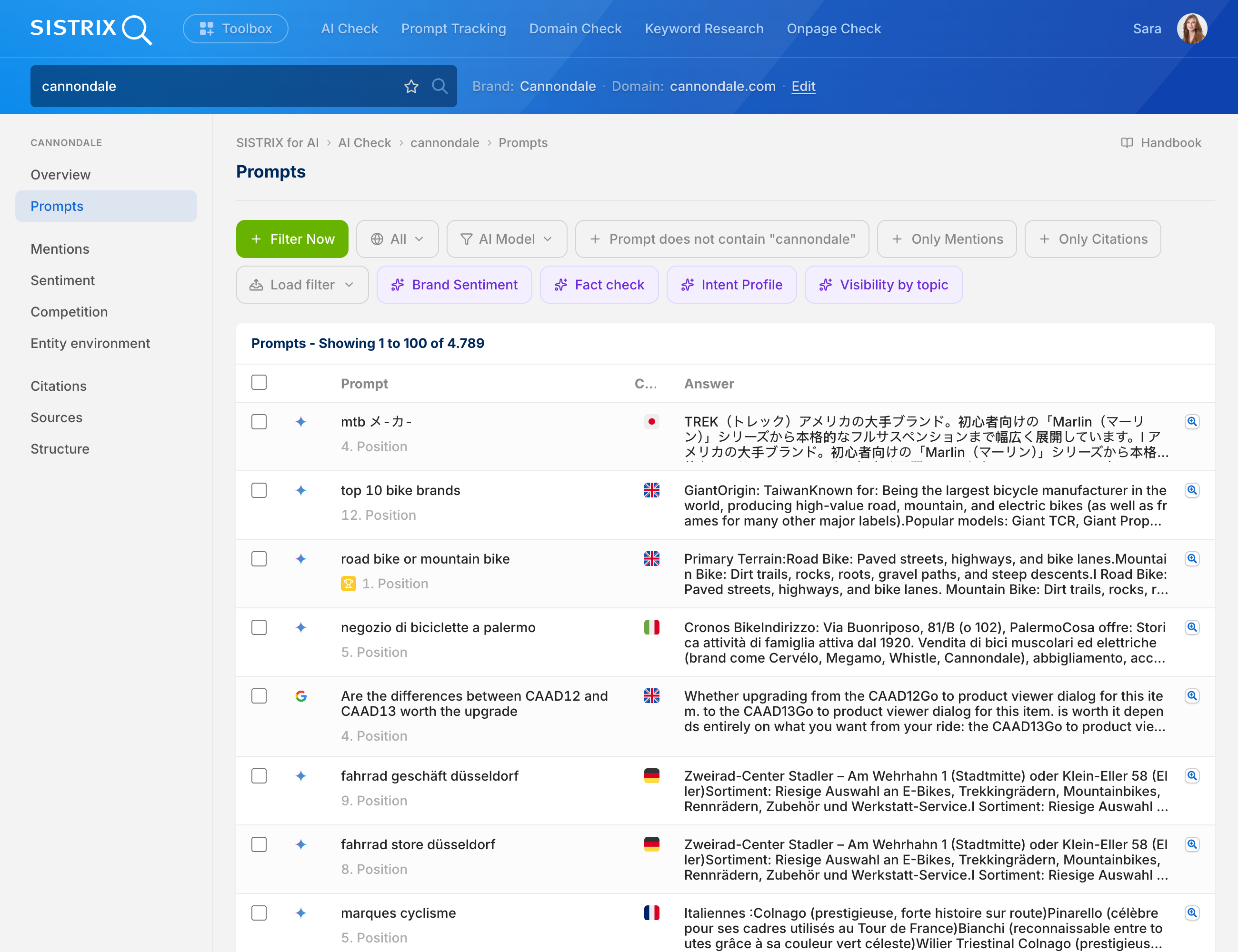
You can find out exactly which prompts these are under ‘Prompts’ on the left. The list shows you which questions your brand already appears in and which topics they belong to. The overview counts each prompt only once, even if your brand is mentioned in it and your domain is linked at the same time. You can find both separately under ‘Mentions’ and ‘Citations’.
The AI Check only counts citations for the domains you have added. If an answer links to another website that mentions your brand, that isn’t a citation for you. If your brand is named in the answer text, however, it counts as a mention.
Why the AI Check reliably shows the status quo
The AI Check measures every brand against the same broad prompt set, which was not selected with any particular brand in mind. That is exactly what makes it reliable for assessing the status quo.
If, on the other hand, you put together prompts yourself, you almost automatically choose questions that are close to your brand. Your brand then performs better than it does in the market: in our analysis, this was the case in three out of four instances. Part 2 shows how you can still arrive at suitable prompts for Prompt Tracking.
Step 3: Reading the trend
Below the overview, you can see the trend, i.e. how the number of prompts featuring your brand develops over time. For Cannondale, it rose to around 3,700 by mid-July 2026, fell to about 2,300 by September and, at around 4,700, is now higher than ever.
How to read the trend: every week, your brand drops out of some answers and newly appears in others. Because losses and gains largely cancel each other out, the total usually changes by only 4 to 10 per cent overall. The more prompts a brand has, the smoother the curve: for brands with fewer than 100 prompts, it typically fluctuates by around 6 per cent from week to week, and for brands with 10,000 prompts or more, by only around 2 per cent.
Small movements are therefore normal. Larger jumps, on the other hand, usually have a real cause: either your brand is actually being mentioned more or less often, or the prompt set itself has changed. Comparing yourself with competitors shows you which of these applies.
Step 4: Compare yourself with competitors
When comparing yourself with competitors, the share is more meaningful than the raw number of prompts. The prompt set in the AI Check is constantly changing: prompts are added or dropped. If the set grows, the number of prompts featuring your brand rises without you having become more visible. The same happens to your competitors, so your respective shares stay the same. If your share changes, however, your visibility relative to the others has genuinely changed.
Here’s how to calculate the share: enter your main competitors in the AI Check as well and note the number of prompts for each brand in the same country. Use the values from the ‘Countries’ box for this, not the total. Canyon shows why: overall, the AI Check finds the brand in 20,266 prompts, 7,053 of them in Germany alone. For the UK market, however, only the 4,033 prompts in the UK count.
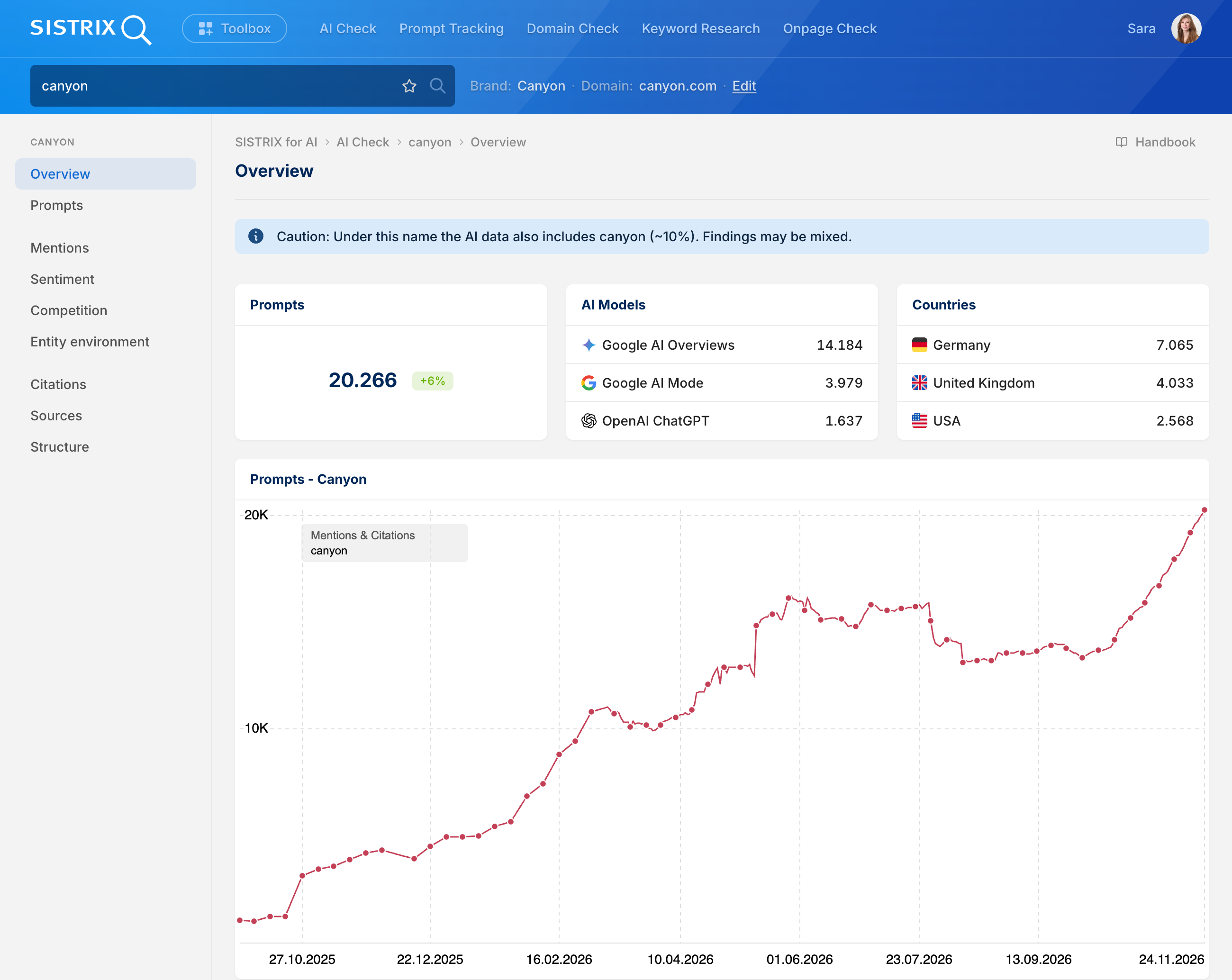
Then divide your brand’s number by the total for all brands. For Cannondale and Canyon in the UK, that’s 1,358 out of a combined 5,391 prompts, a share of around 25 per cent. Adding further competitors such as Ribble or Boardman makes the picture more complete. Here too, make sure the brand and domain are set up correctly for your competitors.
If you repeat the calculation regularly, you’ll see whether your brand is gaining or losing ground against its competitors, regardless of how the prompt set changes overall.
Keep it simple tip: If regular competitor monitoring and calculating the figures is too much effort, simply use our MCP Server and let it do the work. For more inspiration, take a look at our other use cases.
What’s next
The AI Check shows you where your brand stands in the market. If you want to track specifically how it performs for the questions that matter to your offering, and whether your measures are working, you need your own prompts. How to find them without making your results look better than they are is covered in Part 2: Finding the right prompts with Prompt Research.
Test SISTRIX for Free
- Free 14-day test account
- Non-binding. No termination necessary
- Personalised on-boarding with experts