
The SISTRIX MCP Server compares the keyword profile of your own domain with that of your most important competitors, identifies thematic gaps, and delivers a prioritised content plan directly — in a fraction of the time required for a manual analysis.
| TIME REQUIRED | TIME SAVINGS | DIFFICULTY | APPLICATION |
|---|---|---|---|
| 5–10 mins | 3–5 hours | ●●○○○ | Pitch / Strategy / Ongoing |
Benefits
- Making keyword gaps visible: At a glance, you can see which topics and search terms competitors rank for while your own domain does not. Instead of manually compiling data from multiple tools, the SISTRIX MCP Server delivers a consolidated gap analysis in minutes.
- A content plan instead of a keyword list: The model doesn’t stop at the data — it groups the gaps into thematic clusters and directly provides article ideas, formats, target keywords, and URL suggestions, ready to pitch to clients or use internally.
- Saving several hours of work: Manually, a comparable analysis (keyword exports, tabular comparison, thematic clustering, prioritisation) would take half a working day. With the SISTRIX MCP Server, it takes under 10 minutes.
- Applicable to any industry and niche: The use case works equally well for e-commerce, B2B, publishers, and local providers — anywhere competitors can be reached via organic traffic.
Prompt
Example Prompt
Analyse the domain [your-domain.com] using the SISTRIX MCP Server in comparison to the competitors [competitor1.com], [competitor2.com], and [competitor3.com] for the [country] market.
- Retrieve the top keywords (positions 1–20) for all domains.
- Identify which keywords at least one competitor ranks for but your own domain does not. These are the content gaps.
- Group the gaps into thematic clusters (e.g., buying guides, troubleshooting, how-to content, audience-specific content) and indicate which competitors rank for each.
- Prioritise the clusters by potential (search volume, competitive strength, brand relevance) as High / Medium / Low.
Create a content plan with article titles, recommended formats, target keywords, and URL suggestions, exportable as an Excel file.
Workflow
Step 1: Retrieve keyword data
The SISTRIX MCP Server simultaneously fetches the top keywords for all domains — your own domain and up to three competitors. Depending on the scope, 100–200 keywords per domain are loaded (positions 1–20). The data flows directly into the context without any manual export.
Step 2: Perform the gap analysis
The model compares the keyword sets of all domains and filters out which terms are present for competitors but missing for the analyzed domain. Brand keywords are automatically detected and separated from generic terms — because only the latter represent genuine content gaps.
Step 3: Thematic clustering and prioritisation
The identified gaps are grouped into thematic clusters — such as buying guides, troubleshooting, or informational content. Each cluster is evaluated by potential: search volume, competitive strength, and relevance to your own brand are all factored into the prioritisation.
Step 4: Create and export the content plan
From the prioritised clusters, the model derives concrete article ideas: with titles, recommended content formats (guide, how-to, comparison, FAQ), target keywords, and URL suggestions. The finished content plan can be exported as a formatted Excel file on request, ready for use directly by the editorial team or as a client deliverable.
Output / Result
The result consists of two parts: an interactive overview in the chat (tabs: “Overview,” “Content Gaps,” “Content Plan”) and a downloadable Excel file with four worksheets — ready to use directly as a client deliverable or for editorial planning.
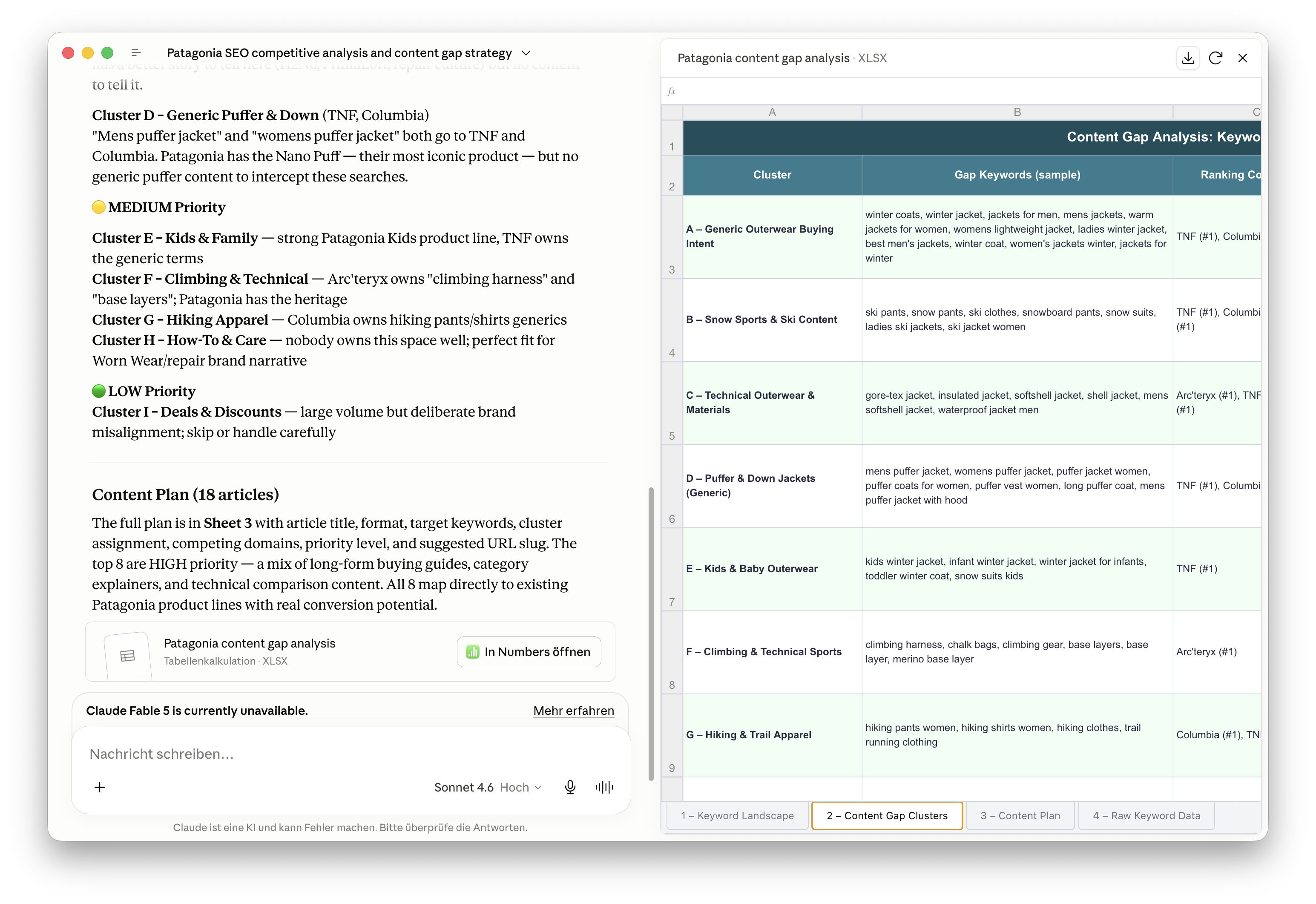
| Spreadsheet | Contents |
|---|---|
| Summary | Overview of all gaps and clusters |
| Gap cluster | Content gaps grouped by topic, with prioritisation |
| Content Plan | Article title, format, target keywords, suggested URL |
| Raw keyword data | Complete sets of keywords for all analysed domains |
Combinations and Variants
Combination: Keyword analysis and content gap analysis — Start with a general visibility and keyword analysis, then run the gap analysis. This gives you the overall context first, allowing you to assess the gaps more precisely.
- Country comparison: Extend the analysis to multiple markets (e.g., Germany, Austria, Switzerland) and check whether gaps exist across markets or are specific to individual ones.
- Category focus: Use a regex filter to analyse only keywords from a specific product category — ideal for clients with a large portfolio.
- Automatic competitor detection: First run the “Identify SEO competitors” use case to determine the most relevant competitors via SISTRIX, then move directly into the gap analysis.
Stuck? Our support team can help with the SISTRIX MCP Server setup and answer questions about using it with Claude or ChatGPT. Contact support.
Test SISTRIX for Free
- Free 14-day test account
- Non-binding. No termination necessary
- Personalised on-boarding with experts