

Reports let you combine key figures from SISTRIX in a single document and send them automatically by email to everyone who needs regular updates. A report can bring together a brand’s visibility in Google Search, on Amazon, and in AI systems. Besides sending it by email, you can share it as a page with a link or download it as a PDF or PowerPoint.
How to Create a Report
Nearly every box in SISTRIX can be added to a report, including those from AI Check and Amazon. First, open the analysis whose data you want in the report, for example by entering the domain in the search bar. Then click the cogwheel icon in the top right corner of the box to open the box options, and click “Add to report“.
You then choose an existing report or create a new one via “Create new report”. The new report is automatically called “My report” until you rename it.
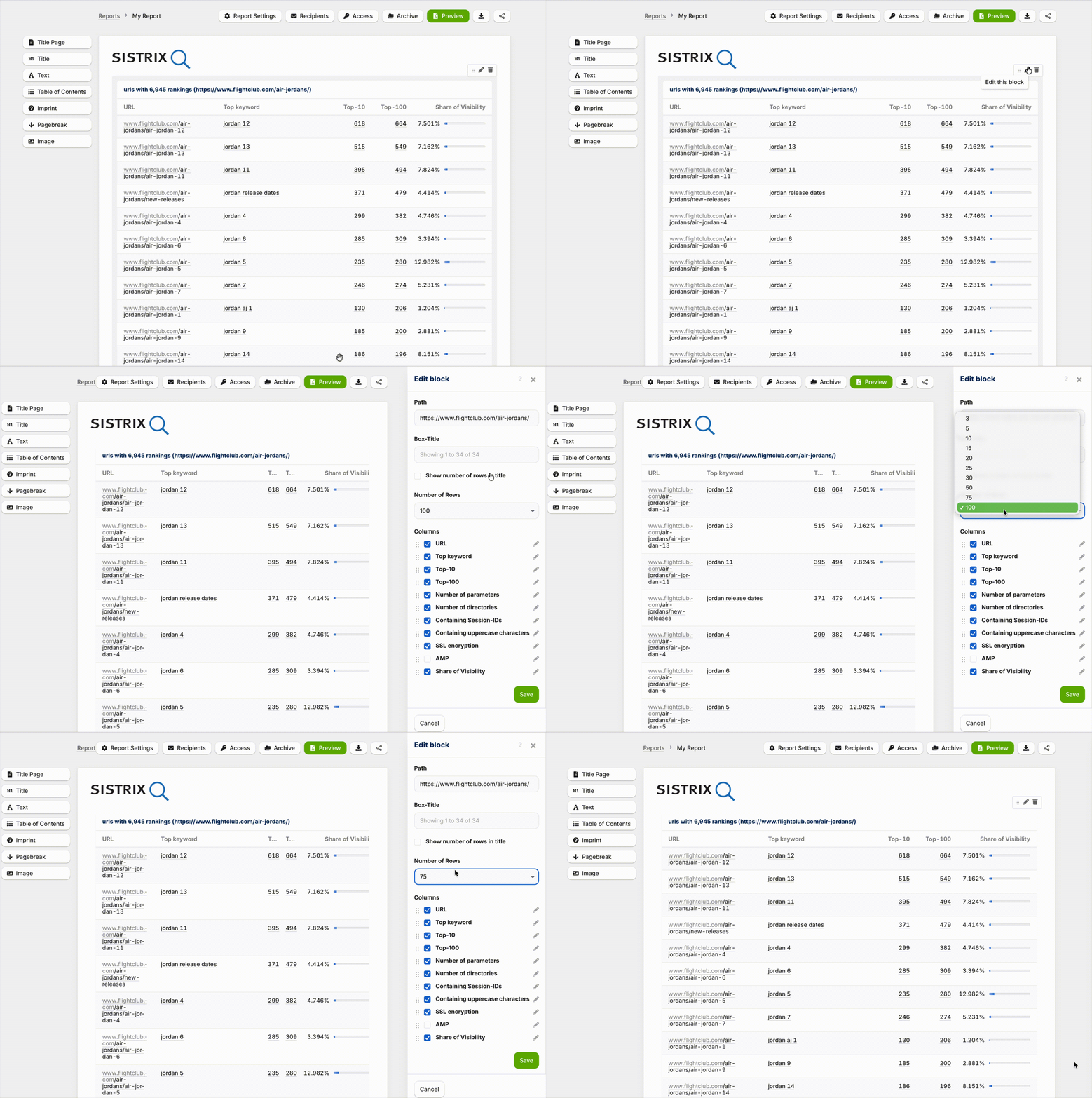
Each box is added to the report with the settings you chose in SISTRIX, i.e. with the same columns, rows, and metrics. Boxes that are newly added to SISTRIX automatically become available in reports as well.
Alternatively, you can start with a template: select a template, enter a domain, and the key metrics are already in the report. You’ll find the available templates in the report overview under “Report templates”.
Report Overview
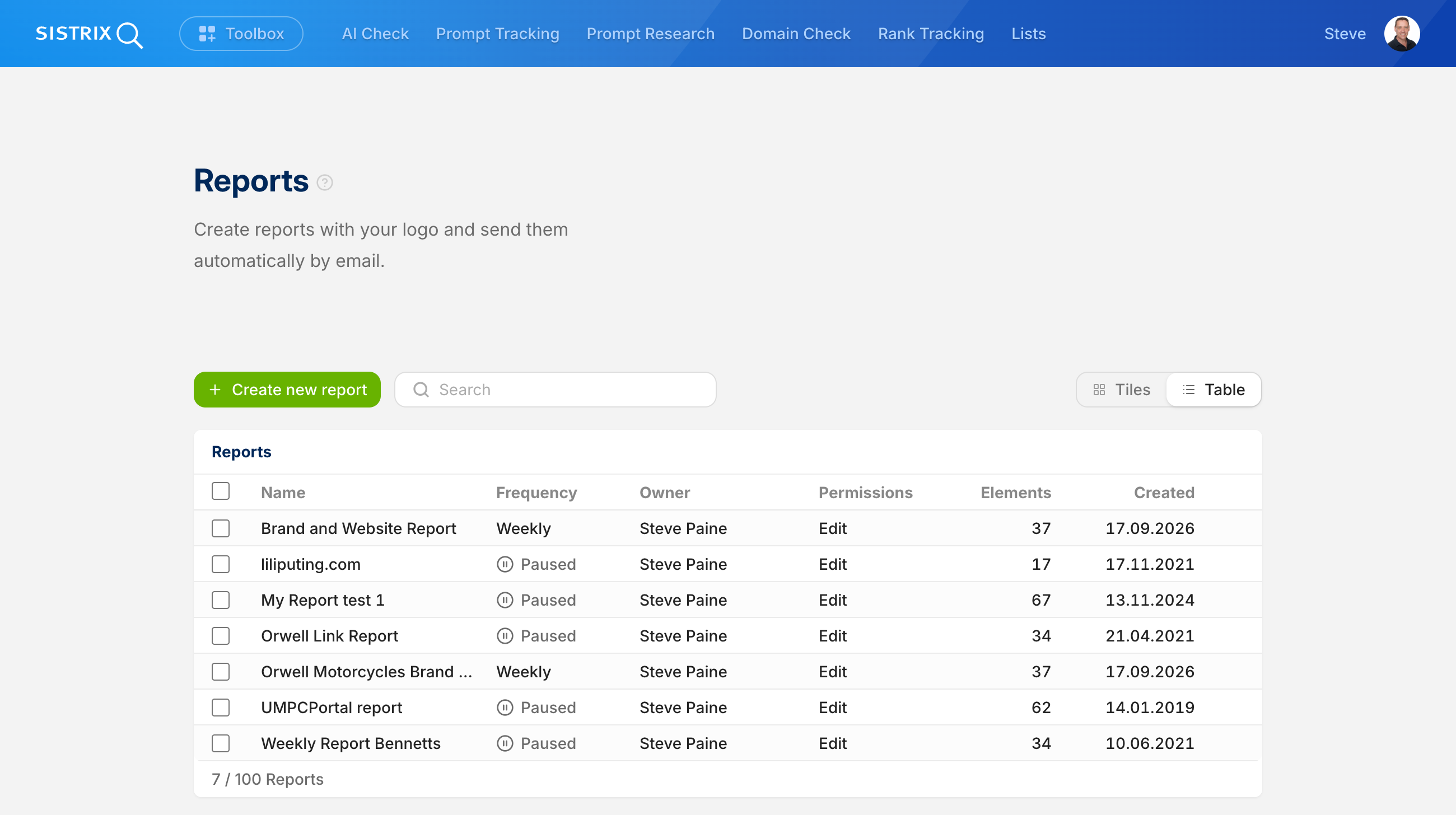
You’ll find reports in the “Workspace” menu area under Reports. The overview brings together your reports, report templates, and design templates, each in its own table. Use the toggle at the top right to view them as tiles or as a table, and use the search to quickly find individual reports.
Click the green “Create new report” button to set up a new report. Deleted reports can be found in the trash at the top right.
Reports
The table lists all reports in your account. For each report, you can see the name, the sending frequency, the owner, your rights, the number of elements, and the creation date. Reports whose sending is paused are marked as “Paused” in the frequency column.
Below the table, you can see how many reports you’ve already created and how many your account allows in total. Click a report’s name to open it in the editor.
Report Templates
Report templates are ready-made reports you can use to start a new report right away instead of building it box by box. Alongside your own templates, you’ll find templates from SISTRIX here, such as the SISTRIX SEO template, marked with the SISTRIX label. Click the “Create from template” icon at the end of the row to create a new report from a template.
You create your own template by converting an existing report via “Convert to report template” in the report settings. Templates aren’t sent. Below the table, you can see how many of your own templates you’ve created and how many your account allows. Templates from SISTRIX don’t count toward this.
Design Templates
Design templates define the look of your reports, for example the logo. A design template can be used for several reports. The Reports column shows how many reports a template is currently used in.
Click “Create new template” to set up your own design template, then assign it to a report in the report settings. Below the table, you can see how many design templates your account allows. You can learn more about designing reports in the tutorial “How to create and configure reports in SISTRIX“.
Report Setup
Editing a Report
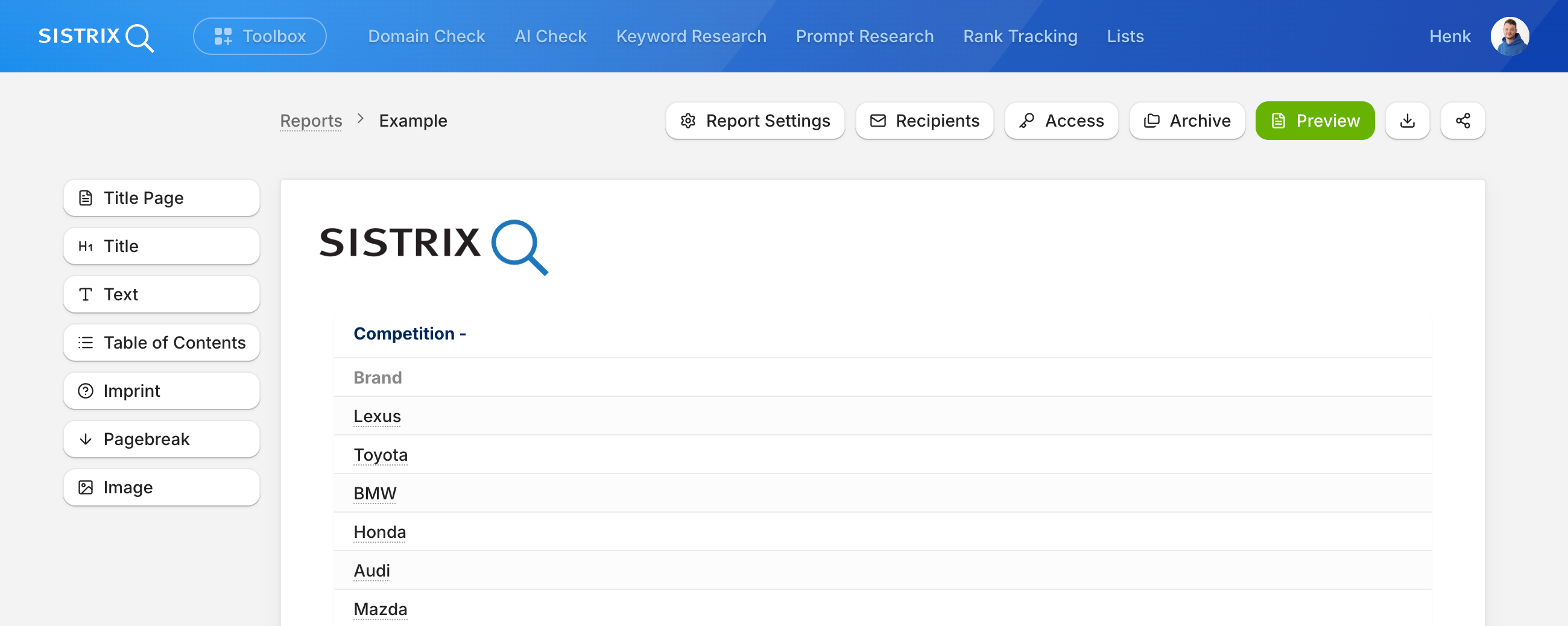
In the editor, you’ll see all the boxes you’ve added to the report in the middle. Above them is a bar with everything that affects the report as a whole: Report settings, Recipients, Access, Archive, and Preview, with Download and Share to the right. Preview creates the report as a PDF.
When you hover over a box, three icons appear in its top right corner: use the dots to drag the box to a different position, the pencil to edit it, for example its title, and the trash can to remove it from the report.
Boxes and elements can be arranged in different widths in the editor, so you can build your report flexibly. On the left, you’ll find the design elements you can add to the report:
- Title Page: adds a page with the report’s name and the current date.
- Page Title: adds a heading that automatically appears in the table of contents.
- Text: adds a text box.
- Table of Contents: automatically creates a table of contents from the boxes and page titles you’ve added.
- Imprint: adds an imprint at the end of the report.
- Page Break: inserts a manual page break.
- Image: uploads your own image to the report.
Report Settings
In “Report settings”, you set the report’s name and file name. In the file name, the placeholder #DATE# is replaced by the report’s date. If you leave the field empty, the file is automatically named after the date.
You also choose whether the report is sent daily, weekly, or monthly, and on which day: the weekday for weekly sending, the date for monthly sending. You can also set the page format, orientation, language, and the report’s design, i.e. the design template used.
Use “Convert to report template” to turn a report into a template. A template isn’t sent, but its recipients and sending schedule are saved and restored when you convert it back. You can also delete a report in the settings.
Recipients
Under “Recipients”, you enter the email addresses that SISTRIX automatically sends the report to on the chosen schedule.
Access
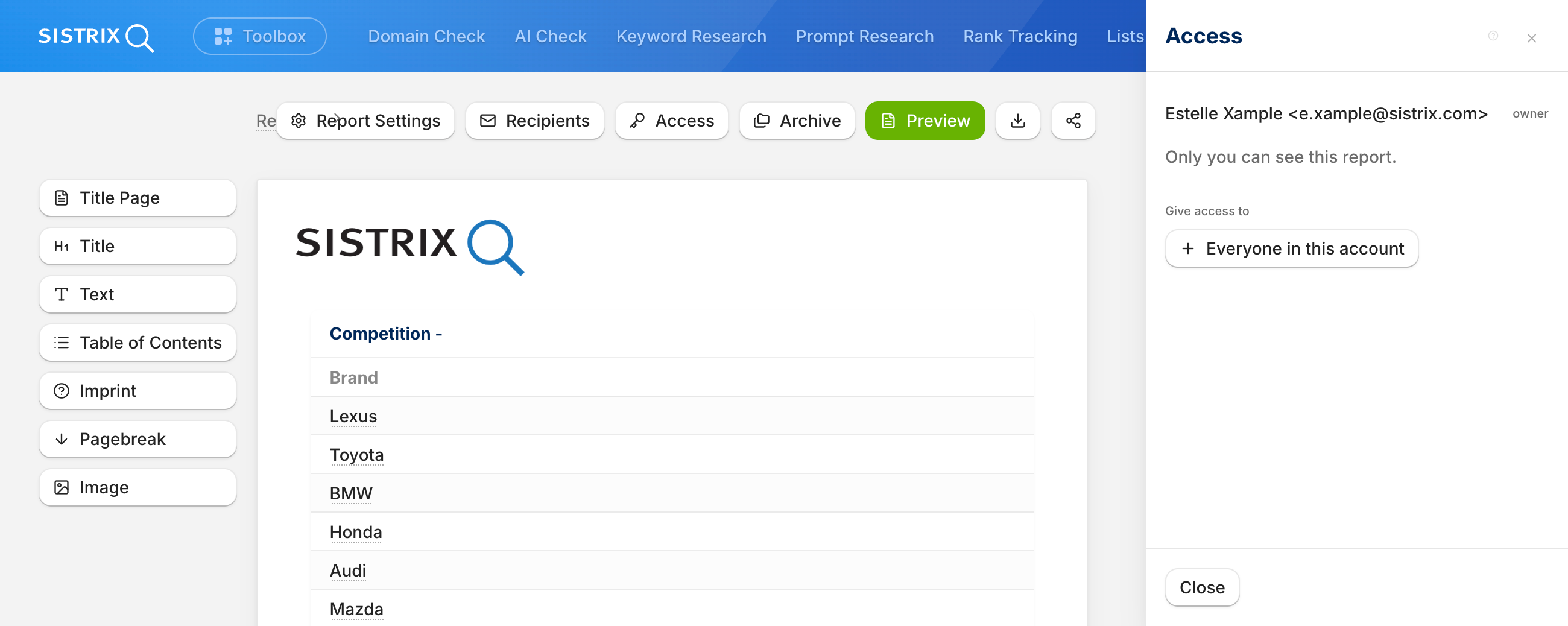
If several people in an account work on reports, use “Access” to decide who can view or edit a report. In addition to the owner, rights can be granted to all users in the account together or to individual users.
Download and Share
Click the download icon on the right of the bar to download the report as a PDF or PowerPoint. Click the share icon to publish it as a page with a link, which you can also share with people who don’t have SISTRIX access.
Archive
Each report has its own archive. You open it via “Archive” in the bar above the report. All automatically created editions are stored there, so you can retrieve older reports at any time and track developments over time without having to save them yourself.
Report Archive
The table lists all automatically created editions of the report as PDF files, named after their date. Click “Download” to download an edition.
How often a new edition is added depends on the sending schedule in the report settings. Click “Report” at the bottom right to return to the editor.


