
Google search is once again facing a fundamental change. With AI Mode, which is currently rolled out as an option to users in many countries, not only does the appearance of search results change, but also the way content is discovered and processed. Read on to find out about AI Mode and how it affects search marketing.
- What is AI Mode?
- What changes for SEO now
- The challenge of visibility
- Who is being cited in the AI Mode?
- Staying visible – in the AI Mode
- What is important now
- AI Overviews and AI Mode: two levels of AI-powered search
- SEO Checklist for Google's AI Mode
- Technical prerequisites:
- Content structure:
- Content depth: answers for each subquestion
- Brand presence and authority: recognisability for humans and machines
- Monitoring and maintenance: securing visibility long-term
- Assurance of quality: less is more
Discover how SISTRIX can be used to improve your search marketing. Use a no-commitment trial with all data and tools: Test SISTRIX for free
With Google now deploying its own large AI system, it is no longer possible to ignore AI-powered search systems, even for those who previously wanted to avoid them. For companies, the question now is: What does this mean specifically for visibility, content, and strategy? And how can visibility in AI Mode be measured?
What is AI Mode?
AI Mode is Google’s new search feature, available at https://www.google.com/ai and directly within the Google search interface. It is based on Gemini 2.5, a multimodal language model with high processing depth. Users can enter questions, interact directly with AI Mode, or upload images. Search results are no longer just lists of 10 website links, but AI-generated answers that are structured and content-rich. This means that the content from websites is no longer being processed by Google directly and for many search requests, a click on a website is not necessary anymore.

“AI Mode combines elements of a chatbot with classic web search. It uses the capabilities of Google’s language models as well as various backends such as web search, image search, and the Knowledge Graph to deliver understandable and verifiable AI search results.”
Johannes Beus – Founder, SISTRIX
What changes for SEO now
Google positions AI Mode not as a supplement like the AI Overviews, but as an independent form of search. In practice, this is reflected in several changes that have immediate consequences for SEO and content strategies.
- Users interact in dialogue. They ask an initial question, receive an AI-generated answer, and can follow up directly. This creates a search logic that allows for much more contextual relevance but disrupts traditional SERP structures.
- The AI thinks ahead. When asking about a product, concept, or problem, users also receive information about related aspects. The system anticipates likely follow-up questions and answers them immediately. For content providers, this means that relevance is generated not only by the initial query but also by adjacent topic areas.
- Pages provide information, but not necessarily the click. Content is processed and cited by the AI, often without the user directly visiting the source. The zero-click rate thus rises significantly, along with the challenge of measuring visibility meaningfully and converting clicks.
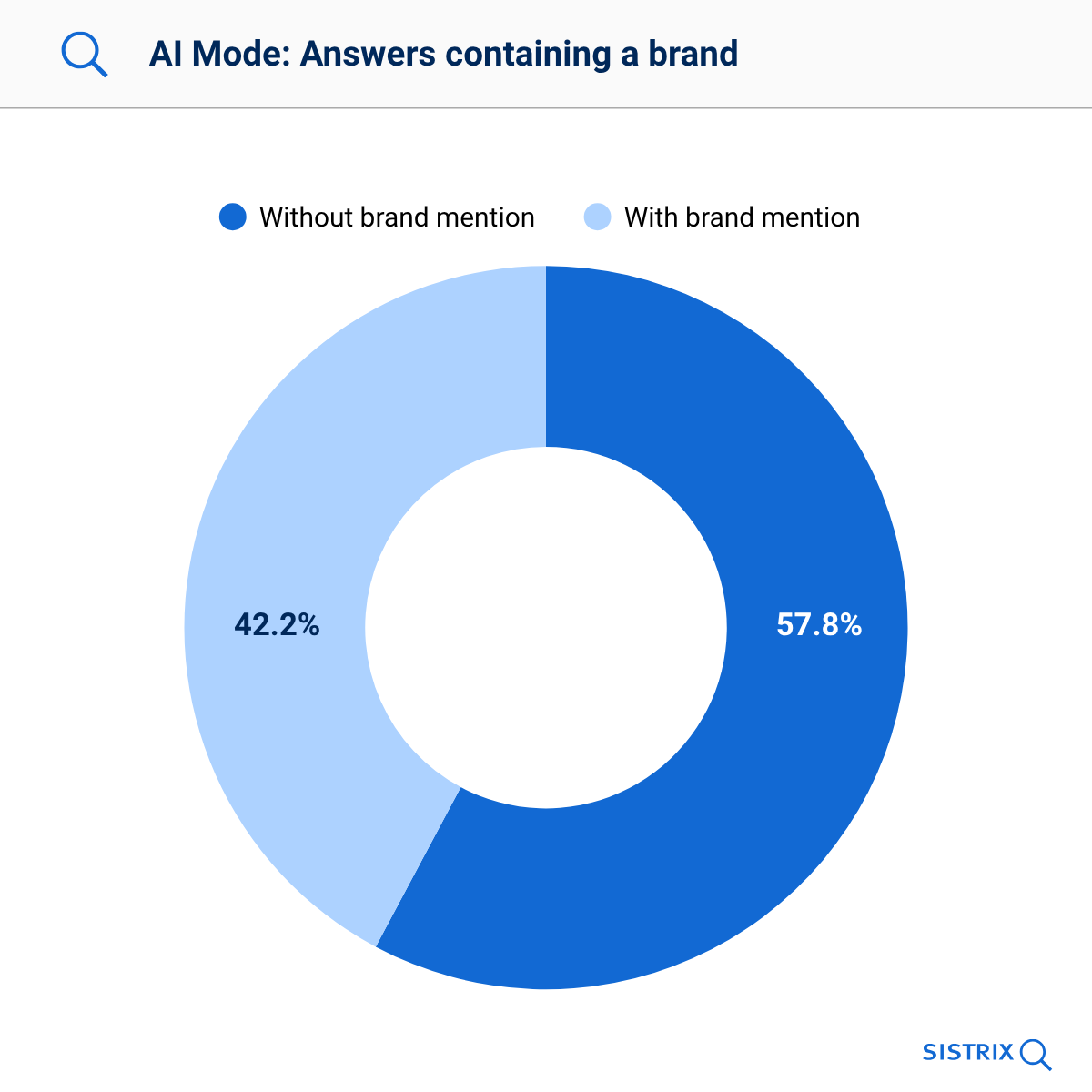
- Unlike the classic ten blue links in Google search, not every query automatically includes a brand. Less than half of all AI Mode answers contain any brand reference at all. In only 42.2 percent of prompts did we measure at least one brand in the answer.
Google emphasises that no special measures are required to be visible in AI Mode or AI Overviews. If a site is found in classic search, it generally meets the requirements for AI answers—provided the page is indexed, technically accessible, and discoverable in the SERPs with a snippet.
The challenge of visibility
A central problem for SEOs is measurability. Visibility in AI Mode cannot currently be tracked clearly in Google Analytics or Search Console. There is no separate “AI Mode” source, no counting of citations, and no differentiation between clicks and references. This changes how success is measured, as visibility increasingly occurs without direct traffic.
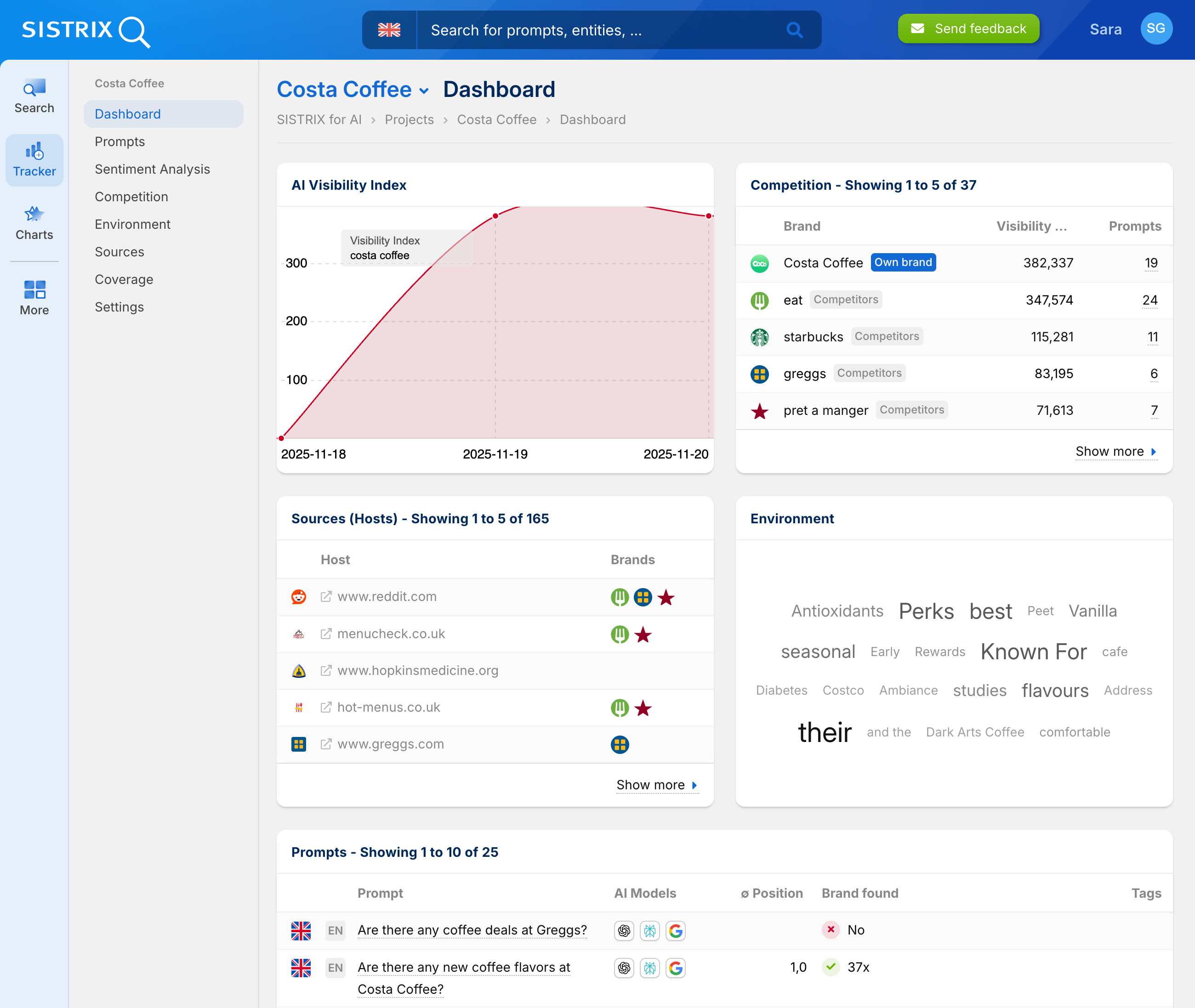
SISTRIX already allows you to track your visibility in AI answers. In the AI/Chatbot Beta, a project can be created by entering a brand. SISTRIX automatically identifies relevant prompts and a competitor environment. This makes it possible to see in which answers your brand appears, which content is used as a source, and how mentions develop over time. The visibility index shows whether presence is increasing or decreasing and which competitors are cited more frequently. This way, it becomes clear which content works and where optimisation potential exists.
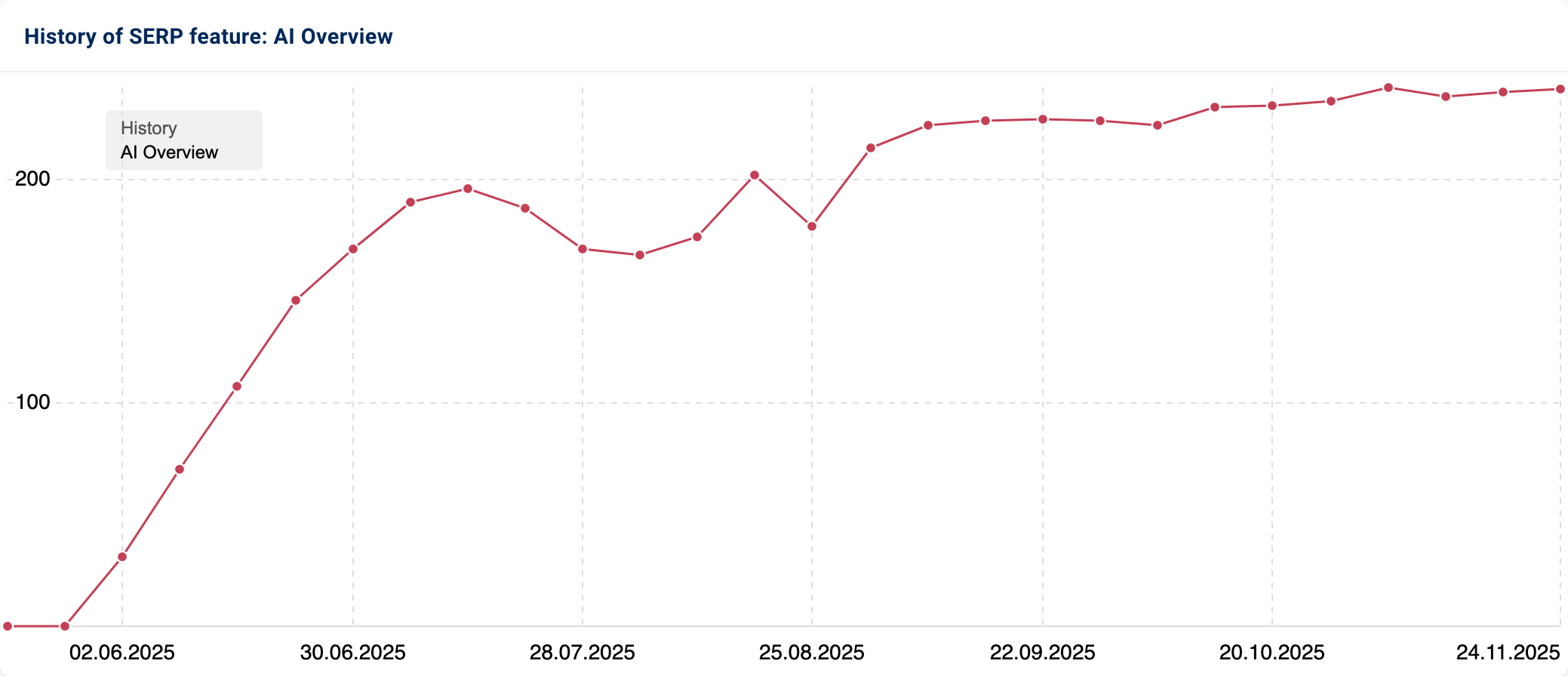
AI Overviews in Google Search can also be analysed specifically with SISTRIX. Using the filter in the keyword table, all queries for which Google displays a generative answer become visible. In the AI Overviews section, it additionally shows for which keywords your own domain is cited as a source and at what position within the box it appears. This allows you to see which topics Google is already using your content for and where visibility is still lacking. Comparing this with organic rankings shows whether additional presence is being generated or existing rankings are being replaced.
With the AI/Chatbot Beta, SISTRIX already enables data-driven analysis of AI Mode. This allows you to track how many prompts and responses mention your brand, how these mentions are distributed across different AI systems, and how visibility develops over time. Several functions are available for this purpose:
- Prompt research – Shows which prompts a brand is actually mentioned for in Google AI Mode or ChatGPT. This reverse search helps to understand in which topics your own brand is already visible and where there is potential for optimization.
- Analyze competitors – Since brands are rarely mentioned in isolation, this view reveals which other brands appear most frequently alongside your own. This makes competitive environments measurable in AI search for the first time.
- Discover sources – This reveals which content the AI uses to answer a question. This is particularly important for identifying content gaps and developing targeted content that has a chance of being cited by the AI.
- Check structure – This view shows which parts of your website are most frequently crawled by AI systems. This helps you understand whether your content is structured clearly enough to be reliably recognized and displayed by AI Search.
Now is the right time to align content with AI answers. Those who measure and optimise early will remain visible not only in the rankings but also in the systems’ responses. Test SISTRIX free for 14 days and analyse where your brand is already mentioned and where there is still potential.
Who is being cited in the AI Mode?
Since the introduction of the AI Mode in Europe, we were able to analyse and evaluate millions of responses. A clear pattern emerged: Google continues to refer to external sources but decidedly prefers its own offers.
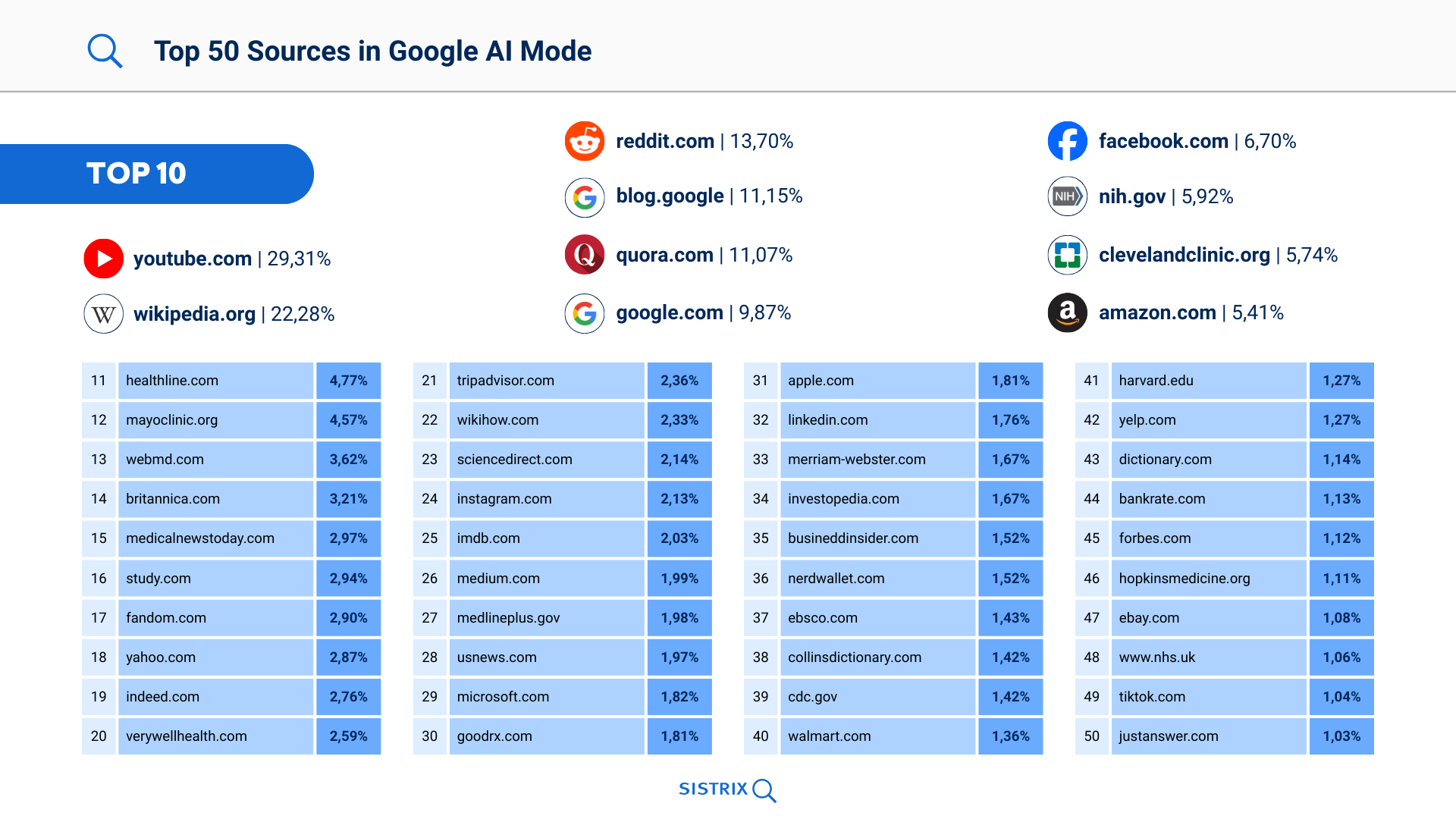
Almost 30 percent of all responses include a link to YouTube. The video platform is thus the most cited source in the AI Mode. In the following spots, more Google services can be found, such as its blog. External pages, like wikipedia, are included but the sum of Google’s own offers make up just over 50%. Reddit also regularly makes an appearance as a source.
Our evaluation shows distinct differences to the conventional organic results. Brands such as WebMD, wikiHow and Instagram are much more present in the AI mode, while many informational pages largely remain stable.
Staying visible – in the AI Mode
What should you do to stay visible in the AI Mode?
The familiar SEO basics are still relevant: content has to be crawlable and internally linked to offer a good user experience, as well as being clearly legible for humans. Structured data can help but is not mandatory. Additional markups or AI specific labels are, according to Google, not necessary.
At the same time, there is no guarantee for visibility: the AI Mode chooses content dynamically based on relevance, utility and quality; without conventional rankings. The Top 10 are a thing of the past, now there is only a combined answer made up of multiple sources.
The deciding factor is thus the suitability in terms of content. SEO makes sure that content is even considered. However, if it actually gets cited is dependent on its ability to answer a user’s question in a complete, comprehensive and helpful way.
What is important now
Existing content should not only be judged based on keywords but also its AI suitability. Which texts offer clear responses? Which are structurally formulated in a way that functions as a response block?
Helpful content should be…
- structured alongside typical user requests
- built in modular blocks with clear headlines
- formulated precisely and clearly, without vague language
- exceeding definitions and offering context, examples or comparisons
- updated regularly
- enriched sensibly with visual elements (images, diagrams, info-graphics with alt texts)
In short: the base is technical, but within the AI Mode the content that most clearly answers a question wins.
AI Overviews and AI Mode: two levels of AI-powered search
AI Overviews and the AI Mode are not two distinct systems, but two forms of the same development: the integration of generative AI into Google search. They differ in their depth, interactivity and user navigation but have the same goal: efficiently answering complex questions and creating new research opportunities.
AI Overviews directly show up in regular search results, often above the conventional link list. They offer short, automatically generated summaries and link to supporting content. Their purpose is to ease the introduction into a topic, for example via definitions, contextual references or initial explanations. The interaction is thus reduced.
The AI Mode goes one step further: instead of only giving one response, it opens a digital interface on which users can ask follow-up questions, get more in-depth details or view alternate dialogue options. The central principle behind this idea is the so-called “Query Fan-Out“. The AI dissects a complicated question into multiple subquestions, researches them simultaneously and puts the result into one coherent response. This way, it doesn’t just create a solution for the original query, but also delivers a content-wise expanded delineation with further contextual info.
Additionally, the AI Mode is multimodal. Users can also ask questions by employing pictures or PDFs. The AI analyses visual elements, recognises correlation and uses these to generate fitting responses. With the AI Mode, Google is expanding the search realm significantly, away from pure text inputs and towards contextual research across multiple media formats.
Both systems have a similar goal, but differ in their use case. While the AI Overviews offer a quick orientation, the AI Mode, on the other hand, facilitates a deeper examination. Depending on the type of question and user intent, the same content can play a role in the short overview or the detailed answer dialogue.
“With the introduction of the AI Mode into large parts of Europe, Google is securing a distinct lead in the race for market dominance in AI search. The following months will show if and how ChatGPT can catch up.”
Johannes Beus
SEO Checklist for Google’s AI Mode
The following checklist will help you to optimise content specifically for the AI Mode. It includes technical foundations, a content structure, semantic depth and tips for the measurement and maintenance.
Technical prerequisites:
- Make sure that your pages are indexed and not excluded by robots.txt or noindex-instructions.
- Keep an eye on the renderability, so that dynamically loaded content by the Googlebot or AI models can be processed as well.
- Build a sensible internal linking structure, especially between thematically related content. This will support the semantic classification.
- Optimise for mobile users and quick loading times. In the AI Mode, user experience plays a central role as well.
Content structure:
- Start every paragraph of content with a clear, concise answer to the corresponding subquestion. This will increase the chance of being recognised as a citable source for the AI.
- Use descriptive headlines (H2, H3), ideally in a question format. This will make it easier for the AI to structure its response.
- Divide content into clean, closed-off modules. This way, it is easier to reference them and build them into a context.
- Add high-quality images, diagrams or informational graphics that visually support the topic. Make sure to attach alt texts and image descriptions.
Content depth: answers for each subquestion
- Focus on topical depth instead of breadth. Cover relevant subquestions of your topic as well.
- Generally, don’t use automatically generated texts as these do not hold any additional value. Texts that are well-versed in their content are becoming increasingly important due to the rising demands in SEO.
- Use different terms of the same variant, synonyms or related concepts. This way, you will increase the semantic relevance for the AI system.
- Show thematic proficiency, experience and credibility, for instance via clear sources, naming the author or external references. Google also judges content based on E-E-A-T criteria (Experience, Expertise, Authoritativeness, Trustworthiness).
Brand presence and authority: recognisability for humans and machines
- Supplement author specifications with short biographies and topical evidence. The AI will be able to contextualise your content better.
- Look out for consistent terminology and key terms across all content and channels. Your brand will be associated with certain topics long-term.
- Communicate your expertise clearly and comprehensibly, for instance by using examples of experience, your own data or case studies.
Monitoring and maintenance: securing visibility long-term
- Update content regularly. AI systems prefer current information, even for statistical topics.
- Test your content selectively in the AI Mode: Which sections show up? Which topics are cited? This way, you will receive direct indicators for optimisation.
- Use tools such as the Search Console to quickly identify technical problems. Even if the AI Mode is not separately identified, the “web search” area will give you initial reference points.
- Include zero click scenarios in your measurement of success. Visibility emerges increasingly without a click, instead, for example, via a citation or a visual integration into the AI response.
Assurance of quality: less is more
- Avoid superfluous filler content. Each paragraph should have a clear function.
- Reduce repetitions and structured content in a way that makes each claim independently coherent.
- Keep an eye on formal quality: correct language, unambiguous statements, comprehensible sources. Faulty content is cited less often—or not at all.
Test SISTRIX for Free
- Free 14-day test account
- Non-binding. No termination necessary
- Personalised on-boarding with experts