
“Query Fan-Out” refers to a technique in AI-powered search systems where a user query is not simply processed as a whole, but is automatically broken down into several sub-queries . This only occurs with complex search queries that require researching multiple aspects to find an answer.
Discover how SISTRIX can be used to improve your search marketing. Use a no-commitment trial with all data and tools: Test SISTRIX for free
Google patented this principle in December 2024 and describes it as follows:
What Google says
When a user selects a displayed topic, the system automatically generates a second, more specific search query by combining the original search query with the selected topic, and then delivers new search results to the browser that relate exclusively to this now narrowed-down topic.
These sub-questions address different facets of the original question in parallel. The results are then aggregated into a coherent answer.
Query Fan-Out in Practice
Here’s how query fan-out works in practice:
- The original query or prompt is semantically analyzed and broken down into several meaningful sub-questions.
- Each subquery is researched independently (e.g., web, databases, knowledge graph).
- The results are weighted and combined to provide a coherent answer.
- To the user, the answer appears seamless within seconds, even though several parallel search paths were running in the background.
Whether the answer is correct depends on several aspects: the quality of the prompt, the factual accuracy of the training data or the search result, and the weighting within the language model.
Example
Suppose a user asks: “What is the best CRM system for startups?”
A classic approach: An answer with a list of three CRM systems and a recommendation.
With Query Fan-Out: The system breaks down the query into sub-questions such as:
- “Which CRM systems are affordable for startups?”
- “Which CRM systems offer many integrations and APIs?”
- “Which CRM systems are compliant with data protection regulations in the EU?”
- “What are some of the experiences of startups regarding CRM selection?”
The system now conducts parallel research on these sub-questions, draws on data and sources, weights the results, and produces a more complex answer with several options – each with context explaining why they are suitable for certain types of startups.
To appear in these answers as a CRM provider, this means specifically: Don’t just present the CRM, but cover all relevant sub-questions (price, API, test results, GDPR, target group, etc.) and use headings, tables and FAQ sections to answer these sub-questions clearly.
Practical relevance for SEO
Why is query fan-out relevant for SEO? Because query fan-out significantly changes the logic of search queries and how search systems use content.
Impact Overview
- Multidimensional user intent
- A query often contains several implicit sub-questions. A system with fan-out logic automatically recognizes these and provides answers for all aspects. For content, this means that it is no longer sufficient to answer a single question cleanly; one must consider which sub-questions might arise from the main question (e.g., technical aspects, alternatives, applications, costs, risks).
- Content depth and semantic breadth are gaining in importance.
- AI search systems prioritize content that covers multiple facets of a topic. Pages with an isolated focus on a single, narrow question are at a disadvantage compared to those with a broader thematic scope.
- Structure and readability for machines
- Since an AI system processes multiple subqueries in parallel, content must be structured in a way that allows for easy extraction: clear headings, modularly structured sections, tables, or FAQ blocks to cover the sub-questions. Without such a structure, an AI search engine will have difficulty integrating content as a building block for answers.
- Visibility through citations instead of traditional ranking.
- Within systems like Google Gemini or Google’s “AI Mode,” the focus is increasingly shifting from mere listing in organic rankings to the question: Is a page included as a citation ? Content appearing as a citation element in a generative system gains visibility, even if click traffic decreases.
Find prompts with SISTRIX
That’s all well and good. But in which prompts is the brand or entity even mentioned or quoted, and, more interestingly, in which prompts does this happen without the brand being explicitly asked about?
To tailor content to a query fan-out, it’s essential to analyse the prompts and questions where your brand appears. This allows you to identify thematic connections that can then be addressed with relevant content and a clear structure. It becomes even more insightful when you conduct the same analysis for competitor websites. This enables you to identify, aggregate, and strategically target prompts and classic search queries in modern search systems.
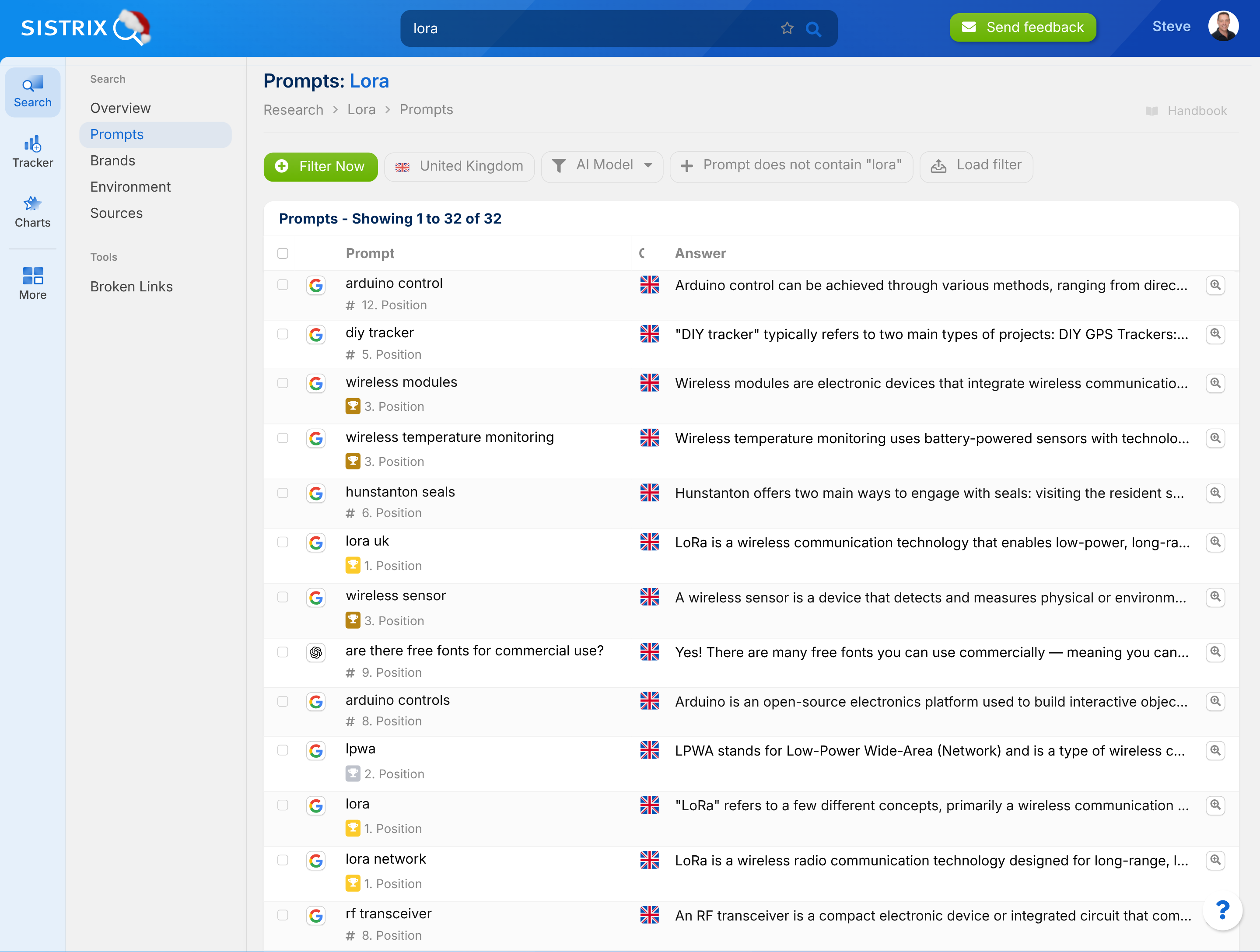
In SISTRIX, a brand or entity can simply be entered into the search field of the AI/Chatbot analysis. Under the Prompts tab, all prompts queried in connection with this entity will then appear. Activating the filter “Prompt does not contain [entity]” will only display prompts where the brand is mentioned in the answer but was not part of the actual question.
Summary
Query fan-out is a method used by new AI search systems to automatically break down user queries into multiple sub-questions. For SEO, this means that content must now be broader in scope, more deeply structured, and easily extractable by machines.
SISTRIX allows you to identify relevant sub-questions, plan content accordingly, and measure your presence in generative answers. By structuring your content so that it can be used directly as answer building blocks, you increase your chances not only of being found, but also of becoming visible as a relevant source in AI-powered search results.
FAQ
- What is the difference between query fan-out and classic keyword research?
- Traditional keyword research focuses on individual keywords and ranking positions. Query fan-out, on the other hand, goes beyond this, aiming to identify all the sub-questions of a user query and to structure content in such a way that it can be used by AI systems as building blocks for an answer.
- How can I use SISTRIX to determine if a domain is already visible for Query Fan-Out topics?
- Which content formats are particularly suitable for Query Fan-Out?
- Formats such as lists (listicles), step-by-step instructions, tables with comparative data, and FAQ blocks are particularly suitable because they offer clear, extractable units that an AI can use directly.
- Are there any technical requirements that should be given special consideration?
- Yes. In addition to a fundamentally good page structure (semantic HTML), structured data (e.g., schema.org markups) and visible freshness and authority signals are important ( EEAT ).
Test SISTRIX for Free
- Free 14-day test account
- Non-binding. No termination necessary
- Personalised on-boarding with experts