Brand gap analysis compares how you see your brand with the AI view and allows you to optimise your marketing strategy. In this tutorial, you’ll walk through the comparison in five steps using three brand analyses tools in SISTRIX AI Check using Lufthansa as an example.
- What is a brand gap analysis?
- Why is a brand gap analysis important?
- Step 1: Define your brand’s self-image
- Step 2: Start the external perception analysis with sentiment analysis
- Step 3: Check your positioning against the competition
- Step 4: Check Purchasing Touch Points with the Recommendation Map
- Step 5: Final Brand Gap Analysis with Action Derivation
- Lufthansa Self-Image vs. External Image
Summary: The five-step brand gap analysis process
A brand gap analysis reveals where your brand’s self-image differs from that of AI chatbots, and the implications this has for your marketing strategy and content plan.
- Document your self-image: Note down your opinion of the brand’s positioning, related entities and competitors, customer touch-points, product portfolio, strengths and weaknesses.
- Start the external perception analysis: Evaluate the sentiment score and topic analysis in the AI Check tool.
- Assess positioning against the competition: Compare your own attributes with those of competitors in terms of how they are perceived within the market.
- Examine purchasing touch-points: Evaluate recommendation presence and gaps in the recommendation map.
- Evaluate the gap: Compare your self-image with your external image and consolidate the tool’s recommendations into an action plan.
The Lufthansa example illustrates just how much such an analysis reveals. For example, a sentiment score of +44, but coverage in only 6 out of 12 purchasing touch-points and one single instance of being the ‘first choice’. The end result is a comprehensive action plan with eight prioritised content strategies, which we’ll derive step by step in this tutorial.
Want to get started straight away or follow along? Try it out for yourself in the AI Check tool.
What is a brand gap analysis?
Every brand has a self-image – its position, its strengths, and the touch-points on which it wants to be the first choice. AI systems also have an image of the brand. This is not derived from your communications, but from the sources the AI models draw upon. This Brand Gap Analysis superimposes these two views and reveals the differences: Where does the external perception differ from the self-image? Which attributes are being lost to the competition and in which purchasing situations is the brand absent?
Actions that steer your GEO activities can be derived from this gap. What content needs to be created, where should a stronger relationship with key entities be built, how reviews and UGC can be used strategically, and where stronger external positioning is required.
The tools you’ll use are the three brand analyses in AI Check: sentiment analysis, competitive perception and the recommendation map. All three utilise genuine AI responses and every statement is backed up by an AI answer and the prompt that triggered it. For many findings the tool already provides its own recommendation and it’s these recommendations that are the building blocks that will help you build your action plan.
Why is a brand gap analysis important?
More and more purchasing decisions begin with a question posed to an AI system. What happens there is not simply the return of information, but the start of a mult-stage and comprehensive purchasing advice service. The responses contain ready-made assessment which may include brands and providers that are worth considering, along with pro’s and cons. If this assessment differs from your perception and you don’t check it, every AI response will work against your brand communication, without you even realising it.
The gap cannot be identified by asking a chatbot. What a model replies to the question ‘How do you view Brand X?’ is a snapshot without a data basis. Furthermore, anyone who formulates their own prompts to check their external image will devise these questions from their own brand perspective and will therefore not necessarily capture the language and reality in which real users actually ask their questions. The picture only becomes reliable once many thousands of genuine AI responses have been systematically evaluated. This is precisely what the three analyses in the AI Check do.
In this tutorial, we’ll walk through a complete brand gap analysis in the market environment, using Lufthansa as an example.
Note: The analysis becomes reliable once there are around ten meaningful mentions of a brand. If little or nothing is displayed for your brand, this is usually not down to the analysis itself, but because the data set is still too small.
Step 1: Define your brand’s self-image
Before you start using the tool, you need a benchmark against which to compare. Define in advance how your brand sees itself and how it wishes to position itself. Five questions will help with this:
- Positioning: What should the brand stand for, in one sentence?
- Entities: Which five to ten entities should be associated with the brand?
- Touch-points: In which purchasing or decision-making situations should the brand be recommended?
- Product portfolio: Which products do you offer, which target groups do you address with them, and what are their key features?
- Strengths and weaknesses: Where do you see your own USPs that absolutely must be highlighted? What weaknesses are you aware of?
An extract from such a reference for Lufthansa:
- Positioning: The premium airline from Germany that connects people with the world in a cosmopolitan, personalised manner and to the highest standards of quality.
- Entities: Cosmopolitanism, premium, the crane/heritage, air travel, individuality, sustainability, innovation, safety, business travel, trust, exclusivity.
- Touch-points: The brand aims to be the go-to choice for business travel where there are high expectations regarding network coverage and reliability; for significant personal journeys (family, new beginnings, special moments); when consciously opting for premium and luxury travel experiences; for sustainability-conscious booking decisions; and whenever travellers wish to choose a German quality brand with confidence.
- Product portfolio: From Economy to First Class, a redesigned cabin product (Allegris), as well as an offering via Eurowings for price-sensitive short- and medium-haul customers. This appeals to price-conscious leisure travellers as well as business travellers and premium travellers. Key feature: the new First Class suite offering maximum privacy and a design award (Red Dot Award).
- Strengths and weaknesses: Strengths include safety, premium innovation, a strong network (Frankfurt/Munich) and leadership in sustainability. Weaknesses include a long-standing poor track record on punctuality, a lag in digitalisation and the outdated previous cabin product.
Against this benchmark, you will assess the external perception in the next steps.
Step 2: Start the external perception analysis with sentiment analysis
Next, you’ll determine the overall sentiment score for your brand. To do this, enter your domain or brand name into AI Check and open the ‘Sentiment’ section. The analysis evaluates all AI responses in which your brand appears and factors each evaluative statement into the sentiment score.
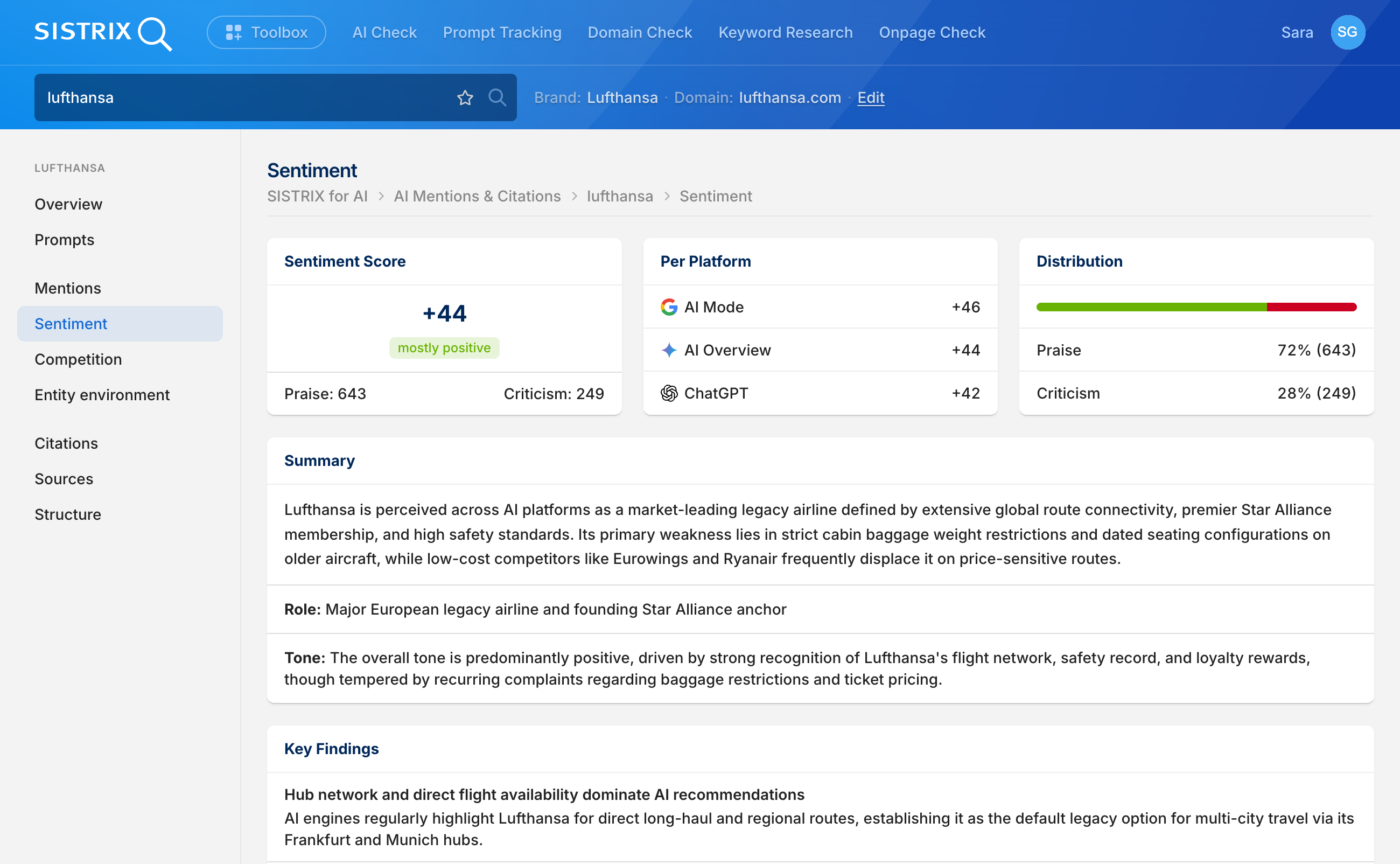
Important for context: the scale ranges from -100 to +100, but AI systems predominantly use positive language. Across many brands, the actual midpoint tends to be around +50. Lufthansa achieves a score of +45, with 643 positive mentions compared to 249 negative ones. The AI classifies it as Germany’s largest airline, an established premium carrier and a leading member of the Star Alliance, driven primarily by praise for safety, reliability and its network, though this is tempered by the restrictive baggage allowances in the basic fare.
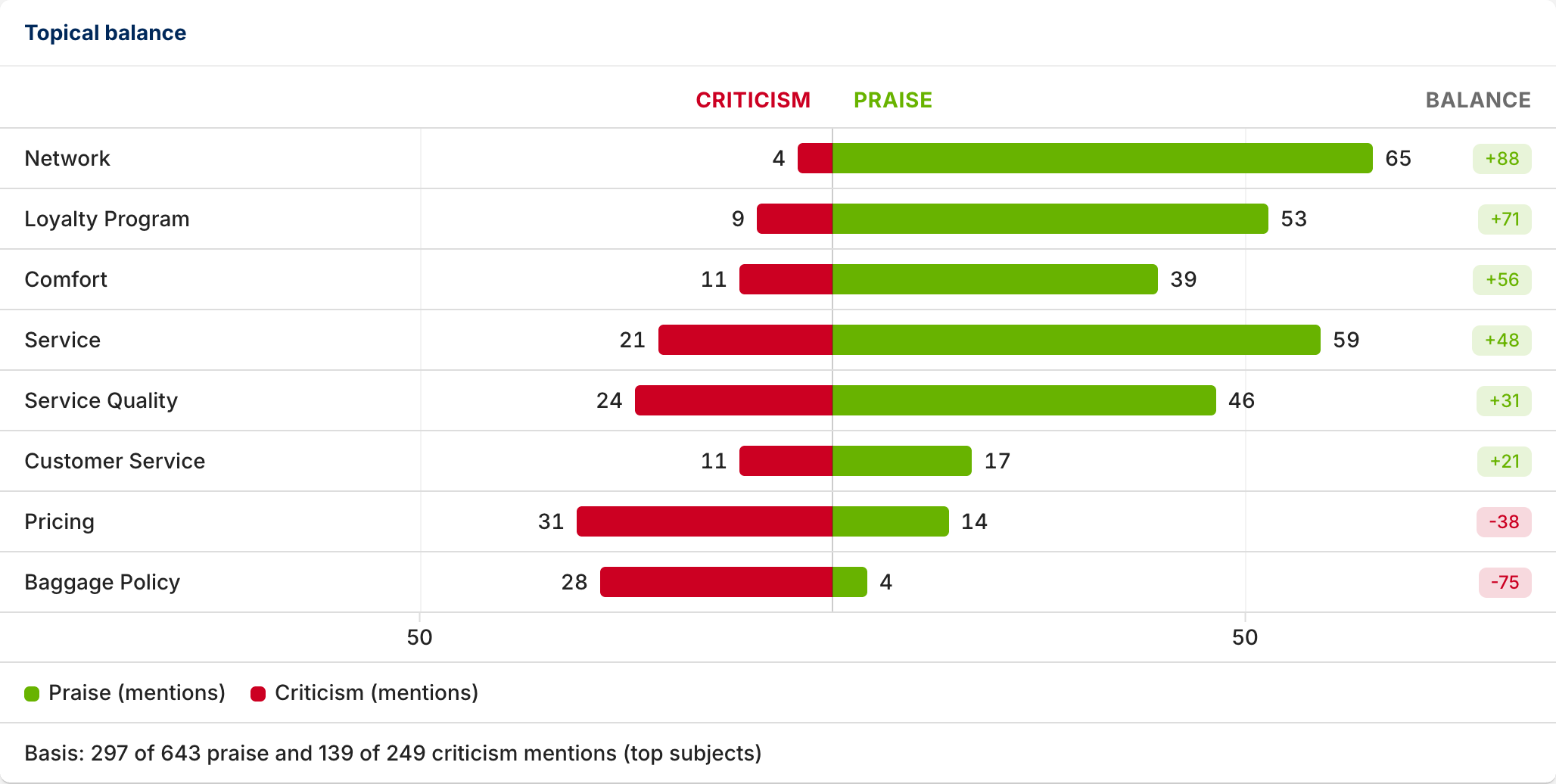
Next, take a look at the topic-by-topic summary. It shows the balance of praise and criticism for each topic and highlights the areas for improvement: for Lufthansa, the loyalty program is clearly in the black at +71, as are flight comfort (+56) and the network (+88). On the negative side are pricing at -38 and, above all, baggage policy at -75. The expandable ‘Strengths’ and ‘Weaknesses’ sections provide the respondents’ verbatim comments, the sources behind them and a recommendation for each, based on what can be deduced from them.
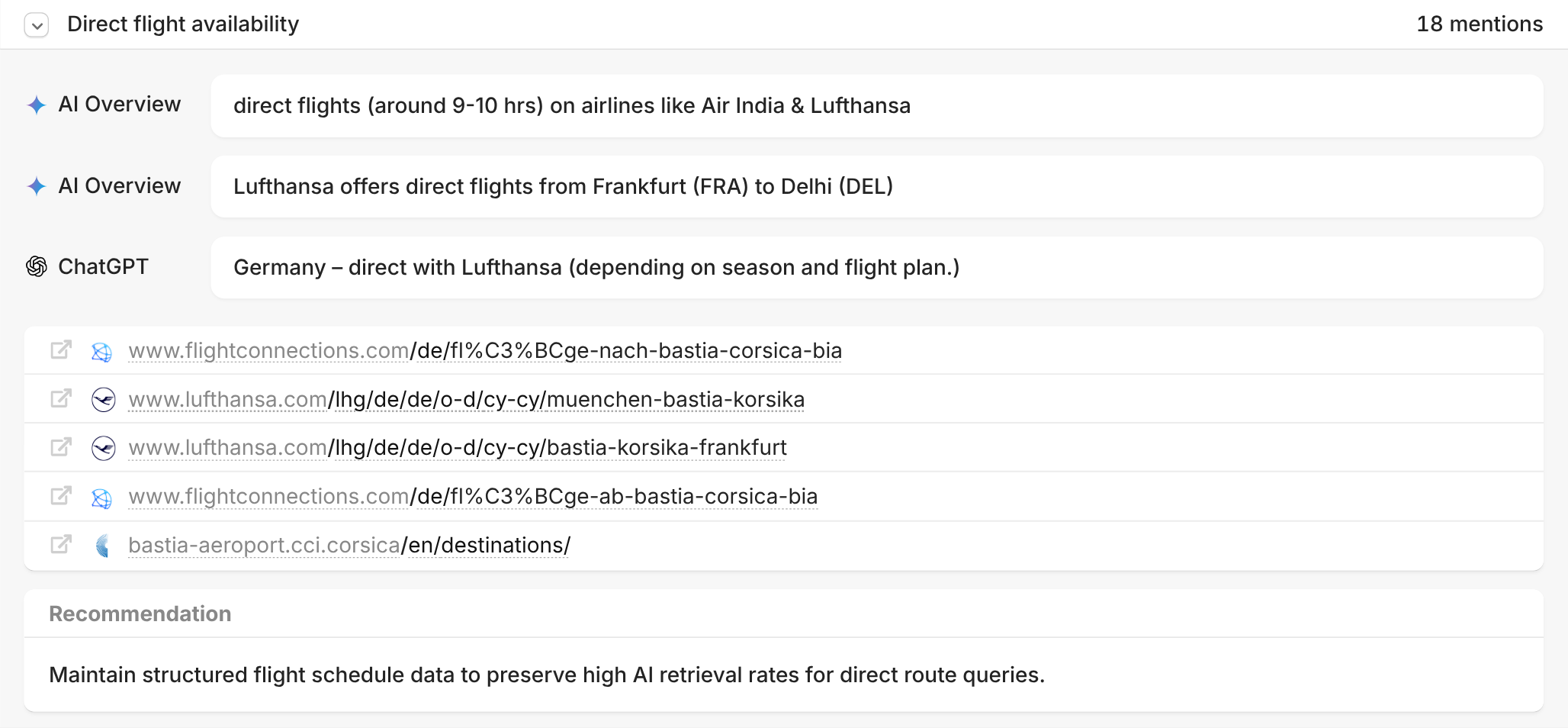
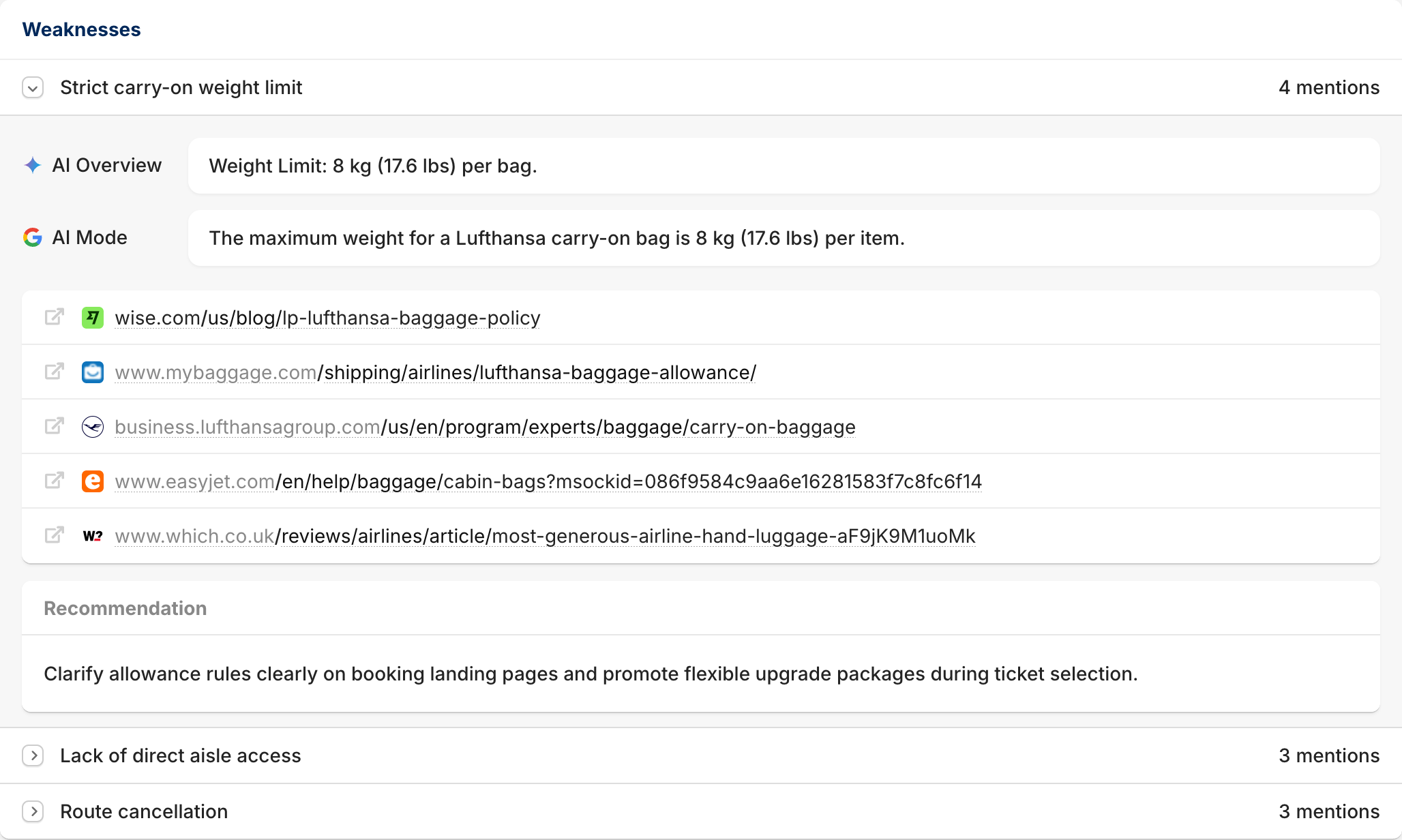
To help you compare your self-perception with how others see you later on, answer the same questions as in Step 1, this time from an external perspective:
- Positioning (external perception): Lufthansa is perceived as an established premium market leader for global direct flights, with high regard for safety and its network, but noticeable criticism of its baggage policies and entry-level segment.
- Entities: Direct flights, route network, reliability, Star Alliance, Allegris/premium classes, service, safety, baggage regulations, price.
- Touch-points (where applicable): Non-stop flights from Frankfurt/Munich, booking Premium Economy/Business/First Class, student fares with free baggage allowance. For further touch-points, the recommendation map from Step 4 is still missing.
- Product portfolio (public): Allegris (First/Business) is viewed very positively, whilst Economy Basic is criticised; digital assistants are considered weak. Target audience according to AI: safety- and reliability-oriented travellers, as well as premium and business travellers.
- Strengths and weaknesses (external perception): Strengths include direct connections (10 mentions), reliability (7), safety (7) and membership of the Star Alliance (7), with the strongest areas being the route network (+88), flight availability (+85) and network coverage (+84). Weaknesses include the restrictions on the Economy Basic fare (3), strict baggage rules (3), a lack of direct flights on certain routes (3) and long waiting times in the event of disruptions (2), with the most criticised areas being baggage regulations (-67) and price (-38).
This now allows us to identify the first brand gaps:
3 brand gaps: Lufthansa’s self-image vs. external perception
- Premium falls short in Economy: The premium claim is only confirmed in the higher classes. Baggage allowances (-75) and price (-38) are the worst scores.
- Brand values are not resonating: cosmopolitanism and sustainability are central campaign themes in the self-image, but do not appear in any AI quote or topic. The external perception is purely fact-based.
- Eurowings is regarded as a competitor, not as a group brand: it is listed on a par with Ryanair as a ‘cheaper alternative’.
Step 3: Check your positioning against the competition
Go to the ‘Competitors’ section and open the ‘Competitive Perception’ analysis. This presents the topics covered by your brand and those of your direct competitors side by side in a matrix. The analysis takes into account not only the AI responses relating to your brand, but also those relating to your direct competitors. In the Lufthansa example, this comprises 1,500 analysed AI responses containing 36,376 brand mentions.
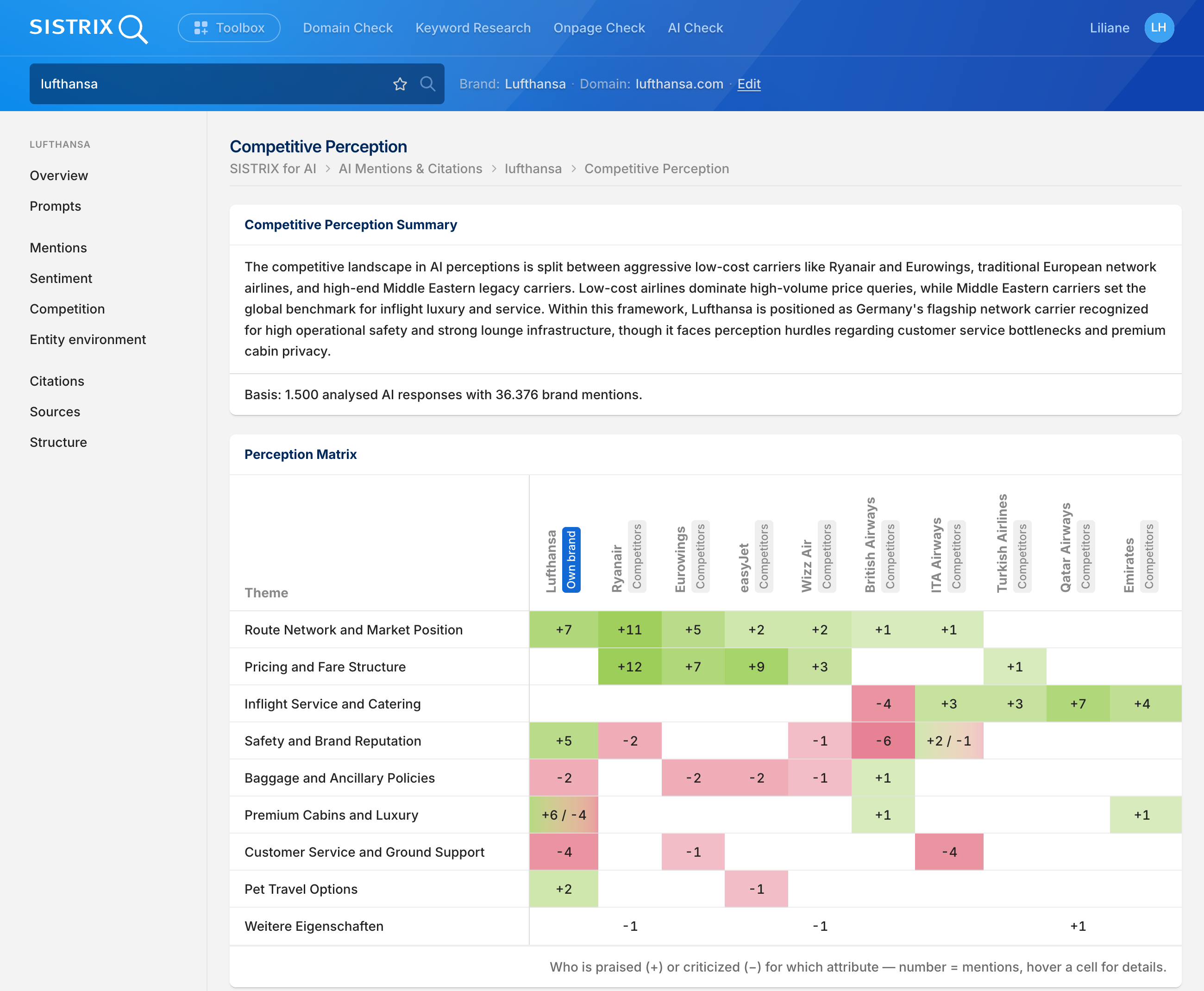
Read the matrix in two directions. First: Where does your brand lead? Second, and this is more critical for the gap analysis, which attributes from your self-image are occupied by others?
- Lufthansa leads in: Route network and Market Position (+7, more mentions than Eurowings and easyjet), flight safety (+5, more than Ryanair and Wizz Air), and Pet Travel Options (+2, more than easyJet).
- Competitors lead in: Ticket prices and fares, Lufthansa is not mentioned, while Ryanair and easyJet occupy this field. Inflight Service and Catering, Lufthansa is also not mentioned, the field leaders are Qatar Airways and Emirates (+7 and +4).
Below the matrix, the analysis summarises the leading fields and the lost fields, and derives the next steps: concrete starting points for expanding your brand gap analysis.
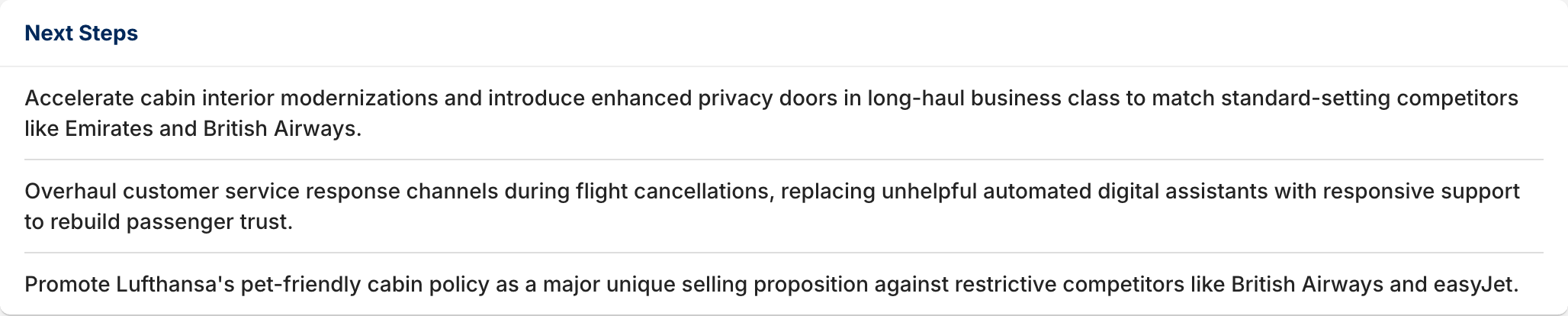
2 Brand Gaps: Lufthansa Self-Image vs. Competitive Landscape
- Eurowings occupies price against its own parent: Dominates the ticket prices and fares field together with Ryanair. Lufthansa loses this field to its own group subsidiary.
- Cabin equipment still seen as outdated despite Allegris: The self-image celebrates Allegris as a design-award-winning relaunch, but in competitive comparison, cabin equipment is still criticised as partly outdated. The modernisation narrative has not yet landed in broad perception.
Step 4: Check Purchasing Touch Points with the Recommendation Map
Open the Recommendation Map as your third analysis, also found in the Competitors section. It answers the toughest question in gap analysis: Is your brand recommended when users face a concrete decision? For this, each AI response records which brand appears for which purchase touch-points and in what role: as the first choice, as one of several options, not mentioned at all, or even actively advised against.
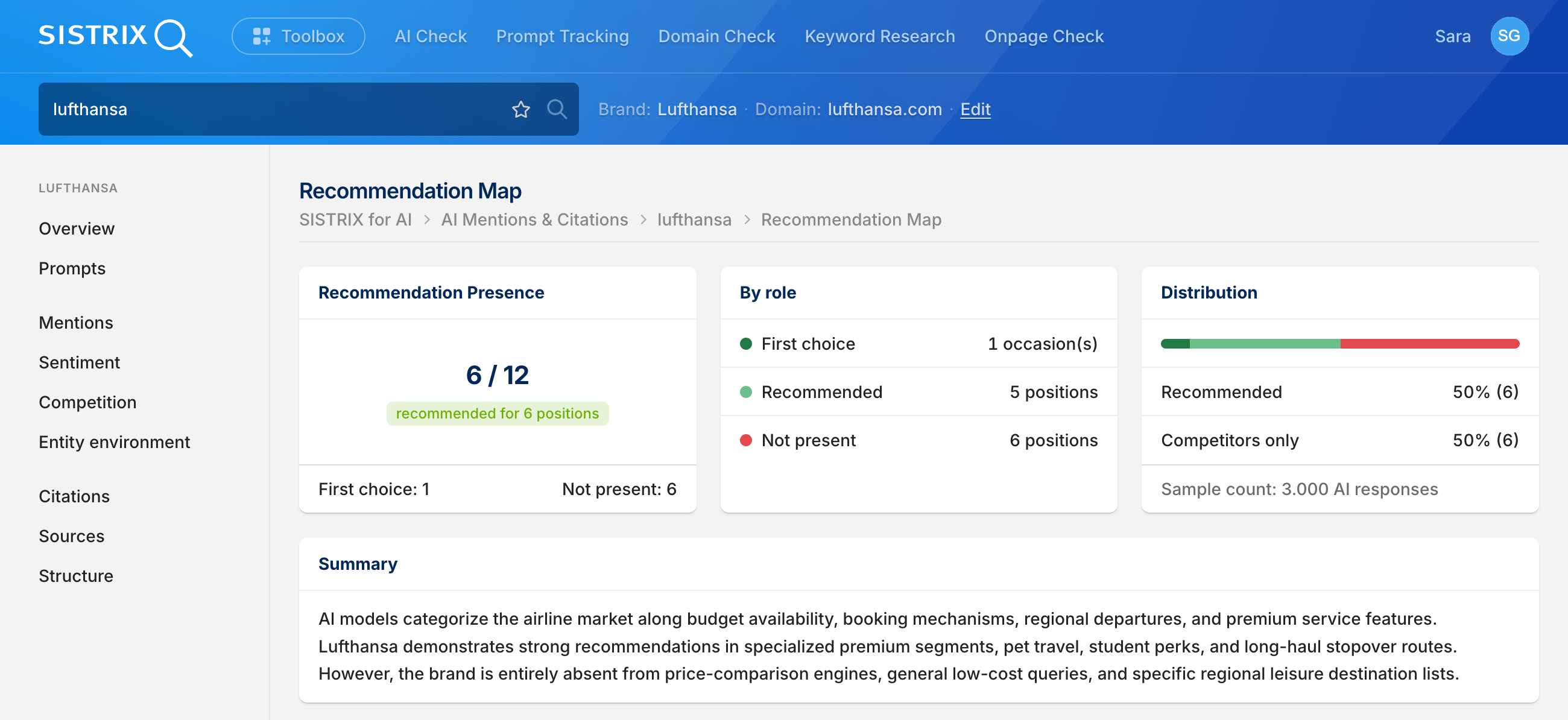
The recommendation presence shows the result at a glance: Lufthansa is present in 6 out of 12 relevant purchasing situations or touch-points (50%), the brand is completely absent in 6 of them (50%), and it is rated as the “first choice” in a single case. So even where it does appear, it is usually just one of several options, not the clearly preferred recommendation.
Where Lufthansa is recommended: Pet travel in cabin (19 recommendations, strongest competitor Air France with only 3), New Zealand stopover (15, strongest competitor Singapore Airlines with 3 recommendations and 3x first choice), flight booking (15, strongest competitor Swoodoo with only 1), Student flights (11, strongest competitor StudentUniverse with 2 recommendations), and Direct flights from Glasgow (9, strongest competitor easyJet with only 1). These are touch-points with low to medium competitive intensity: Lufthansa dominates where little competition is fighting for the recommendation.
The Priority Matrix ranks all purchasing situations / touch points by attractiveness and your own competitive strength, and provides an action recommendation for each field: expand, selectively target, or low priority.
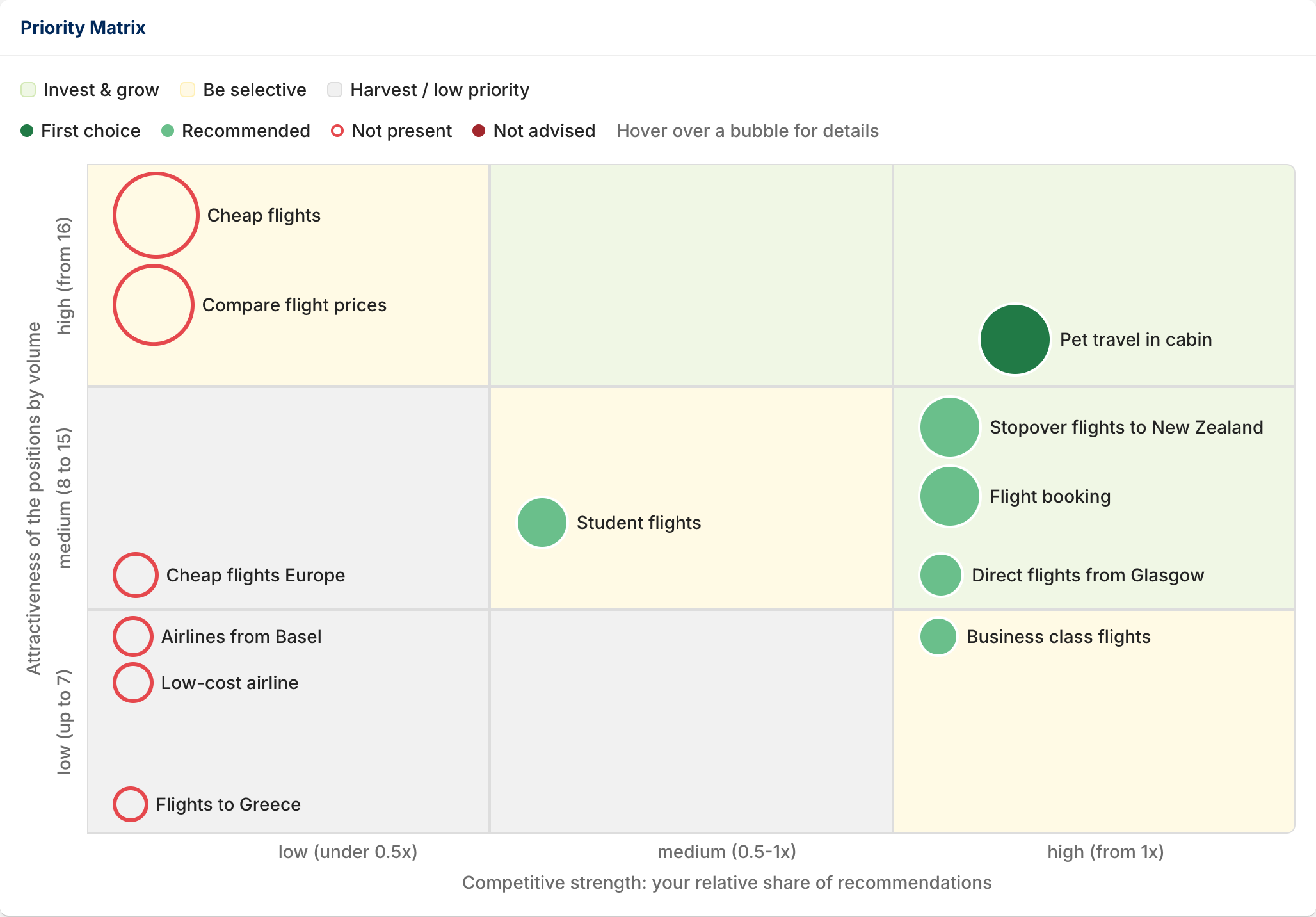
The “Positions without the brand” list below shows, for each gap, who leads there, with which original quote, and which content approach would close the gap, fully formulated and ready to use.
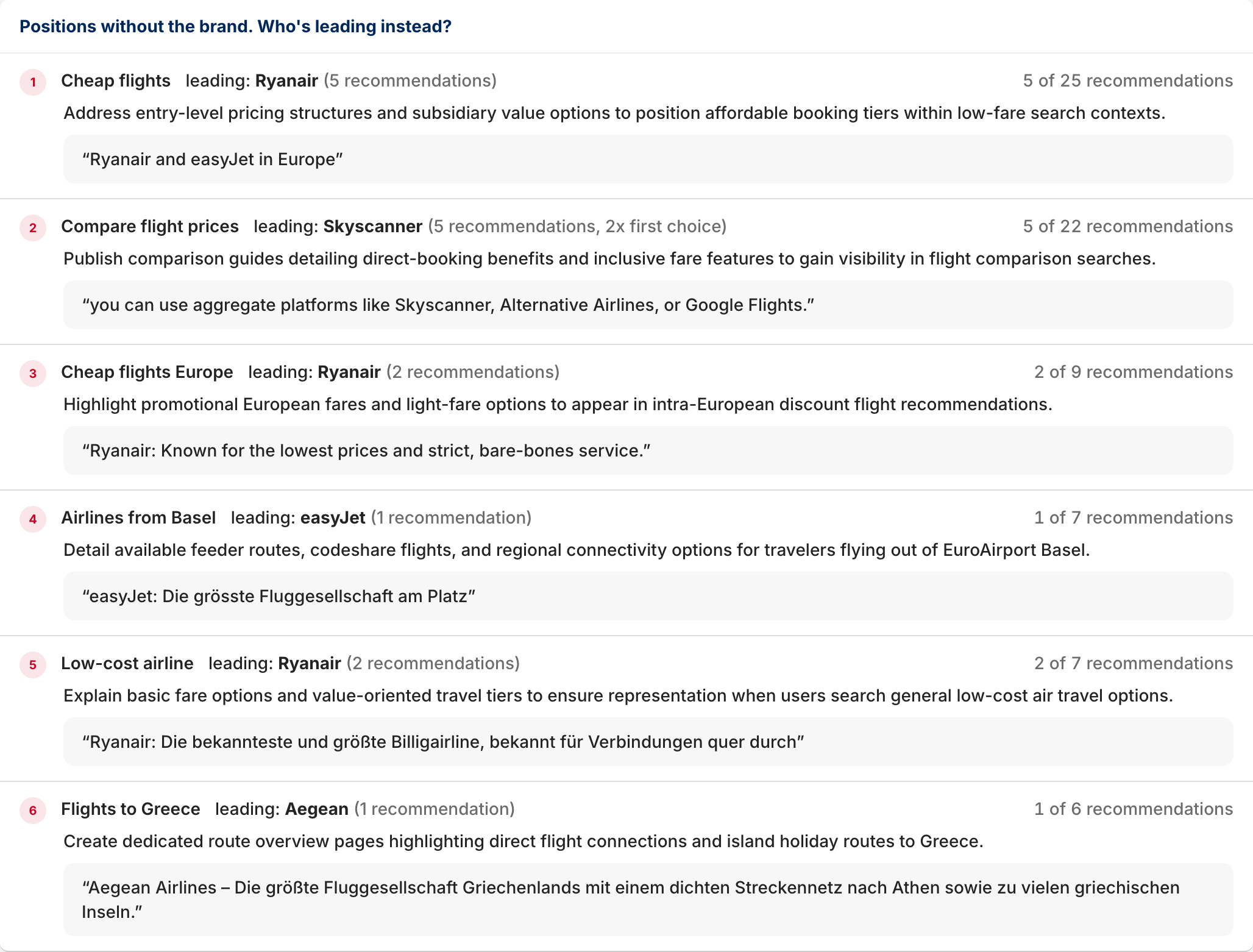
Positions without Lufthansa, who leads there:
- Cheap flights, leading: Ryanair (5 of 25 recommendations). Lufthansa needs to address how the higher ticket price pays off in the long run through included services.
- Comparing flight prices, leading: Skyscanner (5 of 22, 2x first choice). Lufthansa would need to show why booking directly on lufthansa.com is worthwhile compared to third-party providers.
- Cheap flights Europe, leading: Ryanair (2 of 9). Lufthansa needs to highlight affordable European routes via Eurowings or promotional fares to compete for budget-conscious travellers in this purchasing situation.
Step 5: Final Brand Gap Analysis with Action Derivation
Now both sides are laid side by side: the self-image from Step 1 and the external image from Steps 2 to 4. Go through the reference point by point and mark every deviation.
For Lufthansa, this would look as follows: The positioning as a premium market leader is present in the external image and even predominantly positive (sentiment +44), but inconsistent. It clearly holds true for the upper classes, but breaks down for Economy Basic and baggage regulations (-75). From the attribute set, price-performance and cabin modernity are lost to the competition, while safety, reliability, and route network are strongly held. And for purchasing touch point presence, the gap is large: only 6 out of 12, and only one single case of first choice.
Every deviation leads to a measure in the GEO mix. Your task in this final step is not to reinvent the measures, but to bring them together and prioritise them: first the attractive purchasing situations / touch -points where competitive strength is lowest, then the criticism topics with the greatest leverage, and finally the lost attributes that can be regained in the long term.
Lufthansa Self-Image vs. External Image
Preliminary note: Lufthansa positions itself as a premium brand, so price leadership is not a goal. Price-oriented gaps (Ryanair, Skyscanner, Eurowings) are deliberately left open and referred to the group subsidiary Eurowings, rather than closing them with the brand’s own price content.
| Occasion / Topic | Measure | Priority |
|---|---|---|
| New Zealand stopover | Deeper content to move from "recommended" to "first choice" | High |
| Price occasions (Ryanair, Skyscanner) | Deliberately leave unaddressed, refer to Eurowings in communication | Deliberately low |
| Baggage regulations (-75) | Transparency content on free baggage allowance and fare tiers | High |
| Digital assistants | Align digital experience with the premium claim | Medium |
| Cabin still seen as "outdated" despite Allegris | Push the modernization narrative (Allegris, Red Dot Award) more strongly | Medium |
| Openness & sustainability invisible | Build citable content instead of pure campaign imagery | Long-term |
Brief summary: Premium is clearly reflected in the external image for the upper classes, but breaks down for baggage, digital experience, and disruption service. Price gaps are strategically fine and are deliberately left to Eurowings. The task: carry the premium narrative consistently through to the Economy baggage rules, the digital touchpoints, and service during disruptions.
Tip: Export all three analyses directly as Markdown or PDF, including all recommendations they contain. Together with your self-image reference from Step 1, this gives you the complete brand gap analysis as a document, serving as a basis for reporting, prioritisation, and revisiting in a few months to measure how the gap has developed.